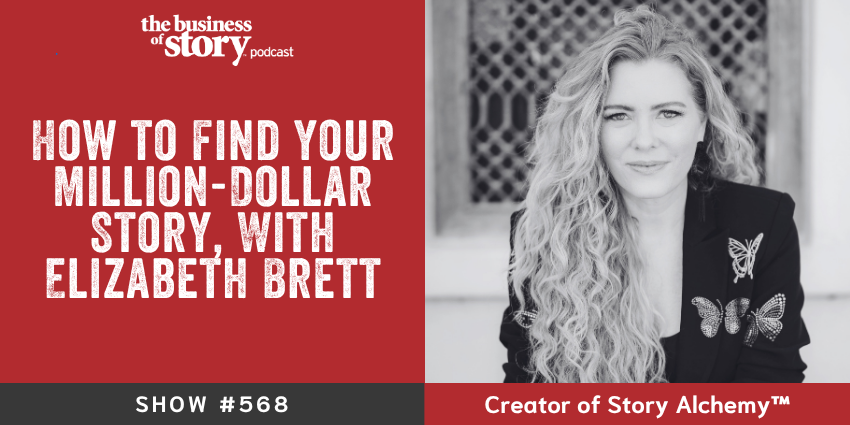
The Story You’ve Been Afraid to Tell Is the One That Will Change Everything
What NBC, a Near-Drowning, and Story Alchemy Teach Us About the Power of Authentic Business Storytelling
You want your brand story to move people — not just inform them. And if you’re willing to go beyond the polished, performative version of yourself to the authentic truth underneath, then you will command the kind of fascinated attention that turns audiences into devoted clients.
But you’re frustrated because every storytelling guru is telling you to be more vulnerable, more transparent, more raw. And it’s starting to feel like a performance of authenticity.
Which is just another kind of performance.
That’s the paradox Elizabeth Brett has spent 13 years helping founders, creatives, and thought leaders escape. And she does it through a framework she calls Story Alchemy — the marriage of inner narrative and outer story work that transforms your most difficult experiences into your most powerful business assets.
Meet Elizabeth Brett: The NBC Reporter Who Became a Story Alchemist
Elizabeth Brett is a former NBC reporter turned storytelling authority, media mentor, and creator of the Story Alchemy™ framework. After nearly a decade in broadcast journalism — starting in Albany, moving through Columbus, and finishing at NBC Houston — she developed a sharp ability to distill truth, build trust, and communicate with clarity and resonance under deadline pressure.
 Today, she works with founders, creatives, and thought leaders to refine their voice and step into a more powerful form of visibility rooted in authenticity rather than performance. Her work has been featured on The Today Show, The New York Times, and The Wall Street Journal. She is also the host of the Sacred & Sovereign podcast, where she explores identity, reinvention, and redefining success on a more meaningful level.
What’s in it for You
Tune in to this conversation and you’ll discover:
- The story roadmap framework from broadcast journalism that lets you tell any story in 30 seconds or 30 minutes
- Why the performance trap — voice coaches, hair consultants, scripted delivery — is killing your authentic connection with your audience
- The sovereignty filter: three questions to ask before sharing any personal story in a business context
- What a million dollar story really is, why it operates at the identity level, and how to find yours right now
- How the StoryCycle Genie® revealed Elizabeth’s primary archetype as the Alchemist — and surfaced a UVP she’d never quite put together before
The Performance Trap Is Real — And It Starts Early
Elizabeth grew up in newsrooms. Her father, Chuck Scarborough, anchored for WNBC in Manhattan for 50 years. She did her first live television segment at age 15.
But when she entered the industry at 22, the first thing NBC gave her wasn’t a story assignment. It was a voice coach.
“It was all very superficial about how I sounded and how I looked,” she told me. “And there was very little that was actually about the heart of the stories, the actual emotion in the stories.”
That tension — between performance and presence — followed her through her entire broadcast career. And it’s the same tension most business leaders carry into every presentation, every pitch, every piece of content they create.
The escape route isn’t more polish. It’s more truth.
The Near-Death Baptism That Changed Everything
Elizabeth’s pivot from NBC reporter to Story Alchemist didn’t happen in a boardroom. It happened in the ocean.
A few years ago, she was swimming at a Long Island beach with her eight-year-old daughter when a set of waves overwhelmed them both. She held her daughter up through wave after wave until she had nothing left. She screamed for help. Her cousin — a former lifeguard — reached them in time.
As she crawled back onto the beach, she knew: the woman who had gone into the water that day was gone.
“The biggest feeling I had then was that performing in any way was no longer an option,” she said. “From this point forward it was about doing my soul work.”
That experience became the foundation of Story Alchemy — and it became her million dollar story.
The Sovereignty Filter: Is This Story Mine to Tell?
Not every story should be shared. Elizabeth’s sovereignty filter asks three questions before you go public with any personal narrative:
Is this mine to share? Is this in integrity? Does this align with who I am now?
“I’ve heard so many women say they feel overexposed after going through storytelling,” she said. “They were taught to share the whole ugly underbelly of what they were going through to connect with their audience. And it didn’t feel in integrity for them, but they didn’t have a barometer.”
The sovereignty filter is that barometer.
Your Million Dollar Story Lives at the Identity Level
A million dollar story isn’t a capability story or a credibility story. It’s an identity-level story — one that shows your authority without listing your credentials, differentiates you without attacking competitors, and makes you impossible to replicate because it’s irreplicably yours.
“It hits at an identity level,” Elizabeth said. “It gives them an identity-level connection to you as the storyteller and to what you’re speaking about.”
When I shared my own story — being number five of seven kids, always feeling misunderstood, spending 40 years helping businesses be better understood — Elizabeth reflected it back to me in a way I’d never heard before.
“The ability to help businesses and founders become understood is truly your soul work,” she said.
That’s what a million dollar story does. It doesn’t just tell people what you do. It shows them why you were always going to do it.
Links
- elizabethbrett.com
- Elizabeth on Instagram: @ElizabethSBrett
- Sacred & Sovereign Podcast with Elizabeth Brett
- Craft your vibrant brand story with the StoryCycle Genie®
- Free Brand Story Grader: storycyclegenie.ai/brand-story-grader
Deepen Your Communication Mastery: Three Essential Episodes
To amplify your transformation from today’s conversation, these carefully selected past episodes provide complementary wisdom from the Business of Story archive:
How a Broken Heart Created a Hollywood Media Empire with Rachel McCord — Rachel’s story of transforming personal trauma into a media empire is the perfect companion to Elizabeth’s Story Alchemy framework — both prove that your most difficult experiences are your most powerful storytelling assets.
Make Your Audience Feel Your Message — Not Just Hear It with Charly Tate — Charly’s deep dive into brand tone and emotional resonance directly extends Elizabeth’s conversation about moving beyond performance to authentic connection.
Your Best Ideas Are Not Going to Come From a Chatbot with Sara Connell — Sara’s exploration of accessing your creative genius and authentic voice is the natural next step after Elizabeth’s sovereignty filter and soul-voice framework.
Elizabeth Brett’s Conversation With Park Howell on The Business of Story Podcast
From NBC Reporter to Story Alchemy Creator: How Elizabeth Brett Reinvented Her Career as an Authentic Business Storytelling Coach in Austin
Park: Hello, Elizabeth, welcome to the show.
Elizabeth: Hello, hello, thank you so much for having me.
Park: This is going to be great because we’re going to talk about your approach to finding your million-dollar story that really brings your authority and your authenticity to the world. I’m especially considering your background with NBC reporting and how that all plays into it.
Gosh, where do we even begin? I know you’re in Austin, Texas, where our son and daughter and granddaughter are. Love it out there. Have you been there a long time? Because with NBC, you were probably out on the East Coast covering lots of stuff.
Elizabeth: Yeah, so my career slowly took me west. I started in Albany, New York, then worked in Columbus, Ohio, and my last job with NBC was in Houston. That’s what actually brought me to Texas.
When I left news and became a recovering TV news reporter, I quickly moved to Austin because I’d fallen in love with it. I loved the energy here. It was a beautiful place. My family’s all still East Coast, but for me, this was a new place to call home.
I actually thought I would just be stopping by, and then met my husband a couple of months later and here I am still, like 15 years later.
Park: That’s awesome. Now I studied communications at Washington State University — the Edward R. Murrow School of Communication. I had a lot of friends that were in broadcast journalism. I don’t think any of them actually landed that career. It’s a tough job. Did you study broadcast journalism and then get a job right out of school?
What It’s Really Like Growing Up as an NBC Anchor’s Daughter — And What Going Live on Television at Age 15 Taught Elizabeth Brett About Storytelling Under Pressure
Elizabeth: Well, I grew up in a newsroom. My dad was an anchor for NBC in Manhattan. From the time I was two, I was in newsrooms. Chuck Scarborough just retired after 50 years as an anchor for WNBC. So I really had a taste of it young — and I actually resisted it.
I didn’t think I would go into news. I went to a liberal arts college where they didn’t have a degree in journalism or communications. I studied art history and political science.
But when I graduated, I had this choice: the Peace Corps or journalism. I thought, let me just check that box. Let me see if I love it or hate it.
And I fell in love with the storytelling. I fell in love with interviewing people and learning their stories, and how different every single day was. I loved breaking news. I loved the stories I got to develop over months.
It was a beautiful way for me to find my own relationship with it after growing up with a dad who’d been in the business for a very long time. We would talk almost daily about how our stories were that day. It was a beautiful way for us to connect.
Park: Did he push you in that direction?
Elizabeth: 110%, Park. In his mind, there was no other option. He took me in for Take Our Daughters to Work Day — I was maybe 14 or 15. He thought it would be fun if I interviewed some kids. I was all about it.
Then I asked if I could do a walk and talk. So they let me do that. And then I put a whole package together where I even did the voiceover. I had this whole story that was going to air.
Not long before the newscast, he said, “Do you want to introduce your story live on air?”
He told me later, right before we were live — maybe five seconds before — he thought, what have I done? I’m putting my daughter on air in the largest TV market. She’s never done anything like this.
But of course it went great. I feel like that was the moment that sealed it for him.
Park: You were 15 at that point, so you tried it, you loved it — but when you went to university, you were like, maybe I’ll do something else.
Elizabeth: I just loved the idea of a liberal arts education. I was a free spirit, Park. At that point, I didn’t feel like I needed to be so focused on the exact thing I wanted to do for the rest of my life.
The Broadcast Journalism Story Framework That Changes How You Communicate: Why Every Compelling Narrative Needs a Beginning, a Transformation, and an End
Park: You’ve got to think on your feet as a storyteller in broadcast journalism. A big complex story comes rolling in and you’ve got to boil it down to 60 or 90 seconds. For our listeners who are business people trying to take a complex message and boil it down, what advice would you give them?
Elizabeth: The most important thing I learned was practicing — recognizing how to get to the essence quickly. And a lot of times what that is, is the emotional essence of the story.
What I’ve come to develop over time is what I call the story roadmap. It’s a way where you can map out your story without it feeling scripted. You can use it like an accordion — as long or as short as you want.
Really what you’re wanting to do is understand where you’re going to begin the story, what the transformation is — that big emotional piece, that golden insight you get from that emotion — and then the end of the story.
If you just know where you’re going to start people, where you’re going to ultimately take them, and the big shift that happens in the story, those are the three essential pieces. You can make it 30 seconds or 30 minutes.
Park: It’s a three-act structure of story, right? Setup, conflict, transformation, and then resolution — that aha moment. Do you think about first, what is my end game? Where do I want to take my audience in the conclusion, and then build backwards?
Elizabeth: Yes, and for where I like to start — of course, where are we taking them? What is the mission of this story? Then I like to go to that emotional piece next, the heart of the story, the soul of the story — that transformation you’re going to take them through.
And I feel like the beginning is a really fun place to play. There are probably dozens of ways you could start. That’s where I really love to allow for who am I speaking to specifically.
It might be different if I’m doing this in front of a group of women over lunch versus a board meeting. The opening can be an amazing place to always get to be in relationship with how present you are to the story.
A lot of people have a story they know is great for their work, but it starts to feel stale when they’ve been telling it over and over again. One of the ways we can stay fresh is to just tap back in — to become really present with the story as it happened in your life.
Why Polishing Your Presentation Won’t Save Your Story: The Performance Trap That Blocks Authentic Business Communication — And What to Do Instead
Park: You mentioned an anecdote about being a young broadcast journalist — very focused on hitting your mark, saying all the right things, looking into the camera. And then a moment where you realized you needed to bring more of yourself to it.
Elizabeth: This is something I’ve been reflecting on this week — I’ve been talking a lot about performance and how we all are taught to perform. We’re taught to play roles.
Especially as a TV news reporter, I came right out of college, 22 years old. The first person I met with was a voice coach to teach me how to sound more like an authority. I learned how to use my voice to sound more like an authority.
Then I had someone who told me how I should wear my hair — kept it short and straight, looking very sophisticated. And then throughout my career, consultants talking about what to wear, what colors were good on me, what my makeup was doing.
It was all very superficial about how I sounded and how I looked. And there was very little that was actually about the heart of the stories, the actual emotion in the stories.
That is where I feel like the real work is — understanding how to bring yourself and your emotion into the story, how to connect with the emotion so that you can have that experience with your audience.
How a Heartbreaking NBC Exit — And a Pivot to the Today Show, WSJ, and NYT — Became the Foundation of Elizabeth Brett’s Storytelling Philosophy
Park: So how long were you a reporter and what transitioned you into what you’re doing now?
Elizabeth: I worked for NBC right out of college for almost a decade. Moving up in my markets, having all these different experiences in different places.
And then I had a really big heartbreak — one that shattered everything, including my whole path forward in my career. All of a sudden I was asking, is this really what I want?
I knew I wanted to have a family. I wanted a quote unquote normal life. In news, a lot of the time I was up at 3 a.m. for the morning shift or staying until midnight. I realized I no longer thought it was worth it. The emotional toll it was taking on me was real.
So I decided to leave news. I had this idea of creating a business to help women get over heartbreak.
I sent myself flowers and put a note on it that said, “Girl, don’t even be sad about a guy who wouldn’t send you these.” That little act really woke me up and changed the trajectory of my grief.
I decided it would be really cool to create something for other women going through a heartbreak. And what I knew was my genius was getting interviews and doing interviews.
So I ended up being on the Today Show and the Wall Street Journal and the New York Times — getting a lot of interviews about this new path I was on. I went in as a relationship expert.
And it was the first time I had ever shared my own story. For so many years I had been learning the art of sharing other people’s stories. I had this whole different experience when it was mine, when it was so personal.
That was what got me really fascinated by how people are sharing their own stories. And as I was doing that, people started asking me, “Could you help me? I’ve got this appearance coming up.” So this naturally morphed out of that.
Park: Was it because of your standing as a national broadcast journalist — the connections you had in network news — that got you on those big shows?
Elizabeth: That’s definitely one reason. The other things are I knew how to pitch and I was a great interview. I would do one and then take that interview and send it off to the next one.
Also, what I was doing at the time — it doesn’t sound incredibly revolutionary now, but at the time it was. I had a way that women could receive text messages, these little pick-me-ups over a certain period of time. We kind of had to hack it together. It was not something readily available.
So it was probably a combination of the unique approach, the skillset I brought, and then yes, the relationships.
The Near-Death Ocean Experience That Became Elizabeth Brett’s Most Powerful Story — And the Crisis Moment That Gave Birth to Story Alchemy
Park: How long have you been doing this and how would you define exactly what it is you do?
Elizabeth: When I left news, it was 15 years ago. When I first started working with women on messaging and media training specifically, it was about 13 years ago.
The iteration I’m doing now — which I would really say is soul-level storytelling — I work with women on really understanding the power of their authentic voice through their stories and through interviews.
What I call it is Story Alchemy and Interview Alchemy, because I believe that stories not only have the power to transform how the world sees you, but they have the power to transform how you see yourself.
This iteration actually happened after a near-death experience I had in the ocean with my daughter a couple of years ago.
Park: What happened?
Elizabeth: It was a normal day. We were at our favorite beach off of Long Island. My daughter at the time was about eight years old — about 60 pounds, a great swimmer, loves the water.
My cousin and my son were also there. We all went out to swim. After a while, I could tell she was starting to get a little tired. My son and my cousin hollered that they were going in.
As she began to show signs of tiring, I started to look for a good time to go back in. There were three waves coming for us. I told her we had to go under. We went under the first one. As we came back up, I could feel her starting to pull on my shoulder.
We went under the second wave, came back up. After that third one, I was thinking, okay, we’ll go right in. But there was another set coming.
In that moment, I began to calculate how long I felt like I could actually continue swimming and holding her up before going back in. It was a very primal experience.
I let out some kind of scream: “I can’t hold her.”
Amazingly, my cousin was not too far away. He could hear me. He is a former lifeguard. He is six foot five, so he could actually reach the bottom longer than I could. He managed to come back in and I remember the moment where I handed her to him and I knew she was safe.
I knew in that moment that she was going to make it. And I had nothing left. I completely surrendered. I completely let go.
I remember saying to the water — everything that I’d been fighting with, all of that energy, it just was gone. I said to the water, “Take me home.” I didn’t know in that moment if I was going to make it back to the beach or if the ocean was just going to take me.
The next thing I remember was crawling on my hands and feet, feeling the sand under my hands. Looking back, I don’t know if that was 30 seconds or 20 minutes.
I couldn’t speak. I just turned around and looked back at the water.
It would take weeks and months to truly understand the impact of those moments. But I knew in that instant that the woman who had gone into the water that day with her daughter was gone. And there was a new version of me that had emerged from the water.
The biggest feeling I had then was that performing in any way was no longer an option. That pretending or playing a role or doing anything to be professional or successful was no longer on the table.
From this point forward it was about doing my soul work. Being present in every moment for my kids. Prioritizing what mattered to me and creating a life around that.
My work also shifted. It became much more about authenticity, about understanding the power of your unique voice. It became much more about, let’s uncover the genius that has always been there. Let’s do it in a way that only you can.
Park: It’s almost a baptism, wasn’t it, for you?
Elizabeth: It’s exactly what it was — an anointing of baptism. I had spent five years prior to that deep in sacred feminine work where I had learned all about soul alchemy and archetypal frequencies. I had learned the art of anointing.
So I had been doing this very deep inner work about transformation. And in that moment, I know that’s why I was able to have that perspective. Why I knew instantly that this was a shedding of the old version of me, that I had been reborn, baptized into this new version of who I was and that everything would shift as a result.
Is This Story Mine to Tell? The Sovereignty Filter That Protects Your Personal Integrity While Deepening Your Business Authenticity
Park: Is this where Story Shift came from?
Elizabeth: Story Shift is actually an offer I have on the website. And Story Alchemy came from that — the marriage of the inner narrative and the outer story work.
The work I do with women over and over again — with these exceptional, brilliant women who are complete badasses in their field — so much of the work we end up doing around storytelling ends up in how they see themselves, what they’re giving themselves permission to do. Stories they have around who they have to be, how they have to perform.
When we can break all of that down, when we can remove those layers and masks, that’s when they can actually get to their authentic voice. I like to call it their soul voice — because it’s not from the mind, it’s not from the intellect. It’s from something much deeper.
For us women, I say it’s in our womb space, it’s in our heart space. It’s that innate wisdom that we get to speak from — which requires you to stop looking at the experts for how to do it and much more about turning inward.
Park: I see that a lot on LinkedIn — experts telling you exactly how to handle everything. And I’ve come to thinking, what about you? I’ve spent 40 years in the branding marketing world. I’ve learned from failures, from successes, from brilliant people. But you’ve got to make it your own. You’ve got to bat away 90 percent of that stuff and say, what’s the 10 percent that really honors what I have to say and how I show up in the world?
Elizabeth: Yes, and it’s what worked for them, right? Most people are teaching what’s worked for them. So it really becomes an echo chamber. It doesn’t mean it’s going to work for you.
Starting an online business, there were a million people telling me how to do that. And what I kept coming back to over and over was, how does that align with who I am?
As you get into branding and marketing, so many different ways to connect with your audience, so many formulas. But what about your authentic voice? What about the wisdom that you know? What about the reason you started the business to begin with and the hearts you’ve already connected to in your audience? You know what they desire. You know what they long for. Speak to that.
Park: I had a guest on maybe six months ago who said something I really liked. She was starting her speaking business and went through a training where they fire-hosed her with information. She realized there was no way she could retain all of it. She said, “I’m only going to do 50% of it.” And that became a mantra of hers. I really liked that.
Elizabeth: I love that. One of the things I talk about in storytelling — I have an offer called Story Authority, which is really a beautiful way to understand the story gold mine that lives within you. Building out your strategic story vault and recognizing that there isn’t just one story, that there are so many stories that you have.
In that offer, I highlight something I like to call the sovereignty filter. You can use it for stories, and also for any area of your life. To really say, what is mine to share? How does this feel? Is this in alignment with who I am now as I’m sharing this?
One of the things I see over and over is women still sharing stories that were relevant 15 years ago, but now who they are — maybe the story still works, but how they are seeing it and the value in it have changed.
This ability to have that filter of sovereignty over everything you’re sharing — to come back to a series of questions to see how it actually feels for you. Not how it feels to an expert.
Is this mine to share? Is this something I feel in integrity with? Is this something that aligns with who I am now?
I’ve heard so many women say they feel overexposed after going through storytelling. One of the reasons they’re timid to do it is because they’ve got these vulnerability hangovers — not the positive ones. They were actually taught to share the whole ugly underbelly of what they were going through to connect with their audience. And it didn’t feel in integrity for them, but they didn’t have a barometer.
Park: You hear that all the time from so-called gurus: be vulnerable, be authentic, be transparent. And I’m like, yeah, maybe to a point. You definitely want to be authentic. But you’ve got to have a barometer of what’s comfortable for you to share. And what do they really need to know?
Elizabeth: And it needs to be intentional. Storytelling with a purpose is really important. If you are sharing something incredibly vulnerable, it probably is going to be speaking about a return to your authenticity, a new agreement you’ve created with yourself around not performing.
What Is a Million Dollar Story? The Identity-Level Narratives That Differentiate Leaders, Command Premium Value, and Make Your Business Impossible to Replicate
Park: I’ll now be curious where this conversation goes. The million dollar story — what is it? How do you find it? And where do you use it?
Elizabeth: I’m so glad you’re asking about this because I don’t believe we only have one million dollar story. I believe that the better we become as storytellers, the more that will become apparent to us. So we have multiple million dollar stories.
But these are stories that can win over audiences, that can move them in a specific direction. They become a part of your legacy, a part of your leadership that is intrinsically tied to who you are.
Your million dollar stories are those stories that are going to differentiate you. They’re the ones that are going to elevate you. They’re the ones that show your authority without you having to say, “Here are all the credentials of why I’m so good at what I do.”
They define who you are as a leader simply by showing up and sharing that story with the audience.
Park: Can you walk me through it very quickly to find one of my million dollar stories — so all of our listeners can think about it too?
Elizabeth: Tell me about right now. I know you have this beautiful creation with your AI tool, the StoryCycle Genie. I understand that in it you are working with a specific type of leader who is turned off by complicated branding. Tell me what it is that is like the biggest transformation you want them to feel by using this. What do you want them to actually experience?
Park: Great question. It’s kind of what you’ve been talking about in this first 30 minutes — to help them have their aha moment when they find out what their true brand story is. And when I say brand story, it’s not just their business, it’s themselves as a leader.
What we like to say is everyone has an important story to tell. You can feel it. You just can’t find it. And what the StoryCycle Genie ultimately does is helps you find, helps you unearth, helps you reveal that story.
Elizabeth: And why is that so important to you that you help people reveal that story?
Park: Well, I was raised as one of seven kids. We had a marvelous family. My mother, who was 101, just passed away three days ago. So this is very, very raw for me, but very healthy. All the way up, she had her mental faculty. She just said after 101, you’re done.
When we were raised in this brood — seven kids in nine years — to get heard, you had to raise your hand. You had to out wrestle your brother. You had to out talk your sister. I went through a lot, felt very misunderstood.
I took a very artful approach to business — a music composition degree, ran my own ad agency, was in PR. I can’t tell you how many times my mom and dad, right up to the bitter end, asked me exactly what I did. They never really understood what I did.
I find that in helping businesses that are misunderstood — both internally, even by the owner, by the founder, and even their colleagues — still not completely understanding the business, why it exists, what the story is.
I can only go back to those very early days of being a misunderstood Howell as number five among seven kids. And I think I play that forward now, 50 years later, helping businesses to be better understood.
Elizabeth: And so I would love to explore — if we had all the time in the world — that idea of being misunderstood that you felt, and maybe some visceral experiences you had around that and how that has informed and stayed with you and become part of your identity.
The ability to help businesses and founders become understood is truly your soul work. And to me, there is a beautiful story there that is far more on the emotional side of what the StoryCycle Genie is.
I know I’ve been misunderstood. And the idea that when you put that personal angle into why the brand story matters and really helping these companies and these founders be understood in a way they never have before — it gives them a lens into why you do what you do that also allows them to have that emotional hook in.
Park: Thank you for that. I’ve never thought about it that way before or ever talked about my life’s work that way before.
I’m curious if you find this in your work too — what I’ve learned and experienced is this idea of being enthralled when their story starts materializing before their eyes and they’re going, yes, yes, I’ve never thought about saying it that way, but this is exactly it.
One of the definitions of enthralling is the fascinated attention on something. And isn’t that what every brand and every founder and every person really wants — to command a fascinated attention on their own story, on their own life’s work, and on how they help people get what they want out of life?
Elizabeth: Absolutely. And one of the things we’ve touched on but haven’t named is what made that so powerful — what we just did around your million dollar story — is that it actually hit at an identity level.
To me, a million dollar story requires — it is not a surface level story. It is something that hits at an identity level.
Park: And by identity level, you mean it goes beyond that logic-reasoned executive functioning brain and dives deep into that soul story.
Elizabeth: Yes. Same with my story of the ocean. You can see how that shifted me on an identity level and what that provides for the person experiencing it — an opportunity to really see themselves in the experience or to connect to an experience they’ve had.
It gives them an identity-level connection to you as the storyteller and to what you’re speaking about, what you’re leading them into.
Story Alchemy Meets AI: A Live StoryCycle Genie® Brand Story Assessment Demo With Elizabeth Brett That Reveals the Hidden Story in Your Business
Park: This is really interesting. We did run your brand story through the StoryCycle Genie and feel free to punch me in the nose if any part of that felt inauthentic to you. What did you think of what you got from your brand assessment and your narrative strategy?
Elizabeth: First of all, it’s just so cool. I love this tool. I was actually really interested in the assessment and didn’t even realize it had so much more than just the assessment afterwards until today.
For the assessment itself, I really loved how it was broken down into the different dimensions. It could tell me clearly — give me an actual rating of what it thought I was doing well. I got eights and eight point fives and nines and I was like, well, I’m very curious about what would bring me to a ten.
Park: On your positioning clarity, it said you got an 8.5 out of 10. The quick assessment was you have strong differentiation, but maybe you need some minor clarity on that differentiation.
Elizabeth: Yeah, which I love. As I went through it, it didn’t feel exactly like my voice. It breaks down into primary audiences — it broke down three primary audiences for me and went through each in quite a bit of detail about who they are, the challenges they feel, the fears, the frustrations, and the aspirations.
It gave me an ABT statement for each of the three audiences it identified. Very thorough.
Again, the ABT statement for me was not in my voice. So I would have to work with it to make it feel authentically mine. And so that was the biggest thing I was feeling going through this more in-depth work — I can see the power of what it’s offering, and to make it feel like me, I would have to massage it into place.
Park: That’s absolutely what it does, because all I did was take your website, give it to the Genie, and in about two minutes it gave me the assessment. And then in about another five minutes, it created the whole brand narrative strategy — as in, this is the way you are currently showing up in the world.
But you as a user would then work and collaborate with the Genie to say, this isn’t quite right. I would say it like this. And with every iteration, it gets smarter about how you show up in the world. That’s why we call it artful intelligence.
Elizabeth: I love it. And I really love the part — I love to geek out on archetypes. You gave me three archetypes and brand personality traits and I just loved those pieces. Those were really fun.
Park: You felt like that was on — your primary archetype is the magician category and the sub-archetype within that is the alchemist. And seeing how you’ve got Story Alchemy, that seems to make sense, right?
Elizabeth: Yes, it’s beautiful. And even the unique value proposition — very simple, four words: “Elegant authority, unmistakably yours.” I thought that was beautiful.
Park: Did you ever say that anywhere or is that something it cobbled together?
Elizabeth: I have said both of those things in my copy, but never put them together as a UVP. So that was neat to see.
Park: So it kind of inspired you with a potential UVP for your business. I wanted to ask you about this because you deal so much in emotion. It said your emotional promise and I’ve not seen this ever with any guest — I’ve run hundreds of brands through the Genie. I’ve never seen “undeniable” as an emotional promise. How does that land with you?
Elizabeth: It’s very interesting. I really sat with that one. I thought there were other words it used — like liberated and sovereign. There were a lot of other words that I thought were interesting that it could have chosen. I’m not convinced that “undeniable” is the ultimate emotional promise.
Park: And then what you would do in the Genie is say, I like where you’re going with it, but I’m not quite sure it’s where I want it to be. I want you to consider these thoughts. You just tell it your thoughts. You don’t have to know any prompt engineering. You just talk to it and it’ll come back and give you three, four, five different options for that emotional promise.
That’s where it helps reveal some gaps, but inspires you with new ways to authentically think about your brand story without telling you what it is. It’s just saying, here’s what I think I’m seeing. What do you think, Elizabeth? And then help us build the brand brain around this.
Elizabeth: Which I think is so fun because if nothing else, the inspiration from this to then sit with how it could feel perfectly aligned — it gives you a different way of thinking about things.
Park: Yeah, exactly right. It’s going to probably get you 90% there with the first pass, but then you as the brand storytelling owner collaborate with it. You can revise it and refine it anytime you want as you grow and evolve as a thought leader.
You had said something earlier about this sovereignty filter. I can tell you in 570 plus episodes, nobody has ever used the word sovereignty on the show. And why I think it’s so interesting is when I was working recently, updating the brand brain around the StoryCycle Genie itself — a very meta exercise, working on the Genie, in the Genie, about the Genie — it came up with this idea of story sovereignty.
It’s based off of that line I had said earlier: everybody has an important story to tell. You can feel it. You just can’t find it until now. And then when you do within the Genie, it becomes story sovereignty. It is your story. It’s not hallucinating. It’s not bringing in a whole bunch of generalized stuff from generic AI slop. It is all built about your own specific story and built with you. So you will always have that story sovereignty.
Elizabeth: Very cool. I love that that came up.
How to See the World Through the Eyes of a Storyteller: Elizabeth Brett’s Closing Advice for Business Leaders Who Want to Find Their Authentic Voice and Finally Connect
Park: Where can people learn more about you and maybe even try out some of your offerings?
Elizabeth: elizabethbrett.com, easiest place to find me. And then I’m on Instagram at Elizabeth S. Brett.
Park: Any last parting thoughts for the people out there listening about what they could do right now to start thinking about their million dollar story?
Elizabeth: One of the most fun things to do — one of the things I realized I had learned to do without even realizing it as a reporter — was to start looking through the eyes of a storyteller.
So just start looking around at the things that are happening in your life, at the experiences you’re having, at the internal evolution that’s always happening within all of us. Start just allowing there to be this playful curiosity around what stories are ripening right now.
What stories are getting ready to reveal themselves? Start seeing through those eyes of a storyteller.
Park: Awesome. Thank you, Elizabeth. I really appreciate you being here.
Elizabeth: Thank you so much. So great to be here, Park. Thank you.
STEP 3: FAQs (SEO/GEO/AEO Optimized)
Q: What Is Authentic Storytelling in Business and Why Does It Matter More Than a Polished Presentation?
A: Authentic storytelling in business means using real, lived personal experiences — including struggle, failure, and transformation — to create emotional resonance with an audience rather than relying on rehearsed, performative delivery. Unlike polished presentation, which focuses on surface signals like vocal tone, appearance, and scripted language, authentic storytelling leads with vulnerability and truth. Audiences buy from people they trust, and trust is built through perceived honesty rather than professional polish. When a business leader shares a story that is emotionally true — rooted in genuine experience, values, and consequence — it activates empathy and converts attention into connection. For entrepreneurs, executives, and brand builders, authentic storytelling is the single greatest differentiator in a world of commoditized expertise.
Q: How Do You Find Your Brand Story as a Business Leader or Entrepreneur?
A: Finding your brand story begins with identifying the pivotal experiences in your personal and professional life that directly explain why you do the work you do. Your brand story is not your resume or your product features — it is the narrative arc from who you were before, through the challenge or transformation that changed you, to who you became as a result. Start by asking: What problem did I personally experience that this business solves? What belief or value drives every decision I make? What moment cracked me open and redirected my path? The most magnetic brand stories emerge from the intersection of a leader’s deepest wound and their greatest gift.
Q: What Is Story Alchemy and How Does It Transform Personal Experiences Into Business Storytelling Power?
A: Story Alchemy is a storytelling methodology created by Elizabeth Brett — former NBC broadcast journalist — that helps business leaders transmute raw personal experiences, including pain, failure, and reinvention, into refined narrative gold that builds authority, trust, and authentic connection. The process operates on the premise that your most difficult experiences carry the highest storytelling value because they are irreplicably yours. Story Alchemy involves identifying the experiences that shaped your identity, applying a sovereignty filter to determine what is appropriate and ethical to share, and then structuring those experiences using proven narrative frameworks — beginning, transformation, end — to create stories that emotionally move audiences into action.
Q: What Is a Million Dollar Story and How Do You Identify Yours?
A: A million dollar story is an identity-level narrative so specific, emotionally resonant, and authentically yours that it immediately differentiates you from every competitor in your market. Unlike a capability story (what you can do) or a credibility story (what you’ve achieved), a million dollar story operates at the level of identity: it answers the question “why are you the only person alive who could do this work, in this way, for these people?” Million dollar stories typically emerge from personal transformation, reveal a specific belief or philosophy that drives your work, contain an element of unexpected vulnerability, and resolve into a clear point of view that makes your business positioning undeniable. To identify yours, look for the story you have hesitated to tell publicly — that discomfort is almost always pointing directly at the story that will resonate most powerfully with your ideal audience.
Q: How Do You Overcome the Performance Trap in Business Storytelling?
A: The performance trap is the cycle of over-optimizing for vocal delivery, appearance, word choice, and scripted precision at the expense of emotional truth and genuine human connection. It typically develops in high-achieving professionals who have been rewarded for technical skill and presentation quality. To overcome it, shift your preparation focus from “How do I sound?” to “What do I actually feel about this story and why does it matter to my audience?” Practice telling stories in low-stakes conversational settings before polished contexts, prioritizing emotional truth over verbal precision. Use the beginning-transformation-end framework to ground your stories in structure so you can relax the performance anxiety that comes from trying to improvise.
Q: How Do You Decide Which Personal Stories Are Appropriate to Share in a Business Context?
A: Deciding which personal stories are appropriate for business requires applying what Elizabeth Brett calls the sovereignty filter — a two-part ethical and strategic test. The first question is: Is this story mine to share? This asks whether the people or events in your story have consented to being part of your public narrative. The second question is: Is sharing this in integrity? This asks whether the story serves your audience or primarily serves your ego. When a story passes both filters, it is not only appropriate to share — it is often a professional and ethical obligation to do so, because authentic experience shared with integrity is precisely what creates the trust that makes business relationships possible.
Q: How Does the Broadcast Journalism Story Structure Apply to Business Communication and Content Marketing?
A: Broadcast journalism’s story structure — built around a clear beginning, a pivotal transformation, and a purposeful end — maps precisely onto effective business communication because it mirrors the psychological journey every audience member must take to shift from skeptical to convinced. The beginning establishes the world-as-it-is and creates immediate relevance. The transformation introduces the disruption or revelation that changes everything — this is where tension is created and attention is held. The end delivers resolution, insight, or implication that sends the audience away with something they didn’t have before. Business communicators trained in journalism consistently outperform peers because they understand that structure is not the enemy of authenticity — it is the container that allows authentic emotion to flow without losing the audience.
Q: What Is the Difference Between Storytelling and Authentic Storytelling — And Why Does It Matter for Business Leaders?
A: Storytelling is the craft of structuring and communicating narrative using techniques like conflict, character, pacing, and resolution. Authentic storytelling is the practice of doing all of that from a foundation of personal truth, lived experience, and genuine emotional stake. Generic storytelling may be technically competent but emotionally inert — it communicates expertise without humanity and information without trust. Authentic storytelling begins with a real experience the leader has lived, applies narrative structure to that experience, and delivers it with the emotional honesty that only personal ownership can produce. For business leaders, authentic storytelling is the highest-leverage communication investment available because it creates a competitive moat that no competitor can cross — your story is the one thing about your business that is categorically, irreplicably yours.
STEP 4: FIVE POTENTIAL EPISODE TITLES
- How to Find Your Million Dollar Story and Make It Unmistakably Yours…with Elizabeth Brett
- Stop Performing. Start Connecting: The Story Alchemy Method for Authentic Business Storytelling…with Elizabeth Brett
- Your Most Powerful Story Is the One You’ve Been Afraid to Tell…with Elizabeth Brett
- From NBC Reporter to Story Alchemist: How to Transform Your Personal Truth Into Business Authority…with Elizabeth Brett
- The Sovereignty Filter: How to Find, Own, and Share Your Most Powerful Stories…with Elizabeth Brett
STEP 5: 140-WORD SHOW INTRO SCRIPT
You want your brand story to move people — not just inform them — and if you’re willing to go beyond the polished, performative version of yourself to the authentic truth underneath, then you will command the kind of fascinated attention that turns audiences into devoted clients.
But you’re frustrated because every storytelling guru is telling you to be more vulnerable, more transparent, more raw — and it’s starting to feel like a performance of authenticity, which is just another kind of performance.
Hello and welcome to the Business of Story. I’m your host, Park Howell.
Today’s guest is Elizabeth Brett, former NBC reporter, creator of Story Alchemy™, and a woman who nearly drowned in the ocean with her daughter — and emerged reborn. She’ll show you how to find your million dollar story, apply the sovereignty filter to what you share, and step into the identity-level storytelling that makes you impossible to replicate.
STEP 6: LIBSYN EPISODE DESCRIPTION
What if your most powerful business story is the one you’ve been most afraid to tell?
In this episode, Park Howell sits down with Elizabeth Brett — former NBC reporter, creator of Story Alchemy™, and host of the Sacred & Sovereign podcast — to explore the difference between performing your story and actually living it.
Elizabeth spent nearly a decade in broadcast journalism, learning to distill complex stories into 60-second narratives under deadline pressure. But it wasn’t until a near-death experience in the ocean with her daughter that she discovered what authentic storytelling really means — and built a framework to help founders, creatives, and thought leaders find their own.
You’ll discover:
- The story roadmap framework that lets you tell any story in 30 seconds or 30 minutes
- Why the performance trap is killing your connection with your audience — and how to escape it
- The sovereignty filter: three questions to ask before sharing any personal story in business
- What a million dollar story really is — and how to find yours at the identity level
- How the StoryCycle Genie® revealed Elizabeth’s brand archetype as the Alchemist — and surfaced a UVP she’d never put together before
Whether you’re a speaker, entrepreneur, or thought leader, this episode will change how you think about the stories you tell — and the ones you’ve been holding back.
Find Elizabeth at elizabethbrett.com and on Instagram @ElizabethSBrett.
 Listen To More Episodes