The Financial Story Running Beneath Your Brand May Be the Most Important One You’ve Never Quite Understood
Every Business Is Telling Two Stories at Once
You’ve built a business on the power of story. You know that the brands people remember aren’t just the ones with the best product — they’re the ones with the clearest narrative, the most resonant voice, the sharpest sense of who they serve and why it matters.
What you may not have fully named yet is that your business is actually running two stories at once.
There’s the one you’re crafting for your audience — your brand, your messaging, your market position. And there’s the one your numbers are quietly narrating beneath everything else: your cash flow, your margins, your growth arc, your risk exposure.
Both are real stories. Both have protagonists and turning points and consequences. And how well those two narratives are aligned may be the single most decisive factor in whether your business breaks through or breaks down.
The challenge most growth-stage business owners face is that they can tell the first story with clarity and confidence while the second one remains frustratingly out of reach — not because the numbers are impossible to understand, but because the strategic financial thinking required to translate them into narrative has historically been gatekept to the Fortune 500.
The CFO-level advisor who can read your cash flow like a plot arc, who hears the tension building in your margins before it becomes a crisis, who connects what your balance sheet is saying to the direction your business story is actually heading — that expertise has cost more than most $5–$50M businesses can justify spending.
So the financial story keeps running in the background, largely untranslated, while leaders make growth decisions on instinct rather than insight.
This episode closes that gap.
Meet the CFO Who Reads Numbers Like a Narrative
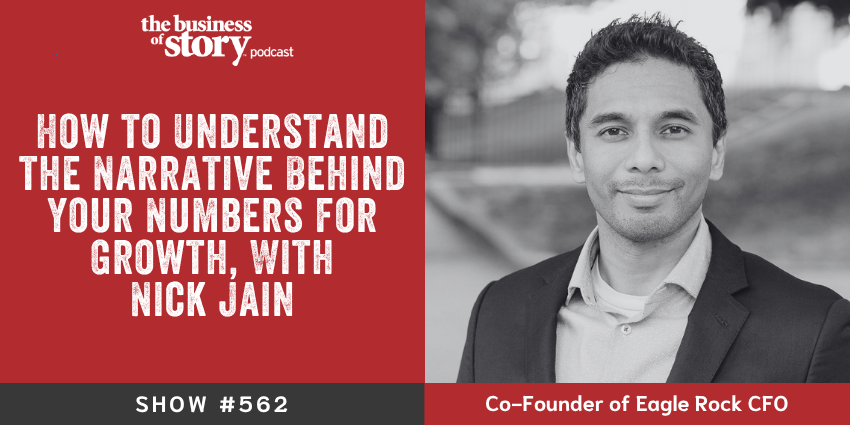
Nick Jain is the co-founder of Eagle Rock CFO — a platform delivering Fortune 500-level financial advisory to businesses doing $5–$50M in revenue. A Harvard MBA who graduated at the top of his class, Nick holds degrees in math and physics and has turned around or scaled three companies with up to $100M in revenue across trucking, software, and eCommerce.
His thesis is simple and genuinely rare: most growing businesses have a financial story they can’t read — and the cost of not reading it compounds every quarter.
Eagle Rock CFO uses AI-native tools to deliver the kind of strategic financial clarity that used to require a million-dollar-a-year executive. The result is a hybrid model where machines handle the data grind and experienced operators handle the strategy — at roughly 5% of what a traditional fractional CFO costs.
What’s in it for You:
- Why cash flow isn’t the same as profit — and the specific timing gaps that catch growing businesses off guard before they become crises
- Why the metrics that matter at $2M revenue will actually mislead you at $10M — and the financial signals that predict whether your growth is sustainable or a ticking time bomb
- A simple framework for thinking like a CFO — whether you’re evaluating a new hire, a big purchase, or when to take on debt
- The three financial stories business owners tell themselves that quietly kill companies — and how to rewrite them
- Why going “code native” with AI coding agents (not chatbots) compresses 60 hours of financial analysis into 20 minutes
The Three Financial Myths That Are Quietly Stalling Your Growth
In our conversation on the Business of Story podcast, Nick laid out the three most dangerous stories business owners tell themselves about their numbers.
The first is vision over data. Some leaders are so invested in their mission that they treat the numbers as secondary. But as Nick put it, what makes us uniquely human isn’t just our ability to tell stories — it’s our ability to hold both story and logic at the same time. Numbers aren’t the enemy of vision. They’re the evidence that your vision is working.
The second is the myth that revenue equals success. Negative unit economics — where every sale actually loses money — means that growth accelerates failure rather than preventing it. You can’t have profits without revenue, but you can absolutely have revenue without profits. Plenty of businesses are growing themselves out of business right now.
The third is the deferral trap. Problems compound. The inefficiency you ignore today doesn’t stay small — it multiplies. Nick’s advice is direct: every problem should be solved today. Not tomorrow’s problems. Today’s problems, today.
The Financial Habit That Costs Nothing and Changes Everything
You don’t need Eagle Rock CFO to start getting better financial visibility today. Nick’s most actionable advice: designate someone — an employee, a partner, even a spouse — to spend one day a week doing nothing but looking at your numbers. Marketing data. Revenue. Margins. Costs. Just stare at the data and ask: how do we get better?
That single habit, consistently applied, surfaces opportunities and problems that would otherwise stay invisible until they become crises.
And when you’re ready to go deeper, Eagle Rock CFO offers a free financial dashboard, a two-week AI agent trial, and a free 30-minute cash flow diagnostic for businesses over $5 million in revenue.
As Nick and Park landed on together during the conversation — the UVP that emerged live on air: Machines handle your data. Experts handle your future.
That’s not just a tagline. That’s what it looks like when your two stories finally align.
Links:
- Free financial dashboard + 2-week AI trial: EagleRockCFO.com
- Book a free 30-minute cash flow diagnostic (businesses $5M+): EagleRockCFO.com
- Nick Jain on LinkedIn
- StoryCycle Genie brand story tools: storycyclegenie.ai
Three Related Business of Story Episodes
Why Building Your Audience Now Is the Only Moat Against AI, with Joe Pulizzi — The content marketing pioneer reveals how to use data and authentic human connection to build a business that AI can’t replicate.
Why Your Growth Depends on Truly Knowing Your Buyer, with Charles Gaudet — The CEO Whisperer shares how aligning your message with your market’s real needs is the fastest path to predictable, profitable growth.
How to Turn Hard-Won Attention into Loyal Customers Without Wasting Another Ad Dollar, with Shamir Duverseau — Why the post-click experience is the biggest missed opportunity in digital marketing — and the framework for fixing it.
Nick Jain’s Conversation With Park Howell on the Business of Story Podcast
From Venture Capital to Fractional CFO: How Eagle Rock CFO Was Built to Serve Growing Businesses
Park: Hello, Nick. Welcome to the show.
Nick: Thank you so much for having me on the show, Park.
Park: All right, now you are throwing me a major curveball because I’ve been doing this show for almost 11 years. Everything we do is around brand business leadership storytelling. And yet I’ve got a financial company showing up. Some of my listeners might be thinking, my God, what’s Park going to do? Take me down the whole VC road?
But no. What I’m really curious about is what you all are doing there at Eagle Rock, how you are differentiating yourselves in the market, and how you are telling that story.
Nick: That’s a hard question, but I will try and answer it. My business partner and I met at business school about a decade ago and we realized we really liked two things — finance and data. We both worked on Wall Street. Then a few months ago we got together and said, the time might be right to do something with AI. It is big. It is real. The technology has gotten smart.
We came up with a bunch of ideas, tested them with the market, and a bunch sucked. But the one we really stumbled upon was this: there are all these business owners out there who would love to have the level of intelligence and ability that a million-dollar-a-year CFO has. But the average business — even a $50 million business — can’t afford to get that caliber of individual. Everyone would love to have Google’s CTO be their CTO. You can’t afford it unless your name happens to be Google, Apple, or Facebook.
So where we landed was: we can offer really thoughtful strategic financial advice that you would have to pay an elite consulting firm half a million dollars a month for — for pennies on the dollar. We tend to serve medium-sized businesses and give them great financial and operational advice.
The story we tell is: you would love to have a great CFO and advisor. You can’t afford anyone as good as what your aspirations are. But we not only have the background — Harvard Business School, Bain Capital, Stanford on our resumes — more importantly, we are leveraging this wonderful technology to give you value at cost. When you have people with fancy resumes coming to serve you as advisors, as friends, at a price point that’s affordable — that’s a really strong value proposition among medium-sized business owners.
How Eagle Rock CFO Uses AI Natively — Not Just as a Chatbot — to Deliver Fractional CFO Services at Scale
Park: You are obviously AI-driven. How are you set up, and how could some of our listeners take cues from what you’re doing and apply it in their work?
Nick: We are AI native. Almost every single thing we do is done by AI. There are two basic things that happen in any business: you go out and find customers, and you serve customers. This is true whether you’re making burgers, selling software, or providing professional services. We use AI on both ends.
On the marketing front, we’re using AI-native tools that are writing our emails, writing our SEO content, optimizing our website, and responding to customers. Those are off-the-rack technologies I really encourage your audience to use. There’s a million of them out there. Pick whichever one you like. They’re all reasonably cheap — about $20 a month.
But the place where we are differentiated — and where your audience could really leverage this — is using AI to do the actual work inside. After you’ve won the customer, after they’ve given you their money, use AI to deliver the service.
Here’s a practical example. In my business, I analyze a company — say, a $20 million revenue Hollywood studio — and figure out how to make them more money next month. Historically, I’d get them to send me data, open up Excel, do a bunch of analysis, make a pretty PowerPoint, and send it to them. That would take two weeks.
Now, the data comes in and I don’t even open the data file anymore. I open up Claude Code and say: here’s the client, here’s the industry, open up the file, analyze it, do whatever you want, give me a PDF with the analysis. I come back 20 minutes later and it’s beautiful. It has compressed 60 hours of work down to 20.
But the important thing is that level of gain is possible in almost any white-collar work — but only if you go what I call code native. You get out of all the tools that look like software or applications, open up a terminal — a big black screen on your Mac or PC — and just talk to a coding agent instead of a typical chatbot.
Park: Why a coding agent versus a chatbot?
Nick: A coding agent can do anything you tell it to. A chatbot can basically only respond back to you. A coding agent can Google the web, make PDFs, do research, write Python scripts to do complex data analysis. It can do it all — as long as it’s in the digital world.
Live Brand Story Analysis: Building Eagle Rock CFO’s Narrative with the StoryCycle Framework
Park: So as I understand it, Eagle Rock is a service provider that brings fractional CFO services to companies that can’t afford the million-dollar CFO?
Nick: Exactly. We actually started out building this amazing technology and asked ourselves, how do we make money off of it? Our first idea was to use it to invest in other businesses — so we started a small venture capital firm. That works, but then you have to wait five or ten years for those bets to pay off. So how do we make money today? We took that exact same technology, put a different website and wrapper on top of it, and it’s this wonderful engine that analyzes businesses and figures out how to make them better.
Park: I fed your Eagle Rock website to our StoryCycle Genie — which does what you’re talking about in the finance world, but for brand storytelling. The discovery took me a couple of minutes. Let me read the positioning statement it came up with. It says: “Eagle Rock VC is the only AI-native venture capital firm that combines institutional-grade investment judgment with systematic market signal analysis across 200-plus data points, delivering 100X evaluation coverage and 24-hour decision capability to find exceptional founders and companies before the market knows they exist.”
To me, that sounds like your first launch into the VC world. Am I right?
Nick: Yes. Your positioning statement is absolutely correct for our VC business. That website is still up, but it’s a slow burn because VC investment takes five to ten years to pay off. Eagle Rock AIBC is the first AI-native venture capital firm — very small, but it is the first, and it’s very thoughtful because AI is doing the investment decision-making rather than humans.
Park: Do you have a different website for the CFO business?
Nick: Yes — EagleRockCFO.com. That’s where we’re running our primary business right now, although we still have the VC firm running as a slow burn.
Park: While we’re talking, I’m going to have the Genie go in and review Eagle Rock CFO, and you are going to learn right alongside me what it comes up with.
Nick: I am excited about it.
Park: I just loaded it up. We’ll get back to it in a couple of minutes.
Nick: We’d been doing the VC side for about a year. Then as our CFO business took off, we launched that, started making money, and didn’t want to switch over our email because we were already communicating with people. We finally switched over our email like two weeks ago.
The 3 Biggest Financial Mistakes Growing Business Owners Make (and How a Fractional CFO Helps Prevent Them)
Park: Let’s think about the numbers — the narrative behind the numbers. What are some big mistakes business owners make when they’re looking at their numbers and thinking in story?
Nick: I’ll give you three. The first is: numbers don’t matter because we are driven by vision. Companies where they don’t even care about the numbers — financial numbers, marketing numbers, sales numbers. Companies driven by vision and the belief that gut feel supersedes numbers.
The second is: we will grow our way to success. There are lots of companies with what’s called negative unit economics. Imagine McDonald’s selling a burger, but every burger they sell loses money. Selling a million burgers doesn’t make you profitable — it just makes you lose a million times as much money as selling one burger. A lot of businesses are growing themselves out of business.
The third is: numbers say we are inefficient today, but we’ll take care of that tomorrow. Problems compound over time. If you don’t wash your hair, it gets incrementally knotty and it becomes that much harder when you finally try to comb it. Don’t shower for a month and see what happens. I don’t recommend it.
The Vision vs. Numbers Trap: Why Story-Driven Leaders Miss the Financial Data That Could Save Their Business
Park: On that first one — vision over numbers — is it that they’re so wrapped up in their story that they think the numbers will eventually follow?
Nick: That’s the more charitable interpretation. The more negative interpretation is that people think, look, we are human beings. We care about emotions and relationships and the stories we tell. Those are important — but not to the exclusion of evidence, facts, numbers, or data.
What is special about us as human beings is not that we are good with numbers. It is also not that we love each other and have emotions — animals have those, and computers can handle numbers. We’re special because we can both think and have relationships and tell stories and have things that exist bigger than ourselves.
There are certain types of leaders who focus so much on the human element — the vision, the story, the relationships — that they forget the numbers matter equally. Data, logic, the facts of the universe — they matter equally.
Park: So they get so enthralled with their vision and mission that they’re not paying enough attention to the numbers?
Nick: Exactly. Or they say, we’re just so successful we don’t have to worry about it. But success doesn’t change facts. You could be making a billion dollars, but you still need to know — is it a billion? Is it $940 million? Is it a billion five? Those are very different numbers.
Growing Your Way Out of Business: How Negative Unit Economics Quietly Kill Profitable Companies
Park: On your second point — growing yourself out of business — I learned that at a very young age. My dad was a civil engineer who ran a huge construction company up out of Seattle — Constructors Pamco. One day I learned that one of his main competitors had gone out of business. They’d been around longer than my dad’s company. I said, Dad, they were always so successful — how could they go out of business if they had that much coming in?
My dad made the plain point: it doesn’t matter what your revenue is if you’re not making any money on it. He said they were losing so much money on the jobs they were taking because they were undercutting his company. He said, take it, it’s yours — because he knew they were going to lose their ass on it. And they ultimately went out of business. That was a real awakening for me as a young man.
Nick: Revenue’s great. You can’t have profits without revenue, but you can absolutely have revenue without profits.
Why Deferring Small Financial Problems Creates Business-Threatening Crises for $5M–$50M Companies
Park: While we’re talking, the Genie has already run your brand assessment. Let me see what it says now that it’s looking at your CFO side of business.
It says: “Eagle Rock CFO positions as the only finance platform that combines AI-powered analytics with human strategic guidance, offering a self-serve dashboard entry point that upgrades to full fractional CFO support. Its core claim is: you grow your business, now own your numbers.” How does that land?
Nick: Perfect. No objections, no modifications.
Park: Part of the reason it’s so accurate is because we did a lot of metadata editing so any AI agent would effectively understand what we’re trying to communicate.
Nick: Exactly. Part of the reason is because we spent a lot of time doing metadata editing so that any AI agent is going to really effectively understand what we try to communicate.
Park: We have that built into the Genie as well. Any content you create in there, we have a Search Engine Optimization Genie — part of our over three dozen experts inside the StoryCycle Genie — that speak with each other and do that same thing.
Now, what was the third financial mistake again, and how do you help people overcome it?
Nick: The third was: there’s a problem I see in the data today, but it’s not a big problem and I will deal with it tomorrow — metaphorically tomorrow. The problem is that problems compound over time. Small problems you don’t deal with today may not become bigger problems tomorrow, but you’ll have lots more small problems to deal with the day after and the day after.
When people see issues in their businesses — numbers, data, whatever — the plan should not be “I’ll deal with that next month.” Problems need to be dealt with today. Someone in the company should be working their butt off to solve every single problem that exists today. Not every single opportunity — every single problem.
Park: You hear that trite tagline out there — “solving tomorrow’s problems today.”
Nick: I’m much less ambitious. I’m not about solving tomorrow’s problems today. Let’s just solve today’s problems today.
Park: Well, if I ever start my procrastinator society, that’s going to be my tagline — solving today’s problems tomorrow.
Nick: There’s a funny poem about exactly that sentiment — just putting everything off till tomorrow.
AI Plus Human Expertise: How Eagle Rock CFO’s Hybrid Model Is Redefining Fractional CFO Services
Park: I’m curious how this positioning statement works for you. “Eagle Rock CFO is the only financial platform that combines AI-powered real-time analytics with elite fractional CFO expertise, giving growing businesses the financial clarity and strategic guidance of a world-class finance team at a price and flexibility that scales with them.”
Nick: Yes, we agree. The imperative thing is the second clause — elite CFO experience. I’ve been the CFO of a hundred-million-dollar revenue company, and my business partner has founded a similar-size company. We’ve run real companies. That resonates with our customers because they’re not just getting tech engineering people. They’re getting business leaders who happen to have experience with technology.
Park: I was just asking it to give me three versions of a UVP. I kind of like this one: “Machines handle your data. Experts handle your future.”
Nick: I like that. That’s a good branding line. I like the rhetorical device — parallelism. I’m going to steal that.
Park: You can steal that.
One Weekly Habit That Protects Your Business: Why Financial Oversight Is the CFO Strategy Every Entrepreneur Needs
Park: What would you tell your ideal customer right now — whether or not they’re considering Eagle Rock CFO — what should they be doing?
Nick: Our customers tend to be mid-sized businesses — five to $50 million in revenue, any industry. Whether or not they use us, my friendly advice is: have someone on your team — a friend, a spouse, an employee, junior or senior — who just spends a day a week looking at the numbers. Staring at the data. Marketing numbers, warehouse numbers, profit numbers, whatever. Just have someone who one day a week just stares at the data.
That will unlock tremendous amounts of value. You will find incredible opportunities to improve the business when you let people look at data and ask the abstract question: how do we get better?
Park: In the 20 years I ran my ad agency, a lot of our business came from people just like you’re describing. They had a five to ten million dollar business, they were making money, they had operations pretty well dialed in — but they’d come to us and say, we think we’re leaving a lot of money on the table because we don’t have a clear brand story. We’ve been successful despite not having one, but now we’re concerned about the revenue we’re leaving on the table.
Is it essentially the same in your world — they’re successful because they have a great model, but they haven’t been paying attention to the numbers because it hasn’t bitten them yet?
Nick: We have customers on both sides of that spectrum. Some are incredibly successful in spite of themselves. Others are on the verge of bankruptcy because they haven’t run themselves well.
The analogy I’d draw is genetics. If you have good genetics, you can be reasonably lean even if you’re not disciplined about diet or exercise — but you will never be an elite athlete. If you want to be an elite athlete, you have to apply discipline. In my world, that means discipline around how your business makes money, how it can make more, how it can spend less.
Any elite athlete will tell you: they measure everything and apply ridiculous amounts of discipline. Annoyingly so. When their coach tells them to do the same exercise 20 times per set, five times a day, at specific times — they may not like it. But that’s what gets them to the Olympics.
Park: So you guys come in as their financial trainers.
Nick: We’re not exactly in the training business. I’d say we’re like the gym trainer you hire once a week. We’ll sit with you, teach you the right exercises, do the analysis, and show you how we did it — but we hope you call us back again next month. We’ll find the next exercise for you when you’ve leveled up one level at a time.
Try Eagle Rock CFO Free: Start With a 30-Minute Cash Flow Diagnostic for Your Growing Business
Park: Do companies come to you when they’ve been around a long time, doing ten million in business, and they want to sell but need to get their financial numbers in order?
Nick: Yes — that’s a business line we just launched about a month ago. We admittedly have no customers on the sell side yet. But our technology analyzes a business and figures out if it’s a good business, a bad business, how to make it a better business. The use case you just identified — it’s time for me to sell, help us get ready — we just launched that in the past three or four weeks.
The opposite side, where we are getting more people actively paying, is on the acquisition side. Private equity firms, search funders, and investors are calling us saying, should we buy this business? Typically, diligencing a $50 million business costs $200,000 to $300,000. We can make that much more affordable — roughly 10% of the cost. And we’re very honest about why: we have all these little AI agents running around doing all the work.
Park: Is there a place on your website people can go and get a free sip of the product?
Nick: Yes. Go to EagleRockCFO.com and click “Get Started Free.” You get access to our free version, which includes two things: dashboards of all your financials — pretty graphs, descriptions of your revenue and costs, free forever — and for two weeks, a free trial of our self-serve AI agent, which will look through your business and say, “Park, you need to make these three changes right now.” After two weeks, we want you to become a customer if you want to continue.
Park: And do you also have a freebie for listeners running a company greater than $5 million — a 30-minute cash flow diagnostic?
Nick: Yes. If you’re above $5 million in revenue, you can book time on my calendar right on the website. Either myself or my business partner will hop on a call and go through your entire business — human to human — and say, here’s how you could make your business better. That’s not a sales pitch. We’d love to just do right by folks, because then eventually they’ll call us back in six months and say, we realized that wasn’t a one-time thing. We want that advisor always in our ear.
Park: Awesome. And they can find all that over at EagleRockCFO.com?
Nick: Yes, sir. It’s got our contact information, access to the free version of our software, our booking calendar, and a bunch of educational resources. That is the place to find anything about us on the web.
Park: Well, it sounds like you’ve got a hell of a product there. Thank you so much for sharing it with us today on the Business of Story.
Nick: Thank you for having me on the show, Park.
Frequent Asked Questions
Q: What is a fractional CFO and why do growing businesses need one?
A: A fractional CFO is an experienced chief financial officer who works with your company on a part-time or contract basis — giving you strategic financial guidance without the cost of a full-time executive. Growing businesses in the $5M–$50M revenue range often have the complexity that demands CFO-level thinking but not the budget for a million-dollar-a-year hire. A fractional CFO helps you understand your numbers, avoid costly financial mistakes, and make strategic decisions with confidence.
Q: How does Eagle Rock CFO use AI to deliver fractional CFO services?
A: Eagle Rock CFO is fully AI-native, using AI agents to handle data analysis, financial dashboards, and strategic reporting that would traditionally take weeks. Rather than relying on spreadsheets and PowerPoint decks, their team uses coding agents — tools like Claude Code — that can analyze entire business datasets, generate PDF reports, and surface actionable insights in 20 minutes instead of two weeks. The result is enterprise-grade financial intelligence at a fraction of the traditional cost.
Q: What is the difference between a coding agent and a chatbot for business use?
A: A chatbot can respond to questions and generate text. A coding agent can actually do things — browse the web, write Python scripts, analyze complex datasets, generate PDFs, and execute multi-step tasks autonomously. For business owners and professionals, going “code native” — working directly with a coding agent in a terminal rather than a chat interface — dramatically expands what AI can accomplish and compresses hours of work into minutes.
Q: What are the three biggest financial mistakes growing businesses make?
A: According to Nick J of Eagle Rock CFO, the three most common financial mistakes are: (1) prioritizing vision over data — letting gut feel and story override the evidence in your numbers; (2) growing your way out of business — scaling a model with negative unit economics where every new sale actually loses money; and (3) deferring small problems — assuming today’s minor inefficiency can wait until tomorrow, when in reality problems compound and become exponentially harder to solve.
Q: What are negative unit economics and why are they dangerous?
A: Negative unit economics means your business loses money on every sale. If it costs you more to deliver your product or service than you charge for it, then selling more doesn’t create profit — it accelerates losses. Many businesses fall into this trap while chasing revenue growth, not realizing that scale makes the problem worse, not better. A fractional CFO can identify negative unit economics early and help you restructure pricing or costs before the damage becomes irreversible.
Q: How can a small business owner get better financial visibility without hiring a full-time CFO?
A: Nick J’s practical advice: designate someone on your team — an employee, a business partner, even a spouse — to spend one day a week doing nothing but looking at your numbers. Marketing data, revenue, costs, margins — whatever is relevant to your business. This single habit, consistently applied, surfaces opportunities and problems that would otherwise stay invisible. For businesses ready to go deeper, tools like Eagle Rock CFO’s free dashboard provide automated financial visibility with no credit card required.
Q: What does Eagle Rock CFO offer for free?
A: Eagle Rock CFO offers a free-forever financial dashboard that visualizes your revenue, costs, and key metrics. New users also receive a two-week free trial of their AI-powered self-serve agent, which analyzes your business and recommends specific changes to improve performance. Business owners with more than $5 million in revenue can also book a free 30-minute cash flow diagnostic directly with one of Eagle Rock CFO’s founders at EagleRockCFO.com.
Q: How is Eagle Rock CFO different from accounting software or traditional financial consultants?
A: Most financial tools are either pure software — dashboards that show you numbers but don’t tell you what they mean — or pure human service — consultants who are great strategically but expensive and slow. Eagle Rock CFO’s hybrid model combines AI-powered analytics with experienced human CFO guidance. Their founders have run companies with $100M+ in revenue and built multiple businesses, so clients get both the speed of AI and the judgment of operators who have actually run real businesses.
 Listen To More Episodes