The Category Queen of Legal SEO Reveals How Radical Niche Focus and StoryOps™ Precision Turn Your Brand Into the Only Answer Your Market Finds
Why Casting a Wide Net Is the Surest Way to Disappear in the Age of AI Search
You want marketing that generates real revenue, and you know that telling a clear, consistent, compelling story is how the best brands separate themselves from the noise.
But most businesses dilute themselves trying to serve everyone. They cast wide nets, collect shallow results, and wonder why their marketing dollars disappear without a trace.
They’ve never gone deep enough into a specific niche to become the undeniable signal — and they’ve never defined, operationalized, or governed their brand story with the StoryOps™ precision it takes to become the category king or queen of their market.
Therefore, the most powerful brand strategy available to you right now is not a bigger ad budget or a better content calendar.
It is radical niche focus, a brand story governed with an eagle eye for coherence, and a digital footprint so deliberately built that Google, Perplexity, and every AI search engine serves you up as the only logical answer your ideal client finds.
Lindsey Busfield has already proven it works.
Meet Lindsey Busfield: The Co-Founder Who Built a Category-Defining SEO Agency by Saying No to Almost Everyone
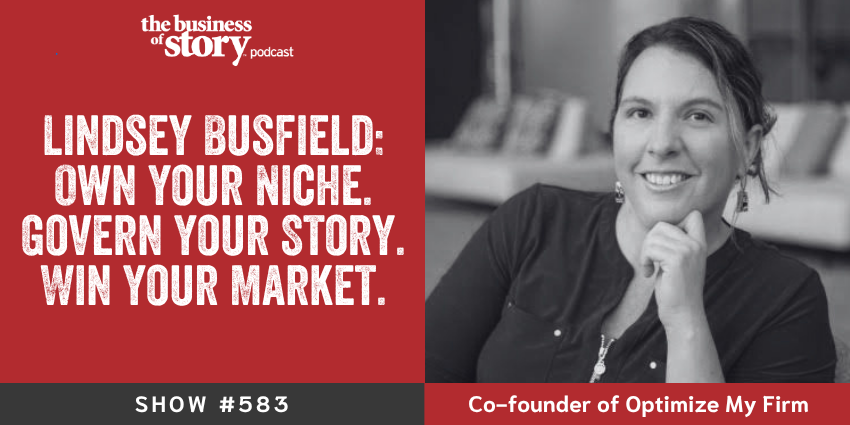
Lindsey Busfield is the co-founder of Optimize My Firm, the SEO and content marketing agency behind some of the nation’s most powerful personal injury law firm websites.
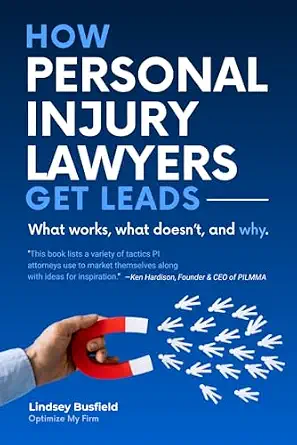 She is also the host of the Personal Injury Marketing Minute podcast and the author of How Personal Injury Lawyers Get Leads: What Works, What Doesn’t, and Why — available now on Amazon, with a free copy available for attorneys at OptimizeMyFirm.com.
Her path to category queen was anything but straight. Philosophy major. Starbucks barista. English teacher. Agricultural compliance auditor for Amish chicken farms. Law firm marketing temp who was handed an SEO project nobody else wanted.
That last accident turned out to be the aha moment where strategy and compliance and project management and English and creativity all collided inside one discipline — and a career was born. Lindsey and her business partner Len now run the most recognized SEO agency in personal injury law, with geographic exclusivity and a no-contract model that has revolutionized how clients and agencies build trust.
What’s in it for You:
- Why going narrower — not broader — is the most powerful brand strategy available to any business owner right now
- How Lindsey’s agency built geographic exclusivity and a no-contract model that eliminates the trust gap plaguing the legal marketing industry
- Why personal injury lawyers are natural storytellers — and what every B2B brand can learn from how they craft a narrative to win cases
- How SEO, AEO, and GEO work together in the age of AI search — and the one content discipline that positions you well across all three
- How owning your niche, governing your brand story through StoryOps™, and expanding your digital footprint with strategic yes decisions makes you the category king of your market
- Why Lindsey’s own website scored a D on Park’s brand narrative assessment — and what that reveals about how different types of businesses need to govern their stories
The Time Trade-Off That Every Business Owner Gets Wrong
Lindsey makes the governing logic of niche focus as clear as it gets. The most limited resource you have is time. You can spend it casting a wide net and getting shallow results, or you can dive deep into one market segment and build the reputation, the expertise, and the brand story that makes you the only credible option in that space.
Optimize My Firm chose the second path. Personal injury law is a hyper-specific niche — but there are still thousands of firms across the country, all competing in local digital markets where consumers search in moments of crisis. The agency researched the market before committing. They confirmed the need was real, the clients could afford the service, and the business model — contingency-based firms with high case values — was one where SEO investment pays back in a measurable, direct way.
That research discipline is the first principle of StoryOps™ niche governance: you do not wake up one morning and pick a niche on instinct. You identify who your service is most valuable to, who can invest in it meaningfully, and whether you can build a sustainable business on relationships with that one target demographic. Then you go all in.
How Governing Your Story Makes You Impossible to Ignore in AI Search
Here is where Lindsey’s story gets particularly sharp for anyone trying to compete in 2025 and beyond. The old SEO playbook — metadata, alt tags, keyword density — has given way to something far more important: producing good, relevant, up-to-date content that genuinely helps your specific audience, distributed across every digital format the internet allows.
Website content. Podcast transcripts optimized for SEO, AEO, and GEO. YouTube shorts and video clips. LinkedIn thought leadership. A book. Guest appearances on other shows to earn third-party credibility and backlink citations that boost your domain authority.
Each of these is a deliberate choice to expand your digital footprint in the one market you have decided to own. And the more formats you use to tell your story, the more surfaces you give large language models — Google, Perplexity, ChatGPT — to pull from when someone types exactly the question your ideal client is asking at the moment they need you most.
This is StoryOps™ in action. Not just defining your brand story, but operationalizing it across every channel and governing it with the discipline to say yes to every legitimate opportunity to tell it in a new format or on a new platform.
Lindsey’s own podcast, the Personal Injury Marketing Minute, is not a vanity project. It is a content machine that compounds. Every episode generates a transcript, a blog post, video clips, LinkedIn content, and eventually — in Lindsey’s case — a book. Each piece connects back to the same governing story: Optimize My Firm is the only SEO agency that goes this deep into personal injury law, protects clients from being burned by generic agencies, and builds trust through geographic exclusivity and no-contract relationships.
That story does not need to be Pulitzer-worthy on the homepage. It needs to be findable, consistent, and credible — and then reinforced through every human conversation that follows.
Why the Discovery Call Is the Most Governed Moment in Lindsey’s Brand Story
One of the most instructive moments in this conversation is Lindsey’s description of what happens on the first client call. It is almost entirely about them. Not Optimize My Firm’s credentials, not the pitch, not the close. The discovery call is built to find out who the firm is, what their pain points are, and whether Lindsey’s team can actually make a meaningful difference for them.
That discipline — qualifying rigorously rather than chasing volume — is the operational expression of story governance. It keeps the brand story coherent from the first touch through every client relationship. Optimize My Firm does not want to be the agency with the most clients. It wants to be the agency that delivers transformational results for the clients it is built to serve. And that requires the courage to say no to everyone who does not fit.
That is how you go from SEO agency to category queen. And it starts with owning your niche.
Links and Resources
- Optimize My Firm
- How Personal Injury Lawyers Get Leads: Wht Works, What Doesn’t, and Why
- Lindsey Busfield on LinkedIn
- Lindsey on X
- Lindsey on Facebook
- Optimize My Firm podcast
- StoryCycle Genie™
- FREE Brand Story Grader
- Brand StoryOps™ for Agencies Newsletter
Related Episodes from the Business of Story Podcast
- How to Effectively Position Your B2B Brand With April Dunford — The world’s foremost authority on product positioning reveals why most B2B brands are positioned on features instead of the market category they could own.
- Find Your One Word and Become Impossible to Ignore With Brian Burkhart — Square Planet founder Brian Burkhart shows how distilling your entire brand story into a single galvanizing belief is the fastest path from commodity to category.
- Stop Pushing. Start Finding the Buyers Who Are Already Sold on You With Rob Snyder — Harvard MBA and McKinsey veteran Rob Snyder reveals why the fastest-growing businesses stop chasing the wrong prospects and build a pull strategy around the customers who are already in motion toward them.
Lindsey Busfield’s Conversation With Park Howell on The Business of Story Podcast
The Hyper-Niche SEO Agency Dominating Personal Injury Attorney Marketing
Park Howell: Hello, Lindsey. Welcome to the Business of Story.
Lindsey Busfield: Thank you so much for having me. It’s a pleasure to be here.
Park: Yeah, and you know what really intrigued me when you all reached out to be on the show is how niched down your offering is. And I can tell you, I never see that.
You know, handling SEO search optimization for personal injury attorneys is like the narrowest, most focused niche in the ad world I have ever come across — and apparently it’s working pretty well for you.
Lindsey: It is. And it’s one of those things where when you’re a kid, you’re a doctor or a lawyer when you’re thinking about your future career. It’s never one of those things where you’re like a six-year-old going, man, I really hope I get to run a company that does search engine optimization for personal injury lawyers.
It’s just not that kind of thing. So yes, it is really unique. And it’s one of those things that when you do find that kind of niche, you really have a story behind how you stumbled into it.
Park: Yeah, well, I mean, you become the signal in the noise out there. So Lindsey, what does Optimize My Firm stand for? You help personal injury attorneys get found online — and it’s not just being found. I like how you say it on your website: it actually leads to cases. That’s the end game.
Lindsey: Yes, because that’s what personal injury attorneys are wanting at the end of the day. And so many marketing agencies approach prospective clients and go, we’re gonna boost your website traffic, or we’re gonna get you to the top of page one, or we’re gonna optimize your — that’s not what they care about.
They care about whether or not their investment is paying off and they’re getting signed cases in the door. So that is our number one priority. And everything else that we do to serve our clients is just a means to the end.
From Philosophy Major to Personal Injury SEO Expert: An Unconventional Path
Park: So how did you get into this line of work? What is your backstory, Lindsey?
Lindsey: So of course it’s a complete accident. And that is how the best stories happen.
I went to college and got a degree in philosophy. So naturally I ended up working at Starbucks and trying to figure out what to do with my life.
Park: There’s a lot of philosophizing going on at Starbucks. A good spot for ya.
Lindsey: There is. You have deep thoughts and dark coffee — and that’s what you do.
So that wasn’t realistic for me to spend the rest of my life doing that. So I became an English teacher and realized the politics in this really isn’t for me. There’s too much bureaucracy. Even though it’s really creative and I love it, and I love everything about English and working with kids — it just wasn’t the best career choice for me long term.
And so I went to work with my parents’ chicken company.
Park: Why? Chicken — as in raising chickens, spewing out eggs — what kind of chicken company?
Lindsey: They were egg slingers.
I come from a family of serial entrepreneurs. Throughout my entire childhood they had started businesses, sold businesses, started businesses, sold businesses. And this was a business that they started out of a bed and breakfast they had in upstate New York. They had a little backyard flock of chickens and they laid the eggs they would use for breakfast.
And these eggs tasted so much better than any eggs you could buy in store. They realized it was because these chickens were outside being chickens, doing natural chicken things, eating good stuff.
This was before pasture-raised eggs was a thing. You had free range, but really that just means the chicken has like two square feet of acreage outside. And it’s just not enough to make a real difference.
So they decided to build a pasture-raised egg model where chickens are actually going outside. They partnered with an Amish farm to create the proof of concept. And from there, they grew this company into the now largest organic pasture-raised egg company — Handsome Brook Farms.
Park: What’s it called?
Lindsey: Handsome Brook Farm — still out of New York and kind of everywhere. And now they supply Costco’s pasture-raised eggs under the Kirkland Signature brand.
Park: So were you a young lady growing up in all of this?
Lindsey: I was absolutely not. They didn’t even start this business until I was in college.
When I came into the business, it was still kind of in its infancy and they needed some help with project management and marketing. And really where they needed the most help was agricultural compliance — building a compliance system to make sure that all of the animal welfare standards were being met, all the organic standards and certifications were up to date.
So I built this compliance program for the company. And that became the foundation of their agricultural compliance program.
Park: By the way, just as a side beat here — I don’t know if you ever watch Portlandia, one of the funniest shows ever. There is a whole scene where Fred Armisen sits down to have dinner and he wants to have the chicken. But he wants to meet the chicken first. So they make a big trip out to the chicken farm. Look it up online — you will probably get a big kick out of it.
Lindsey: I’m sure I’d get a kick out of it.
So yes, I helped build this compliance program. But that put me at traveling about 70% of the time to go and audit Amish chicken barns. And once again, that’s not what I wanted to do with my whole life. So I kind of had to start from scratch again.
Park: So you had the philosophy major and now you’re auditing Amish chicken farms. Beautiful.
Lindsey: Yes. And I felt like maybe this isn’t quite going the right direction.
So I was just kind of at an impasse of going, I still don’t know what I want to be when I grow up. As such, I kind of had to take whatever job I could find.
So I started out as a temp at a law firm in their marketing department as they were merging with another law firm and needed to get their website up to date with all these profiles. I went in and figured out how to update websites. And that was a great skill — one I had always been intimidated by because I’d never really worked with technology on that level before.
I enjoyed it. It was a good team. I enjoyed being in a law firm. I have a lot of lawyers in my family. Being a philosophy major, you either go to Starbucks or you go to a law firm.
And I realized maybe this is starting to look like the right track for me.
At that point, I was surrounded by a big marketing team and they had just hired an SEO agency to help with their website. I didn’t even know how to spell SEO, much less do any of it. And they didn’t have the bandwidth for it. So it kind of got turfed to me to figure out.
And at that point, it all clicked for me.
I learned the ins and outs of SEO — which is combining strategy and compliance and project management and English and creativity, all within this legal world. And it was my big aha moment of here are all of my passions together in something I could really get excited about.
So I ended up meeting my now business partner, Len, who had just happened to start an SEO agency that worked with law firms. He needed somebody to come in and be the project manager because he is so all over the board — brilliant, but so all over the board. He needed somebody to help not only manage the client accounts but also to help scale the business. And the rest is history.
SEO Is Storytelling: The Content Strategy That Wins Personal Injury Clients
Park: You said that working in SEO brought a lot of your different talents together, and you said it’s creative. Now help me understand that — because I come from the writing and creative direction world and I honestly don’t find creativity in SEO in any way, shape, or form. Inform me — how do you find creativity in SEO?
Lindsey: See, from coming from a storyteller background — that’s exactly what SEO is. SEO is telling the story of your brand in a way that resonates with your target demographic.
Park: Well, but it’s gotta resonate with the search engines in order for them to find you, right?
Lindsey: Right. But you have to understand who your target demographic is and what their pain points are — and that’s how you understand what they’re searching for. What information do they need to know that’s going to connect them with your business?
We work with personal injury lawyers. So our target demographic is anybody and everybody who could be in an accident or be hurt because of somebody else’s negligence.
So the creativity comes from exploring all the different case types that somebody might have that could lead them to needing a lawyer. Then really digging into their mindset and figuring out what information do they need? How do I meet them empathetically with the writing and the content that we’re putting out there? And then how do we optimize that content so that not only is it a selling point for a prospective client, but also so that Google understands it, ranks it, indexes it, does everything it possibly can to bring this information to that prospective client.
Park: Yeah, I gotcha. And I am from the storyteller writing standpoint — thinking about that audience, what pain they’re in, writing that article first and connecting with them, and then thinking, okay, how do I bring SEO to it? I get your point there. Thanks for explaining that to me.
SEO vs. AEO vs. GEO: How AI Search Is Reshaping Legal Marketing
Now, how have you seen search evolve with the AI bots out there — GEO, AEO — and how do you incorporate those into your overall search science?
Lindsey: There are eight million different acronyms. And so you’ve got your SEO, your AEO, your GEO, your LLMs — all of this stuff that kind of is essentially pointing to the same answer.
Which is: you need to put your information out there, tell your story out there, in as many different content formats as the internet allows you to.
So following traditional SEO is putting the content on your website and making sure that it’s readable both for your prospective clients as well as for Google — having the right things highlighted in a way that Google picks it up and understands what search terms to align this with.
But then you need to take that same ideology and expand that across the internet. Have a larger footprint and cast a wider net.
The more opportunities that you say yes to digitally to tell your story — whether it’s through podcasts or thought leadership articles or videos that you’re putting on YouTube or anything that you can do to tell your story and develop your brand identity — that’s going to help you show up well in the AI search models.
Park: Yeah, so you write and tell that story, but you still need to go in and put in the right search terms and rankings and that sort of thing first for SEO, but you also need to do that for the search bots.
GEO — what does that stand for again?
Lindsey: Generative engine optimization.
Park: And then AEO — answer engine optimization. Those seem to be the two main avenues you want to use in attracting the AIs.
Lindsey: Well, yes and no.
GEO is kind of a pet peeve of mine because we really don’t have generative engines. What we have are aggregate engines where all of the LLMs out there are searching through different content formats and aggregating and summarizing the information. It’s actually not generating anything new. So GEO is just kind of a marketing buzzword, in our opinion.
Park: Gotcha.
Lindsey: But it all kind of means the same thing and I think everybody’s trying to get to the same point.
Park: And then AEO — that comes in with FAQs and that sort of thing, the answer optimization.
Lindsey: So AEO is really again just talking about how the AI search models, their large language models, are interpreting the information and summarizing it — whether it’s for FAQs, for the snippets on the AI search results in Google or in Perplexity or whatever it is you’re looking for.
Having as much information that’s accurate and up to date — and having that in as many different formats as possible — is how you’re going to best position yourself to show up in AI across the board.
How to Transform Podcast Transcripts Into High-Ranking SEO Assets With AI
Park: Now what I do on your show will be no different. And I’ve been doing this now for the last eighty some shows.
I think about not just the reader and not just SEO, but how is AI going to find me — and then share my shows, share my work with other people.
What I’ve been doing — and you might find it interesting and you might have some tips for me — is I will take the transcript from this conversation and give it to our Story Cycle Genie, which knows my brand inside and out. And I will say: I would like for you to just don’t clean it up, don’t change the conversation, but drop in H2 subheads to make it easier to read — so it almost reads more like an ebook than a transcript.
And while you’re doing that, I want you to optimize for SEO, GEO, and AEO. So it will do all of that in there without changing the script, without changing what you and I say. That optimization is going to come from those H2 subheads.
Then at the end of it, I will say: now I want you to create an FAQ that is optimized to bring everything we talked about together. Maybe a ten-point FAQ.
Those two pieces — that transcription ebook and that FAQ — will follow an 800-word thought leadership piece that is written with SEO, GEO, and AEO in mind.
Because for me, I feel like as AI gets stronger and stronger, you really have to play to the bots with your content if you are going to rise above the noise and the slop out there.
What do you think of that?
Lindsey: I agree with that. And I think that’s a smart way to use the transcript from the conversations that you have.
Anything that you can do to provide good, useful information that people are looking for — and organize it in a way that’s easy to read, both for search engines and LLMs, as well as for anybody who might prefer to read a transcript as opposed to listen to a podcast — then you’re on the right track.
Park: Well, and because I am not an SEO expert like you, I rely on the Genie. It has a search engine optimization Genie built into it as an expert. And I imagine you could look at it and say, that’s good, it could be optimized here and here a little bit. But honestly, myself and probably most of my audience simply don’t have time to do that and are not an expert like you.
Lindsey: Well, and to be honest with you, the metadata and the image descriptions and the alt tags used to be really important because those were big signal differentiators between people who had similar content. But over the years, Google has paid less and less attention to that.
And really the heart of what Google has always looked for — and now what AI is looking for — is that you’re producing good, relevant, up-to-date, accurate content that is helping people. They’ve steered away from those minutiae details.
So the more content that you can produce, the more ways that you can make it accessible, the more platforms that you can put it on — the better.
Content Repurposing for SEO: From Podcast to Backlinks and Domain Authority
For the podcast that I have — it’s called the Personal Injury Marketing Minute — what we do is not only push out the podcast onto all the streaming services, we do the transcript, we optimize the transcript, we put that on our website.
Then we also repurpose the content both on YouTube in terms of video clips and shorts, but also on LinkedIn and turn that into thought leadership.
And I’ve also written a book based on the conversations I’ve had with everybody in the legal marketing world and all the law firms I’ve talked to about their marketing strategies. So it’s repurposing that content with people’s intent in mind and making it accessible across so many different mediums.
Because now those LLMs are pulling from your website, they’re pulling from LinkedIn, they’re pulling from Reddit, they’re pulling from your reviews, they’re pulling from podcasts. It is just amazing how much information they’re able to synthesize and produce back.
Park: Well, and you being on my show and being on other shows outside of your own show, and all of the content we will create — including that transcript ebook — gives you a greater search out there too. Because you’re getting third-party credibility from being on my show, just like I do when I go on other people’s shows. It just gets your word out there and gets your credibility out there.
And I only bring that up for everybody watching and listening: it’s great to be producing your own content. But see if you can’t get on other people’s shows or in news articles or other third-party credible sources that are resourcing your work.
Lindsey: And I think this mentality goes back to something that was a saying in my family, which is: when opportunities come up, just say yes.
And when I was going through my career journey and I was presented with the Amish chicken barns, I just said yes. And that became part of who I became as a professional. Then I just said yes to learning SEO, and I just said yes to working at law firms.
And now when it comes to expanding my digital footprint — yes, if somebody invites me to be on a podcast, just say yes. You never know where they’re going to lead and it’s going to do nothing but help you build your brand.
Park: Yeah. And what I do too — when I am on other shows, I will always request the transcript from that interview. And while the host has done a great job of promoting it out there, I will then create a thought leadership piece on my own blog, including the entire transcript search-optimized like I talked about here, including an FAQ.
So it’s not only giving them more visibility, but I believe still giving me some of that third-party credibility because I was on someone else’s show — even though I’m talking about it from my own platform.
Lindsey: And the other thing to do, Park — and I’m sure you do this already, but for anybody listening who wants to be a guest on a podcast — make sure that the podcast host is linking back to your website. That’s called a backlink citation. The more backlink citations you have from credible outlets like other websites or podcasts is going to help boost your domain authority as well.
Why Radical Niche Focus Beats Broad Marketing — and How to Own Yours
Park: So let’s talk a little bit more about having a niche as you do with your co-founder. How much more effective is it to the search bots and your own search optimization to have such a tight niche that you really don’t care about all the other attorneys out there doing other things?
How important is that? And how can companies niche down to be more effective with optimization?
Lindsey: It is infinitely important and has been vital to our success as a marketing agency.
And if you think about it this way: the biggest resource and the most limited resource that Len and I have is time. And so we can either spend our time casting a super wide net and getting very shallow results — or we can spend our time really focusing and diving in and building our reputation, building our brand, and building our expertise around a very narrow market segment.
And even though it’s really narrow, there are still thousands of personal injury firms across the country. We did our research on this to make sure it was a viable niche before we jumped in.
We know exactly who our target market is. We know that our service is important to them and important to their success. And we know that they have the financial resources to afford it.
So having all of those pieces in place as we found our niche was incredibly important. It wasn’t just, you know, I’m gonna wake up and maybe I’ll do divorce attorneys today. We know that this is a niche that really needs our services and values it enough to put their resources behind it.
Park: All right, Lindsey. But do you ever get that itch and wake up one morning and say, you know, we’re really killing it in this one area — what if we switched over and tried something else?
Lindsey: I’m so itchy all the time. And it drives my family crazy.
But when it comes to Optimize My Firm, what we have done is we’ve built it so well. And we’re constantly doing research on what is out in the market.
The challenge, especially with working with lawyers, is that not every law firm is going to benefit from SEO. So for divorce attorneys, for example — we’ve worked with a number of them, and it’s just not great because we can get the leads coming in the door, but they don’t offer free consultations and they don’t work on contingency. So a lot of these leads just don’t go anywhere for them because their business model isn’t set up to succeed through traditional SEO efforts.
And for corporate law firms, their businesses are built on reputation and referrals. So you really have to understand the market that you’re working in and know where the majority of their leads should be coming from.
For personal injury, it’s very direct-to-consumer — where you don’t have those pre-established relationships and you have to have a very specific business type in order for that to succeed in the legal market.
Why Personal Injury Attorneys Need Brand Storytelling to Win Cases and Clients
Park: Speaking of the legal market — I’ll be honest with you here, Lindsey. The worst in-person trainings I’ve ever done with the Business of Story were always with law firms. Because all those lawyers sit there and cross their arms and they’re like, I am way smarter than you. This storytelling stuff has no place in my business.
Do you find that? Where you approach it from a very logic, reason-driven approach of SEO — and yes, story is involved in it — but you can go into them and say, look, we need to do this. Here’s the metrics, here’s the engagement, here’s the follow-through. That they don’t really care that much about the story of their law firm. It’s really about how can you just get more eyeballs on my site.
Lindsey: It is very much: how many cases can you get me every month? And yes, it is a very data-driven industry because they’re putting real dollars in this. That’s a real hard number and they want to make sure they’re getting real dollars back out of it.
So yes, they are very data-driven. Which is fine because I’m not really a natural storyteller. So I will sit here with the numbers and go, here’s what we’ve expected in this market.
Park: You’re pretty good though. I think you are a natural storyteller.
Lindsey: Well, thank you.
But with personal injury lawyers in particular, there are certain numbers they care about. And I will tell you that personal injury lawyers are the ones who seem to care the most about stories.
Because they are having to go to insurance companies or they’re going to have to go to the courtroom and be able to craft a story — craft that narrative to show just how the damages have impacted their clients. So they have to be natural storytellers, or at least work really hard on becoming a good storyteller.
They understand the importance of that. And as such, they know that their brand needs to resonate in a storytelling capacity to their prospective clients.
Where the challenge comes in is that they aren’t necessarily super self-aware. You ask a personal injury lawyer, well, what makes you different from every other personal injury lawyer on the block? And they kind of go, we care about our clients. And I’m like, okay, well, everybody does.
So the challenge comes in to really having them sit down and figure out why they’re in business. What made you start this? And how does that translate into connecting with your clients in a real, story-driven capacity?
What a D-Grade Brand Story Reveals About B2B Relationship Marketing
Park: Do you feel like with your own website you do a lot of storytelling on there? And again, I’m asking this because you’re in such a logic-reasoned world — in my experience with lawyers, story for the most part doesn’t have to play a big part in it. Correct me if I’m wrong.
Lindsey: No, I think in any sales capacity — which any website is — you have to be able to tell a story. But you have to be able to tell it in a way that’s going to resonate with the audience.
For us, our story does come in the numbers. If you look at our case studies page, you can see the story of: we’ve helped XYZ law firm grow their website traffic by 5,000%. Or we’ve helped this other law firm grow from a five-attorney firm to a twenty-attorney firm.
So it’s painting that picture of this could be you too. It has to go beyond the data itself to say: here’s what we did for somebody similar to you who had the same pain points and the same aspirations. And by doing this and by generating these data points, we’ve now gotten them to exactly where you want to be.
Don’t you want to be there too? Then sign with us.
And that’s the type of story that has to be crafted — where it marries that emotional resonance with the numbers and a plan. A very logical, straightforward, here’s exactly what we’re going to do plan to get you there.
Park: Yeah. Because I led into that because I had a bit of an epiphany when I was looking at your website.
I ran your site through the Story Cycle Genie and sent you over the narrative strategy it created — basically saying, here’s the way you are showing up in the world and here’s the strategy that you’re using from our story cycle system.
I also did something else: on our site at storycyclegenie.ai, you can click the red button for a free brand story assessment. And so I ran your site through the assessment. The narrative strategy I sent you is about seventeen pages long. The assessment is just a couple pages long and gives you a grade from A plus to F minus — a fourteen-point assessment.
And I was really eager to see it because of how niched down you were and how successful you all are. But I was sort of surprised by the grade.
Lindsay, it says through our fourteen-point assessment, your site came in as a D.
Lindsey: No.
Park: I know. But you’re very, very successful. Let me read a couple things: content quality moderate. Homepage delivers clear service positioning for a niche legal SEO agency — which it does, and I commend you for that — but reads primarily as a feature services list rather than a cohesive brand story.
And maybe that doesn’t matter. Maybe you don’t need a cohesive brand story because you’re killing it with what you’re doing right now. What are your thoughts on that?
Lindsey: So that really doesn’t concern me terribly much. Because when you look at it from an SEO perspective — if you do a Google search for SEO for personal injury lawyers, we show up on the first page. And that’s where the majority of our clients find us.
And lawyers are busy. They don’t necessarily want to sift through a whole story if they can find out: does this person provide the exact service I need in a credible way?
And then we get on the phone with them. And that’s where that relationship is built. And that’s where those stories are told and the value proposition is given.
Reading through the seventeen-page document you sent over — which I actually did have a minute to read — most of our prospective clients are afraid of being taken advantage of because there are a lot of legal SEO providers out there.
Even though we are super niche, there are a handful of us — and we’re the best. But we have to be able to show them that through a trusting relationship that is built around their success.
That is the story of Optimize My Firm.
And it was in one of the segments of the document that showed where we are in the marketplace and how we’re different from other SEO agencies. One is that we are hyperniche and our expertise is in personal injury SEO. And that intersects with: we’re the only ones going to provide geographic exclusivity as well as a no-contract model.
So it is both the deliverables they’re looking for and the trust they really need to feel confident moving forward.
How Discovery Calls (Not Contracts) Build Legal SEO Client Trust
Park: Yeah, that’s really, really interesting. And you have rocked my world here a little bit, Lindsey, because so often B2B brands are trying to build that relationship first — yes, they’re trustworthy, yes, they can get it done, here’s their backstory, here are stories of how they’ve helped people.
In your case, it sounds like that first call is more transactional — they get me, they’ve got the numbers, okay, great. And then you come in and build the relationship.
Lindsey: So really the first call does both.
Because it’s the first look at the website that is that transactional piece of: yes, this checks the boxes of what I’m looking for. And then the discovery call is all about them.
It’s really very little about us. It’s figuring out what their background is, what their needs are, what their pain points are, and then figuring out whether or not we can actually help them.
Because we’re not just about trying to get as many law firms to sign up with us as possible. We only want to work with law firms that we can actually make a meaningful difference for. And that’s something that truly separates us from a lot of these large SEO agencies out there that are trying to bring everybody on, even if they’re not a good fit.
So for us, that initial call is really about them — and figuring out if we’re the right fit for them. And if not, then giving them some advice and thoughts on what direction they should be moving in that will help them achieve their goals in a realistic way.
Park: Very interesting. Before we started recording, we were talking a bit about the Story Cycle Genie, and you had mentioned that you all had built something similar for your business. Can you tell us what that is?
Lindsey: Yes. We work with a business consultant and he built on Perplexity a model that we can plug in and interact with — essentially it developed our ideal client profile.
In this ideal client profile, it mapped out where prospective clients of ours would be in their buying cycle, what size law firms we might want to target, the different pain points that they have, and the best ways to approach those and build campaigns that are directed towards their needs specifically.
Park: So how do you do your outreach and marketing? What are some of the channels you use?
Lindsey: I would say that 90% of our prospective clients find us through our website. And since we’re SEO, we very much practice what we preach.
So we do SEO for ourselves. We create our blogs, we create our podcasts, we create our videos. So there’s a lot of that SEO or AEO marketing that we are building just through our own efforts.
And the other thing I do is I go to different trade and conference events. I speak on marketing ethics for the Maryland State Bar Association. I just gave a presentation for a big attorney conference on AI — it was called The Big Lie with AI and all the things that marketing agencies try to sell law firms, just preying on the fact that they don’t understand how AI works and what they actually need to do to be successful with AI.
So a lot of it for me in my business development role is forming relationships and giving back to the community in a way that’s authentic and valuable for personal injury lawyers.
How to Find, Own, and Govern Your Niche to Become a Category King
Park: So let’s wrap up with the final question. I want to go back to this niche idea — because I really believe it all starts right there. What is your recommendation for how to find your niche, how to own it, how to govern it, and how not to be swayed by the other shiny baubles out there?
Lindsey: So for me, what we did is we looked at the market and identified the market need first. Figured out who is going to benefit the most from the services that we provide — and who’s going to be able to afford it.
The first part led us to local business owners because they are competing in local SEO markets where people are trying to find their products or services, and you have a thousand different types of businesses in a local sphere competing with other businesses nearby.
However, a mom and pop shop is not going to have the financial resources to heavily invest in SEO. And for us, it’s expensive. It takes a lot of work and a lot of expertise to get a website to rank.
And we really don’t want to be shaking down mom and pop for $500 a month and writing one page of content, have them get tired of it, and start panicking.
So for us, it was finding a client who could invest in this and get a meaningful result — without being concerned and breathing down our necks too often.
So the first piece is finding that market need and finding out who it’s going to be valuable to, who can afford it, and whether or not you can sustain a business based off of relationships with that one target demographic.
Lindsey Busfield’s Book: The Personal Injury Lawyer Lead Generation Playbook
Park: And you’ve got a new book out there, right?
Lindsey: Yes. My book is How Personal Injury Lawyers Get Leads: What Works, What Doesn’t, and Why. It’s available on Amazon now.
And if you happen to be an attorney listening to this, go to our website — we have a link for attorneys to get a free copy of the book. So happy to send that out.
That book is a great resource for attorneys as well as other types of business owners who are looking for marketing strategies that they might not have thought of yet. It covers a wide range of marketing strategies that I have either implemented myself or talked to other law firms about — sometimes with mixed results. There are some real funny horror stories in there. So it’s kind of a fun read.
Park: Well, congratulations. They can get it on Amazon and any place you can pick up a book. And where can people learn more about you and find you online?
Lindsey: Find me at optimizemyfirm.com. Find me on LinkedIn. Send me an email — lindsey@optimizemyfirm.com. Always happy to give my two cents.
Park: Well Lindsey, I really appreciate your time today. Thanks for coming by the show.
Lindsey: Thank you so much for having me.
Q: What Is a Niche Marketing Strategy and Why Does Narrow Focus Beat Broad Marketing Every Time?
A: A niche marketing strategy is the deliberate choice to serve a specific, well-defined audience better than anyone else — rather than competing across a wide, undifferentiated market. When you narrow your focus, you eliminate generalist competition, compound specialized expertise, and make it effortless for your ideal clients to self-select and find you. Lindsey Busfield of Optimize My Firm demonstrates this with her exclusive focus on personal injury attorney SEO: rather than serving all law firms or all businesses, her agency governs a specific category where deep expertise consistently outperforms broader digital marketing agencies. Niche focus also accelerates referrals because satisfied clients know precisely who to recommend you to and why you’re irreplaceable. As category king strategy frameworks make clear, the goal isn’t to win a bigger market — it’s to define and govern a smaller one so completely that you become the only logical choice.
Q: How Does SEO Work for Personal Injury Attorneys and What Makes Legal Marketing Different?
A: SEO for personal injury attorneys is a specialized form of digital marketing focused on ranking law firm websites for high-intent search queries like “personal injury lawyer near me” or “car accident attorney [city]” — terms typed by people in urgent need of legal help right now. Unlike general SEO, legal marketing must account for intensely competitive local search landscapes, Google’s E-E-A-T signals, legal directory citations, bar association compliance, and the critical need to convert search traffic into signed retainer agreements — not just clicks or inquiries. Effective personal injury attorney SEO combines technical website optimization, locally targeted content strategy, reputation management through verified reviews, and authority-building through high-quality backlinks from legal directories and media placements. Specialist agencies like Optimize My Firm succeed where generalists fail because they understand the exact language injury victims use when searching for help, the trust signals that convert a frightened prospect into a client, and the specific metrics — signed cases, not raw traffic — that define real ROI. For attorneys in this space, being found online is table stakes; the competitive advantage belongs to firms whose digital presence also tells a compelling, trustworthy brand story.
Q: What Is the Difference Between SEO, AEO, and GEO in Today’s AI-Driven Search Landscape?
A: SEO (Search Engine Optimization) is the practice of ranking content in traditional search engine results through keyword targeting, technical site optimization, and authoritative backlink building. AEO (Answer Engine Optimization) goes a step further, structuring content to appear directly in featured snippets, voice search results, and knowledge panels by answering specific questions clearly and concisely. GEO (Generative Engine Optimization) is the newest and increasingly critical discipline: optimizing your content to be cited, synthesized, and recommended by AI-powered tools like ChatGPT, Perplexity, Google AI Overviews, and Bing Copilot when they generate conversational responses for users. All three disciplines increasingly reinforce each other — well-structured, authoritative, semantically rich content that directly answers real questions tends to perform strongly across SEO, AEO, and GEO simultaneously. Businesses that optimize only for traditional search rankings risk invisibility in AI-generated answers, which are rapidly replacing direct website visits as the dominant mode of information discovery.
Q: How Can Personal Injury Attorneys Use Brand Storytelling to Win More Cases, Referrals, and Clients?
A: Personal injury attorneys already understand the power of narrative — they craft compelling stories in the courtroom to help judges and juries feel the human cost of their clients’ experiences — yet most fail to apply that same storytelling discipline to their own brand and marketing. Effective brand storytelling for personal injury lawyers means positioning the injured client as the hero of their own story, with the attorney as the trusted guide who provides expertise, clarity, and resolution in a terrifying situation. This narrative framework creates deep emotional resonance with prospective clients who are not just evaluating legal credentials but searching for someone they instinctively trust. Consistent brand storytelling also differentiates attorneys in a market where most law firm websites lead with identical credentials, awards, and generic promises of aggressive representation. Attorneys who govern a cohesive, authentic brand story across their website, social platforms, reviews, and content compound trust over time, generating referrals, repeat engagement, and category authority that paid advertising alone cannot buy.
Q: What Is Brand Story Governance (StoryOps) and How Does It Give Businesses a Lasting Competitive Advantage?
A: Brand story governance — operationalized through a framework called StoryOps — is the active, ongoing practice of ensuring every piece of content, messaging, and communication a business produces consistently reflects and reinforces its core brand narrative across every channel and touchpoint. Without governance, even brilliantly crafted brand stories erode rapidly as teams, agencies, and platforms generate fragmented messaging that dilutes the brand’s identity and market position. StoryOps treats the brand story not as a one-time marketing deliverable but as a living strategic asset to be actively managed, updated, and protected with the same discipline applied to financial or operational systems. Businesses that govern their brand story consistently compound authority, recognition, and trust over time — making it progressively harder for competitors to displace them in their chosen niche. In AI-driven search environments, brand story governance is especially critical because AI models synthesize information from dozens of sources: a coherent, consistent digital footprint dramatically increases the likelihood of being accurately, favorably, and repeatedly cited.
Q: How Do You Repurpose Podcast Content for SEO, Backlink Building, and Domain Authority Growth?
A: Podcast repurposing is one of the most underutilized — and highest-leverage — content strategies for building SEO authority, domain authority, and digital footprint simultaneously. A single episode can be transformed into a full transcript-based blog post with keyword-rich H2 subheads and FAQ sections, a YouTube video for video search visibility, a LinkedIn thought leadership article, short social clips for platform distribution, an ebook chapter, and backlink citations from every host’s website and show notes page. Each of these assets creates additional indexed content and inbound links pointing to your primary domain, signaling authority to traditional search engines and AI models alike. Using AI tools to extract key insights, generate FAQs, and restructure transcripts into scannable, semantically rich content dramatically accelerates the repurposing process — turning one recorded conversation into dozens of discoverable, citable digital assets. Backlink citations from multiple high-authority podcast appearances compound over time, steadily increasing domain authority, organic rankings, and the probability of being cited by generative AI tools generating answers in your category.
Q: How Do You Find Your Niche and Become a Category King in Your Market?
A: Finding your niche begins at the intersection of three factors: what you do with exceptional, demonstrable skill; what a specific underserved audience urgently needs; and where your competition remains generic, distracted, or disinterested. The most durable niches are frequently discovered accidentally — through an unexpected client, an overlooked problem, or a specialized skill that larger generalists consider too narrow to pursue. Becoming a category king requires more than claiming a niche: it demands governing the narrative around that niche through consistent thought leadership, specialized content, deep community engagement, and the kind of irreplaceable expertise that makes you the automatic referral within your space. Lindsey Busfield’s path to dominating personal injury attorney SEO is a master class in this process — she didn’t engineer her niche from a whiteboard but recognized an underserved market and committed fully to owning it. The fundamental shift in category king strategy is this: stop competing to win a larger share of an existing market and start defining a specific market so well that you become its undisputed authority.
Q: How Is AI Search Changing What Businesses Must Do to Stay Visible and Authoritative Online?
A: AI-powered search tools like Google AI Overviews, ChatGPT, Perplexity, and Bing Copilot are fundamentally reshaping information discovery — shifting from a list of ranked links to synthesized, conversational answers that cite specific, trusted sources. Businesses must now optimize not just for keyword rankings but for citation-worthiness: producing content that AI models identify as authoritative, well-structured, clearly relevant, and consistently present across multiple reputable platforms. Expanding your digital footprint through podcast appearances, published articles, expert guest posts, authoritative backlinks, and consistent brand mentions across media sources signals to AI systems that you are a credible, frequently referenced voice in your category. Content structured with clear H2 subheads, FAQ sections, direct-answer openings, and semantic depth is significantly more likely to be extracted and cited by AI models than undifferentiated, poorly organized content. Businesses that address only traditional SEO while ignoring AEO and GEO risk growing invisibility precisely as AI-generated answers replace direct website visits as the dominant mode of search-driven information consumption.
Q: What Makes a Specialized Personal Injury SEO Agency More Effective Than a General Digital Marketing Firm?
A: A specialized personal injury SEO agency brings industry-specific keyword intelligence, competitive landscape knowledge, legal content expertise, and proven conversion frameworks that general agencies cannot replicate without years of costly experimentation in one of digital marketing’s most competitive verticals. Personal injury law involves some of the highest cost-per-click rates in paid search — which means organic SEO strategy must be exceptionally sophisticated to deliver sustainable, cost-effective results. Specialist agencies understand how injury victims search at each stage of their decision-making process, what trust signals convert a frightened prospect into a client, which practice areas and geographies drive the highest case value, and how to build content authority that attracts both search engines and prospective clients simultaneously. They also maintain working knowledge of legal advertising regulations, bar association guidelines, and the ethical constraints governing attorney marketing — compliance gaps that expose firms working with generalist agencies unfamiliar with the legal industry. The ultimate ROI for a personal injury firm is not website traffic, social followers, or raw leads: it is signed retainer agreements, and agencies like Optimize My Firm are built from the ground up to optimize that specific, high-stakes outcome.
Q: What Are the Most Effective Lead Generation Strategies for Personal Injury Lawyers?
A: The most effective lead generation strategies for personal injury lawyers in today’s search environment combine deep local SEO authority, consistent content marketing, strategic podcast and media appearances, and a digital footprint comprehensive enough to earn citations from AI-powered search tools. Building domain authority through a network of high-quality backlinks — from legal directories, local business citations, podcast guest appearances, and earned media placements — creates compounding organic visibility that paid advertising cannot replicate at scale or with the same long-term ROI. A content strategy calibrated to the specific questions injury victims ask at every stage of their recovery and legal journey positions the firm as the authoritative, trustworthy resource before a prospective client makes first contact. The discovery call model — where the firm invests genuinely in consultation and relationship-building before signing any client — dramatically improves case quality, client satisfaction, and referral rates compared to transactional, volume-driven intake approaches. As AI-powered search continues to reshape how injury victims find legal help, personal injury attorneys who govern a consistent, authoritative brand story across every digital touchpoint will increasingly outperform competitors relying solely on paid advertising or a passive, static website presence.
Q: How Does Backlink Strategy Boost Domain Authority and Search Rankings for Law Firms?
A: Backlink citations — links from external, credible websites pointing to your law firm’s domain — are one of the most powerful signals search engines use to determine how authoritative, trustworthy, and relevant your website is within your practice area and geography. Every podcast appearance, guest article, legal directory listing, press mention, and third-party review platform citation acts as a vote of confidence from the broader internet that your firm is a recognized, legitimate authority. For personal injury attorneys, building a diverse backlink portfolio that includes legal directories like Avvo and Martindale-Hubbell, local business associations, bar association websites, and reputable digital publications compounds domain authority over time — progressively improving organic rankings for high-intent search terms. Beyond traditional SEO, a strong backlink profile also signals trustworthiness to AI-powered search models that aggregate and synthesize information from across the web when generating answers for users. The practical implication for attorneys is this: every opportunity to appear on a credible external platform — from a podcast interview to a thought leadership article — is simultaneously a brand-building and SEO-building investment that pays dividends for months and years after publication.
 Listen To More Episodes