If She Can Stare Down a Cartel Boss in Colombia, She Can Show You How to End Your Brand’s Civil War
The Internal Negotiation Killing Your Brand Story Is the One Nobody Talks About
Every brand leader knows their story matters. You’ve invested in the workshops, the messaging framework, the brand guide that lives on the shared drive — and you believe your team is telling one coherent story out in the world.
But walk into your own organization and ask five people from sales, marketing, and IT to tell the brand story. You’ll hear five different versions. Each team is negotiating from their own silo, speaking their own language, protecting their own turf.
And AI is scraping every contradictory signal they’re sending, amplifying the chaos, and flattening your brand differentiation in the market before you even know it’s happening.
Welcome to the Business of Story. I’m Park Howell.
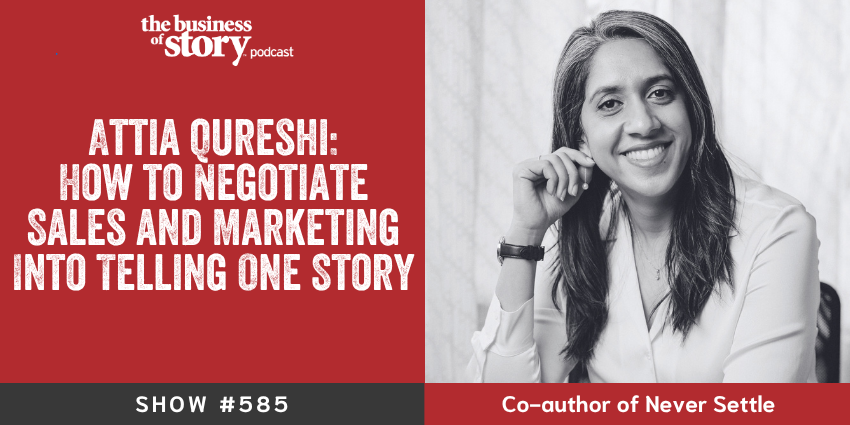
Attia Qureshi was sent to Colombia by the U.S. State Department to negotiate with farmers controlled by a cartel — and she won. If she can do that, she can absolutely teach you how to get sales, marketing, and IT to stop fighting over whose story wins and start building the only one that matters.
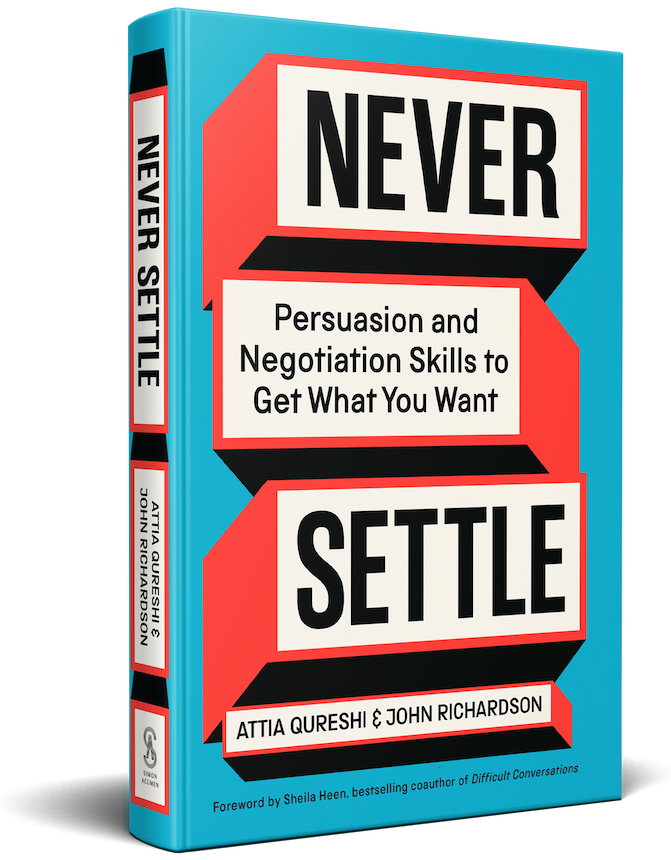
Attia is a negotiation and influence expert, former MIT faculty member, adjunct professor at the University of Michigan, and founder of Attia Qureshi Consulting, where she has spent two decades helping leaders and organizations negotiate better outcomes in every room they walk into. Her work spans Fortune 500 boardrooms, university classrooms, and conflict zones around the world. Her national bestselling book, Never Settle: Persuasion and Negotiation Skills to Get What You Want, earned this from Daniel Pink: “It will train you how to move through the world.”
Today, Attia shows you how relational negotiation is the foundational discipline your StoryOps™ practice has been missing.
What’s in it for You:
- Why your hardest brand storytelling problem is actually a negotiation problem — and what to do about it first
- How to map the interests of every internal stakeholder so you can build genuine cross-departmental buy-in around one sovereign brand narrative
- The reciprocity technique you can use today to repair fractured relationships between sales, marketing, and IT before the next brand meeting blows up
- Why narrative entropy accelerates in the age of AI — and how to use the co-creation of common ground as your StoryOps™ defense
- The three mindset traps that derail your ability to influence your own teams — and how to break out of them
Listen to or Watch on:
Why Sales and Marketing Have Always Fought Over the Story
When I started in the advertising and branding world over 40 years ago, I was shocked that sales and marketing didn’t work hand in glove. Same revenue goal. Completely different stories. Marketing would arrive with a campaign they were convinced would win awards. Sales would greet them with crossed arms because they knew the message would never hold up in the field.
Attia has seen this dynamic in organizations around the world, and her diagnosis is surgical: they are not negotiating. They are each declaring positions, demanding the other side comply, and wondering why nothing changes.
“They’re coming up with their independent solutions,” Attia told me. “Marketing saying this is what’s going to work, sales saying this isn’t going to do the trick — and from the get-go, they’re not trying to take any other considerations into place.”
The fix is not a mandate from the top. It’s not a brand guidelines refresh. It’s negotiation — specifically, what Attia calls interest-based negotiation: sitting the key stakeholders down, mapping what each side actually needs underneath their stated positions, and building the common ground together instead of imposing it from above.
The Curse of Knowledge Is Fragmenting Your Brand
One of the most powerful frameworks Attia introduces in this conversation is what she calls the Curse of Knowledge — and once you hear it, you’ll see it everywhere inside your organization.
Every department has deep expertise in their own domain. IT thinks in systems and code. Marketing thinks in audience psychology. Sales thinks in objections and closes. Each team has developed such specialized knowledge that they’ve forgotten the others don’t share it. They walk into every cross-functional meeting carrying one hundred percent of their department’s context and assume everyone else has it too.
Nobody does.
“When we walk in,” Attia says, “if we can remember they actually don’t have any of this context that we have — can we simplify it and showcase to them what the constraints are and the why behind them? That’s where you start building awareness and understanding.”
This is exactly where narrative entropy begins. Not maliciously. Not lazily. But because nobody has translated the brand story into the language each department actually speaks, given them a stake in it, or created the negotiated common ground that makes it genuinely theirs.
The Three Tools That End the Brand Civil War
Reciprocity. Attia’s most immediately actionable tool costs you nothing. Go get your afternoon coffee and pick one up for the person in the department you’ve been struggling to align with. No agenda. No ask. Just a small gesture that starts the cycle of improving the relationship. Studies confirm this sense of returning a favor is hardwired in us. The relationship always precedes the negotiation.
Interest Mapping. Before your next cross-departmental brand alignment session, spend two minutes writing down your own interests — not your position, your interests. Then spend two more minutes guessing theirs. What is the marketing team actually worried about? What is IT protecting? What does sales need to feel heard? “You have all of these pieces that you can start working with in conversation with them,” Attia says. “And I promise it can take thirty seconds, one minute, and it’ll provide so much more clarity.”
The Listening Session. When fragmentation runs deep, Attia goes in and holds separate listening sessions before bringing the parties together. Each side needs to vent. They need to feel heard about why the other side just doesn’t understand them. Only after that release can you bring them into the same room and ask: what is the common goal we all actually share?
“We do want this to succeed. We do want the organization to succeed. We actually do care that we are cohesive because it’s going to help both of our departments if we’re supporting one another,” Attia said. “When you establish that common goal, then you open up the door to them participating in how to solution around it.”
Why This Is a StoryOps™ Emergency, Not Just a Marketing Problem
Here is what makes this conversation urgent in 2026: AI doesn’t fix fragmentation. It amplifies it.
If marketing is saying one thing in the world and AI bots are scraping that, and sales is saying something completely different, AI search looks at the conflict and flattens your brand into something indistinguishable from your competitors. You don’t just lose alignment. You lose differentiation. You lose search authority. You lose the sovereign story only your brand can tell.
This is narrative entropy — the fragmentation of your brand story accelerated and amplified by AI — and the only governance discipline that stops it is StoryOps™: the practice of developing, operationalizing, and governing your brand narrative across every department in your organization.
Attia’s negotiation framework isn’t a soft skill sitting alongside StoryOps™. It is the engine that makes StoryOps™ work. Because no amount of brand architecture, AI governance, or content infrastructure will hold if the humans inside your organization haven’t been genuinely negotiated into owning the story together.
“You have to have buy-in from the leadership of each department,” Attia told me. “And that leadership has to have the buy-in to push it through their own departments. How do we do this together? Is there a way that we can collaborate effectively so that it meets both sides’ needs?”
That is the question at the heart of every successful StoryOps™ installation I have ever seen.
Where to Find Attia Qureshi and Never Settle
- Attia Qureshi Consulting
- Never Settle: Persuasion and Negotiation Skills to Get What You Want — available at all major retailers
- Free internal influence guide: atiaqureshi.com/story
- Connect with Attia on LinkedIn
You might also enjoy these related Business of Story episodes:
- When Every Person in Your Company Points the Same Direction, That’s Not Culture. That’s Story Governance. — Gavin McMahon on the Arrow of Coherence and why narrative governance is your most critical operating discipline.
- State of Storytelling 2026 Proves Brand Narrative Is Finally a Business Discipline — Elliott Rayner on why 81% of brand touchpoints happen without a shared story and what the rise of the Chief Storytelling Officer means for your organization.
- Because If No One Is Governing It, AI Is Fragmenting It Faster Than You Can Fix It — Rain Bennett on why brand story isn’t a communications deliverable — it’s the operating system your entire business runs on.
Park Howell is Founder of The Business of Story, Creator of the Story Cycle System™, Author of Brand Bewitchery and The Narrative Gym, and Host of the Business of Story Podcast.
Attia Qureshi’s Conversation With Park Howell on The Business of Story Podcast
Park Howell: Hello, Attia, welcome to the show.
Attia Qureshi: Thanks so much for having me. I’m happy to be here.
Park: Well, I’ve got to thank my good friend Scott Waldron, who I met a couple years ago, a leadership coach who really comes from the advertising, branding, marketing world. Great guy. He has a terrific book out. And he sent me a note the other day and said, you’ve got to talk to Attia. She’s got this amazing book out. She’s an amazing negotiator.
And I said, it sounds amazing, but I need to talk about negotiations inside of an organization — to be able to get everybody on the same page with their brand story. And you said yes. So I’m just delighted to have you here.
Attia: I’m excited to be here and to talk about this. Those are one of the most complex negotiations, the internal ones.
Park: Yeah, you know, when you think about it and you’ve done it the world over, we’re gonna hear some of your stories here about negotiation — between world leaders, countries, that kind of thing. And I think people quite often picture negotiation as this big, like, my God, the world’s gonna come apart if we don’t get this right. Versus what are those day-to-day negotiations that we have to do with our colleagues, with our loved ones, with our friends, family members?
So, how did you get into this negotiation world?
Attia: Well, interestingly, I was bullied really severely as a kid. And originally, as a child of immigrants, my parents were really along the lines of don’t rock the boat. So it was a very avoidant negotiation style. You kind of don’t negotiate, you just don’t rock the boat.
And then after I was bullied and had this whole year of heartbreaking loneliness, I developed this really strong exoskeleton around myself — a shell to protect myself. And I decided, not anymore. I kind of flipped to the other side and became more of a conquering style. I stated my demand, refused to budge an inch, and threatened to walk away. That might be what people picture when they think of typical negotiation. Except that is not great on the relationship.
So while I was protecting myself, I was still pretty isolated — until I came across this class in grad school at MIT with my co-author John Richardson. And he said something that pivoted everything for me. He said I could get more tangible value — money, time, energy, resources — by caring about the relationship and what they needed to bring a deal together.
That just flipped everything for me. Because I didn’t have to be that scared little girl inside. I could actually build stronger, lasting relationships and both of us get more value now and in the repeat interactions going forward.
Seeing that, and realizing how many people either avoid negotiation, fear negotiation, think it’s something that they have to hammer down at a conference table and crush the other side — and realizing that it doesn’t have to be that way, that it can really be relational, and it’s us problem solving together and working together to get to a better spot — I pivoted my career and made this my life’s work because it was just so impactful to me. And I want everybody to have more time, resources, energy.
Park: God, I hate bullies. So I can feel your pain. I think we probably all have been on the bullied side of life. I think very few people who are bullies show up in the world the way you and I are showing up here on the show today. But man, I feel your pain. Sorry you had to go through that.
It sounded like you started your negotiation skills more from a defensive posture to get you through those bullying years. And what you learned, it sounds like, is actually there’s an offensive posture to negotiating — and that starts with first really understanding that person you are trying to negotiate with. What is it that they want? Why does that matter to them? You’ve got to understand that first before you can take a position of offense versus defense.
Attia: That’s exactly right. And I would say there’s no single silver bullet in negotiation because every negotiation is different. Every person you’re talking to is different. But I would say one that comes really close is understanding their interests. What do they need?
If you’re thinking about a negotiation as a puzzle, there are a lot of different puzzle pieces. I have some of the pieces. They have some of the pieces. And some other parties may have pieces too that we don’t know about. So if you can assess and try to guess and understand where they’re coming from, you’re so much more likely to be able to effectively influence them because you’re taking an understanding of what they care about.
And don’t we all want our needs met at the end of the day? So the more that you’re able to do that, the more you’re going to get out of the deal too.
Why Understanding the Other Party’s Interests Is the Closest Thing to a Silver Bullet in Negotiation
Park: Did you find that after you had this aha moment, your world and your career in negotiation really took off? Do you have an example of that aha moment?
Attia: Yes. It absolutely impacted my personal and professional life because I think we’re negotiating dozens of times per day. It’s happening with our spouse during the morning when we have childcare and drop off. It’s happening at work with our colleagues and workloads. It’s happening with our neighbors whose music is too loud. So it does impact both personal and professional really heavily.
When I took what we call the offensive, or more of this coach mentality when it comes to influence and negotiation, what I realized when I started my own consulting practice was how much people do want to help you if they like you and are bought into you — because you’ve taken time to understand them and their needs.
One of the first steps when it comes to effective influence is: do you have a good relationship with the other side? Because people can almost always help you. It depends on if they want to. So are they bought into the idea of helping you? Have you established a strong foundation for that?
Park, most of my work comes through referrals. And that’s all about the relationship that I’ve built and then the value I drive. Starting with building that stronger relationship where people do have an affinity toward you — that was a complete tipping moment to making my consulting career a huge success.
Reciprocity and Interest Mapping: Three Negotiation Tools You Can Use to Build Influence Today
Park: So what are two or three things people can be thinking about immediately that they can plug in so that they can be more persuasive and more influential without stepping on toes?
Attia: So let’s start with relationship. Because as you’re thinking about internal negotiations and you’re thinking about your organization and how you want to effectively influence, it’s probably you’re thinking about your team, you’re thinking about your boss and your boss’s boss, and you’re also thinking about the other teams that you have to work with.
We have this idea in negotiation called reciprocity, where I give you something small — I bring you a cup of coffee or a muffin or something that you might appreciate — without any expectation of anything in return, just because I am trying to improve the relationship over time. Studies have shown that this sense of returning a favor is hardwired within us. And it starts this cycle of improving the relationship and people wanting to return that favor to you.
So today you could, when you go get your coffee for the afternoon, pick one up for someone else. Someone that’s working for you, or the person in the marketing department who you haven’t been getting along with lately, and just say, hey, I was grabbing a coffee and I grabbed one for you too. And see what happens. Just notice the effect of it.
Park: How do you do that without feeling creepy or manipulative? Because you are doing it for a purpose. You are trying to maybe repair a relationship or prep a relationship for a negotiation, and there’s manipulation involved in that.
Manipulation vs. Authentic Influence: Where Real Negotiation Power Actually Comes From
Attia: Yeah, it’s interesting. We talk about the difference between manipulation and influence all the time. And there are a couple of ways we think about it.
First, are you doing it authentically to improve the relationship? Do you really care about improving it? People can always smell a quid pro quo. So if I do bring you a cup of coffee and then an hour later make an ask of you, that’s not the same thing. Really, you’re doing this just because improving the relationship is going to be better off for both of us. And down the line, if I do have an ask, it will be helpful.
So that’s first. Your intent matters a lot. We can always smell authenticity or not. And so the intention will really come across.
The second is: if they found out what you were doing, would they be mad about it? If your intent is to improve the relationship and they found out about that, are they going to be upset? I hope not, because really it’s a nice thing to do with your colleagues.
Now, if you are trying to get something from the other person that they don’t want to give, or might harm them or put them in a worse position — that’s what we consider manipulation. And that is what we try to avoid because it’s just going to damage the relationship at the end of the day.
Park: So you’ve got reciprocity. What’s another tool in our toolbox?
Attia: Now we have interests. We have our interests and their interests. So let’s take a moment to think about ours. What I find oftentimes is people think of one thing that they care about. It’s almost a demand or a position. This is what I have to have. This is the behavior that I need to see. And that doesn’t leave any room for influence because it either lets them say yes or no. And that’s not a conversation. It’s either you win or you lose.
So rather, can you take a step back and really think about what are the things you care about right now? I care about having cohesive brand storytelling. I care about the fact that we are, yes, being creative, but we’re doing it in a way that feels authentic to the way our organization runs. I really care that we are able to work collaboratively and come up with that story rather than having disparate ones that are going out there that might be confusing the message.
Those are the interests that are underneath that demand or that position. And the more that we can define those interests and what we care about, the better off we can be in a moment of influence — because rather than it being I win, you lose, or vice versa, it becomes a conversation.
So if you can take two minutes to think about that, it’ll completely pivot the way you’re thinking about what it is that you need. And then spend another two minutes thinking about what they care about — guessing their interests.
Maybe they are stretched really thin. Maybe there were cuts in the department and people have more workload and they want to take shortcuts because it’s so hard to produce as much as the expectation exists. It’s summer. Kids are still not in school. Childcare ends at 3 p.m., which cuts their day even shorter. They’re feeling pressure because of those cuts and they’re fearful of their own jobs.
You can spend two minutes thinking about the things that they care about. And all of a sudden, you have all of these pieces that you can start working with in conversation with them. Thirty seconds, one minute — and it’ll provide so much more clarity on the situation before you even start the conversation.
Negotiating With Cartel-Controlled Farmers: The Colombia State Department Story on Relational Negotiation Under Pressure
Park: Can you give us an example in your own world? Maybe one of your most fraught negotiations where you use this idea of interest to really get two parties to talk to each other.
Attia: Yes. So I was sent to Colombia by the State Department to help negotiate with farmers to move away from growing coca for cocaine production to growing other crops.
So here I am in Colombia as a woman speaking English — and I do speak some Spanish, I had a translator — trying to convince mostly these older Colombian men to stop growing coca, which is very easy to grow. They can grow it on a small plot of land. The cartel comes and picks it up and leaves them cash. So it’s really easy for them. Huge value proposition for them.
Except that every decade or so they’ll go through and gun down an entire village just to prove their point that we’re in charge. So downside as well.
This is a pretty uphill battle because yes, they have that fear, which the cartels want them to have, so they keep growing the coca. And the cartels make it so easy for them to be able to earn income. And pivoting to another crop is really hard. They don’t know how to grow other crops. They don’t know how to get money from those other crops.
First of all, I had to take a moment because in one of these cooperatives I was working with, I suddenly learned early on that the leader of the cooperative was a mid-level cartel boss. And I had to do a lot of internal work in that moment not to freak out and walk away because I didn’t know what was going to happen. How hard could I push? And at what point was it going to become dangerous for me?
So understanding and taking 30 seconds to ground myself and say, hey, I’m here to help these farmers. I care about them being able to have the courage to move away from this and coming up with a plan on how they’re going to do that. They can’t do that without me.
Park: Well, and the intimidation — the pure intimidation’s got to be right at the top of the charts.
Attia: Exactly. Because then your leader is already connected to the cartel. So what happens then? Are you at more risk?
So the first thing I really had to do after I grounded myself and thought about their interests was take a few moments to build some relationship and connection with those farmers — for them to see that I wasn’t there just to tell them what to do, but I really cared about them and where they were coming from. Spending time talking about them, learning their names, knowing about their families, understanding what their goals really were coming together.
And then from there, the mid-level cartel boss kept interrupting the process. And I knew that I had to stand up to him to show the other farmers that if I could do it, they could do it too.
I had my translator. I stood up and I said, hey, we have norms that we’re following here. You are welcome to stay if you are willing to follow those norms. But if you need to keep interrupting, I’m going to have to ask you to leave.
And of course he interrupted again. And I stood up and told him to leave.
As soon as I did that, the entire tone of the room changed with the farmers. There was almost a collective sigh of relief because they realized that they could stand up to him — and they could say, hey, we want to do things a different way and not feel bullied by him.
After that, when I was able to talk with them about their interests and bring out ideas for how they might pivot — they decided oranges — the conversation exploded and they got so much more engaged. They started talking collaboratively about problem solving and how they were going to grow the oranges and get them to market. And at that point I just became a facilitator. I became that coach in their problem solving. But those key pieces up front made a massive difference in being able to do that.
Sales vs. Marketing: How to Use Negotiation Skills to Align Your Organization Around One Brand Story
Park: That is amazing. So let’s talk about maybe a little bit less volatile environment — inside of an enterprise, in an organization.
I’ve been doing a lot of work this year on this concept around StoryOps, meaning developing, defining, operationalizing, and governing your brand narrative across the enterprise with every team, with every person — so that everybody is on the same page with the story about the organization.
One of my recent guests talked about this idea of an arrow of coherence — I really like that. But how to make a story consistent, coherent, clear, and compelling. And you’ve got to make it so that everybody is telling the same one.
Let me preface that by saying I’ve been in the advertising branding world for over 40 years. And when I was coming into it as a writer, I was shocked that sales and marketing didn’t work hand in glove. I was shocked that they actually kind of worked against each other. Because I’m like, well, you’ve got the same goal — revenue development. So why are you not saying the same things?
We would often come in through the marketing side of an enterprise and then meet the sales team. And it was always this derisive relationship. They would greet us with closed arms because marketing brought us in. And therefore we must be an ally of marketing. Screw you, sales, just do what we say. And that has always blown my mind.
So let’s take on that challenge. If you are either in sales and or marketing and you are trying to bring these teams together so they are telling a coherent, consistent, and clear message so that everybody benefits — how do you do that?
Attia: So let me ask you a question, Park. When that contention comes up, where do you see it coming from? Why does it exist?
Park: Boy, that’s a great question. My first reaction was it all came down to ego and ownership. Marketing came up with this great, beautiful, wonderful campaign. Isn’t it so cool, we’re gonna win a lot of awards. Sales — and by the way, from an agency standpoint we’d always feel the same way — sales would say, that’s all well and good, but everything you’re saying there is not going to work out in the field. Here’s what we actually have to be saying.
So to me, I would say number one, it’s ego and ownership.
Attia: Interesting. So right there you have some of the pieces of the puzzle where marketing comes up with this beautiful idea that they believe is going to win awards, and sales is like, hey, this is great, but this isn’t going to do the trick. And what I find really interesting there is that they’re not collaborating at all. They’re coming up with their independent solutions.
So from the get-go, they’re not trying to take any other considerations into place. And so when I look at organizations that are trying to adopt something cohesively across the board, that requires a ton of buy-in. You have to have buy-in from the leadership of each department. And then that leadership has to have the buy-in to push it through their own departments.
So the first thing would be to sit those key people down — the people who are going to influence the rest of the organization — and ask: how do we do this together? You have the sales perspective, you have the marketing perspective. This is where we’re trying to go. Is there a way that we can collaborate effectively on this so that it meets both sides’ needs?
And that’s really how I start — by understanding those needs and bringing people together around them. Because at the end of the day, when you pull those needs together from both sides, you’re going to come up with an even better solution that drives that buy-in rather than working in individual lanes.
Park: So you’ve got to really find that common ground, correct?
Attia: Yes, but you kind of have to find it together — and that’s the challenge. It’s making the two parties work together and come up with that common ground together, because they’re both going to have their own set of ideas on how we’re going to win, how we are going to be successful in this space.
Sometimes what I do is I go in and have listening sessions so that people can vent at first. I would sit down with marketing, I would sit down with the sales department separately, and just let them share with me what’s going on. What are the issues here? And usually they just need to release all of the anger and frustration about how the other side just doesn’t understand them.
After that, once that’s released, then we can bring those two together and say, hey, here’s what I heard that fundamentally we all want. What’s our common goal?
We do want this to succeed. We do want the organization to succeed. We actually do care that we are cohesive because it’s going to help both of our departments if we’re supporting one another. And when you establish that common goal, then you open up the door to them participating in how to solution around that common goal.
You really highlight the ideas that are positive and support both sides. And promote this idea of, hey, as we are talking about this, it’s really blue sky — your ideas support mine, my ideas support yours. It becomes more of a fun thought experiment together. And that sets the tone for building that common ground and coming together around how we have that cohesive story.
Park: So it’s the co-creation of common ground. No kidding. And a lot of people might be watching and listening to this saying, well, yeah, of course, I get that. But it’s just always the way we’ve done it.
And I think it’s probably important to underscore the importance of getting that coherent story now because of AI. If marketing is saying one thing out in the world and AI bots are picking up on that, and sales is saying something completely different out in the world, AI search looks at that and now has this confusing signal coming in that it doesn’t quite understand — and it flattens the brand and kind of makes up a story on your own behalf.
And you start really losing your differentiation in the market. Even your search is going to take a major hit when you do that. So this is why it’s so important to first get your entire team internally bought into the same narrative, so that externally you have consistency across the board.
The Curse of Knowledge: Why IT and Marketing Speak Different Languages — and How Negotiation Bridges the Gap
Park: So let’s now jump from sales and marketing to maybe a department that’s completely different. You’re going to go into IT. And you’ve got marketing. And IT is telling marketing, it’s about the widget. It’s about the features, the function. Our code is incredible. We’ve developed this wonderful stuff. Just show them that and they will naturally say this must be a superior product and therefore we buy in — which of course negates one of our rules of brand storytelling. Your story is not about what you make, but what you make happen in your audience’s life. So how do you go in and get those two very disparate lines of thinking working together?
Attia: Man, you’re really hitting on the key departments that I’ve seen. Technology and IT really — they almost speak a separate language because their language is code. And so building beautiful code in a system that works is not necessarily the same thing as meeting your users’ needs. And so that disconnect — because that’s what marketing’s trying to do, meet the user’s needs — IT wants to do that, but they think about it in a purely systematic, functional way.
I think again, in that instance, what you’re trying to do is decode what’s happening. You almost need a translator in the middle who helps IT see where the pain points are coming from, and helps marketing see what IT’s pain points might be as well.
Because when we come up with these ideas, we have a way of functioning that works within our system. So IT is really thinking about working within their system with their developers. Marketing’s doing the same thing. And so when you’re bringing those departments together — what are IT’s constraints? Does marketing understand that? And then does IT also understand marketing’s constraints?
We often forget the why. There’s this idea called the curse of knowledge, where we have so much information, we have so much awareness of our department and our specialty that we forget other people have no idea. They have 1% of the 100% that we have. So when we walk in, if we can remember they actually don’t have any of this context — can we simplify it and showcase to them what the constraints are and the why behind them? That’s where you start building awareness and understanding.
Because you want IT to have empathy for the marketing perspective. And you also want marketing to have empathy for the IT perspective. The only way to do that is to share those constraints and the why behind them.
And really, if you can facilitate a conversation around that — and they start asking each other questions — you’re golden. Once they start asking each other questions about, hey, how would this work for you? Or what about this process? — and you’re collaborating together around how IT can build something that actually meets the user’s needs rather than building something static that they think will do it — that’s where the co-collaboration meets those needs.
The problem I see with actual implementation is people realize it takes time. It takes time, it takes energy, it takes resources. And at the end of the day, IT is thinking, I should just be spending this time coding. And marketing’s thinking, I should just be spending time doing more user research. Except that the time that you spend together collaborating is what pulls those pieces together.
And even if you spend a few hours up front doing that work, I promise you it will save you dozens of hours on the back end trying to fix things because people worked in silos rather than together.
People Pleasing, Overconfidence, and Other Negotiation Mindset Traps That Destroy Brand Story Alignment
Park: What are the things that we do in the way of our thinking, our mindset, and or our behaviors that derail our ability to negotiate with another person, another team, another country?
Attia: There are so many. The first is our mindset. We walk into work every day probably with a slightly different mindset. Am I having a harder day? Am I having a better day? And then not only the type of day you’re starting with, but also how do I feel about the other team that I’m working with? That goes back to the relationship building piece. The way we feel about the relationship is going to impact how willing we are to actually work with them.
If you feel like there’s a negative relationship, that whole tone is going to be part of every interaction that you have. And so we have to co-manage those feelings and figure out how do we change the dynamic and change the tone.
I have walked in and had poor relationships where I think the other party just doesn’t respect me, doesn’t treat me well, doesn’t listen to what I have to say. And I have to say, hey, I have to change my mentality first before I can get them to listen to me. I’m the one who has to make the first move, which can be a bitter pill to swallow.
Park: Yeah, playing against your ego. Because I want this. By golly, it’s the best way forward. I’m going to push, push, push. And what you have to do is pull back and just kind of let things unfold.
Attia: Exactly. And then also the second piece is assuming that you have all the answers. Influence is never one-sided. You’re not just influencing yourself and your bubble. It is always with another person. That means you only have half the story. So if you assume you have the whole story, you’re really doing yourself a disservice because there’s another person involved — or multiple other people. And you need to understand their stories, their puzzle pieces to be able to effectively influence the situation.
Park: And one more. What’s one more thing that we do to self-destruct in negotiation?
Attia: I think there are a lot of people pleasers. A lot of us are people pleasers. And rather than knowing where we want to go in a negotiation and staying strong with it, if we give up and give in because we want to be that people pleaser, it really has significant downstream impact.
I had a client I was coaching — massive people pleaser. Yes to everything at home, yes to everything at work, yes to everything in the community. Six months later, he is just absolutely crushed. And people are mad at him and people are upset and frustrated and angry. He’s burned out and just devastated because after a while, there’s a massive consequence to being a people pleaser because you can’t do everything. And it impacts the work quality, it impacts the relationships, and it impacts your own mental health.
So not standing firm — and the inability to say no — is another really big way we can self-destruct.
Never Settle by Attia Qureshi: A Relational Negotiation Framework Built for the Real World
Park: So you co-wrote your new book. Did you have to negotiate with your co-author?
Attia: Every day. Every day we were negotiating. And luckily we’re both in the field and we know how to do it. Even though we’re both in the field, sometimes it would get really contentious. But at the end of the day, using our own techniques, we muddled our way through it.
Which stories do we want to tell? How much do we want to talk about? My co-author loves talking about ants and this idea of ants being friend or foe. And I was like, John, we cannot talk about ants for five pages in this book. And we had a whole negotiation about that. So yes, it was pretty constant, but we worked through it really well and I’m so glad we wrote it together.
Park: So there are a lot of books out there on negotiations. What makes yours different? What is it delivering today that others are not?
Attia: There is amazing negotiation content out there. But what John and I saw after teaching at Harvard, MIT, University of Michigan, was we didn’t see the behavioral change. We didn’t see people becoming better negotiators because there is no connection between the theory and action.
So our book really gives people these little exercises like the ones I’ve talked about today. You do it in 30 seconds and you practice. And every day, if you can spend 30 seconds practicing, that’s what actually makes you a better negotiator.
The book tells stories and gives exercises on how to actually become that better negotiator rather than just the theory — because it’s behavioral change. Negotiation is a performance skill, like being an athlete or a musician. They practice one single stroke over and over again until they perfect it. Negotiation’s the same way. We’re not born perfect negotiators. We have to evolve and grow into that. And so we give you the tools to do that.
What the Brand Story Genie™ Assessment Revealed — and Why StoryOps Starts With Negotiation
Park: So, Attia, you’ve got your consulting service, you go in and work as a negotiator, but you also teach negotiation skills to people. And of course, like we do with all of our guests, we ran your brand through the Story Cycle Genie just by simply going to your website — gave us a brand assessment and then about a thirteen-page report on your current narrative strategy. I sent it to you. What did you think of the output?
Attia: I thought the output was amazing. I thought it was so fascinating to be able to have a snapshot into my brand that I didn’t have to create or co-create. Because when you’ve done branding work before, there’s so much input from me that I almost get lost in what the output is. This was fantastic.
All of a sudden the information was just laid out based on an assessment. And really powerful — to understand first the way that you framed how I am a softer side to a lot of the negotiation space. A lot of people in the negotiation space are older men and I come at it from a different angle. Recognizing that and just having that identified for me — hugely impactful.
And yes, it’s obvious, except that sometimes you have to make the obvious written down in black and white to remind you of that value. And it’s like, yeah, this is the area that I really can excel at. I can bring a softer version of it that’s more accessible, more not so theory-based, but rather more practice and exercise and application based.
Park: Yeah — a kinder, friendlier application of negotiation. Because so many people think negotiating is a zero-sum game. I’ve got to be on my game, I’ve got to have an edge, and damn it, I’m going to get my way. When it’s really not that at all, mostly.
Attia: Exactly. And I loved how simplified it was. You can get so complicated. It really simplified that message and made it very concrete. For me, it’s like, yeah, I can keep hammering on this piece.
Park: Did it reveal any gaps in how you were telling your story?
Attia: Yes, that’s exactly what I was about to say. So my husband is a cherry and apple farmer and we live in northern Michigan. And it did reveal that there’s an opportunity to highlight that more because it is so unique. But I didn’t realize how compelling that might be to people because it’s my daily life. I live it and it’s just a section of my life that I don’t always bring into my work. But there’s an opportunity there that it highlighted that might be really interesting and compelling to people.
Park: Yeah. Well, and I think in the notes you sent over to me you said the one thing you can’t negotiate with is the weather.
Attia: Yeah, exactly. You really can’t.
Park: And so it revealed a gap — and it sounds like it inspired you on some new ways to tell your story, some nuances that could have a really big impact for you.
Attia: Exactly. And it also helped me with the through line — what’s the through line to all the messaging that I have and all the communication I put out there? Because I don’t want to flip to that harder, more aggressive side. The through line is that it’s relational and it’s softer, and that we can build this skill over time. Having those few concrete pieces in front of me — kind of like you were talking about, where the arrows are all pointing in the same direction — it helps me with that directionality and really focuses me there.
Park: Do you see the Story Cycle Genie, the tool itself, as being kind of a negotiation tool?
Attia: I think it is a really impactful tool for negotiation. It reminds me of how when I’m brought into an organization, I’m a third party that is neutral. So people don’t have to fight me. They feel like they’re fighting each other, but I’m neutral. So they can be a little bit more open with me, trusting.
What your tool is doing is being more of that third party for the organization to gain buy-in around. So it’s not marketing bringing the idea, or sales bringing the idea, or even IT bringing the idea. It’s making it so that everyone can get buy-in around this expertise that has run this massive assessment and has come back with a really detailed and smart framework to follow. And so it takes away all the argument and pain points around it and builds that cohesiveness, which is influence, exactly like you said.
Park: Well, and also they can work with it of course to develop their content, develop their strategy. While it’s not going to write everything for you — nor do I want it to, I want you to collaborate with it — it is going to bring the positioning, the tone, the feel, even those signed-off messages that sales and marketing have agreed on, that’s in there. So that you are continuing to speak from a very clear, consistent, coherent position.
Attia: Amazing. That’s just a very powerful tool.
Park: It’s fun. Well, thank you so much for being here. Where can people learn more about you?
Attia: Yes, everything is accessible on my website, atiaqureshi.com. You can find info on the book there, but the book’s also available at all major retailers.
And then I created a special guide for your listeners — to be able to take all these ideas, I encapsulated them into a guide of how you can move with that internal influence for things that you need to get done within your organization. It’s just atiaqureshi.com/story.
Park: So your website slash story — we will have that in the show notes. I downloaded that over the weekend actually, Attia, and started going through it. It’s really cool. Thank you for making that available.
And thank you again so much for showing up. Thank you, Scott Waldron, if you’re listening out there, for making this introduction. It’s just been a fantastic show and I appreciate it.
Attia: I appreciate you. Thank you so much for having me.
Frequently Asked Questions About Relational Negotiation, StoryOps, and Brand Story Alignment
Q: What is relational negotiation and how is it different from avoidant or conquering negotiation styles?
A: Relational negotiation is an approach that prioritizes the long-term health of a relationship over winning any single interaction. Unlike the avoidant style — where people sidestep conflict entirely — or the conquering style — where the goal is domination — relational negotiation seeks durable agreements built on mutual understanding and shared interests. Attia Qureshi, negotiation expert and author of Never Settle, teaches that most professional environments, especially in sales, marketing, and cross-functional teams, require relational negotiation as the default mode. It treats every conversation as a deposit into a relationship account rather than a zero-sum transaction. For brand storytelling and organizational alignment, relational negotiation is not optional — it is the governing discipline.
Q: How can reciprocity be used as a daily negotiation and influence-building tool?
A: Reciprocity is the social norm that compels people to return favors, information, and goodwill — and it is one of the most accessible influence tools available to anyone in a professional setting. Rather than saving reciprocity for high-stakes negotiations, Attia Qureshi recommends treating it as a daily relationship-building practice: sharing a useful article, making an introduction, or acknowledging a colleague’s work before you need anything in return. This consistent investment creates a relational bank account that makes future persuasion, alignment, and brand storytelling conversations far easier to open. In the context of sales and marketing alignment, teams that practice reciprocity across departments reduce the friction that causes narrative entropy. The key is that reciprocity must be genuine — transactional generosity is quickly recognized and rejected.
Q: What is interest mapping and why is it more effective than positional bargaining?
A: Interest mapping is the negotiation practice of identifying why someone holds a position rather than fighting over what that position is. Positional bargaining — the “I want X, you want Y” standoff — tends to produce compromises that leave both parties partially dissatisfied and no closer to understanding each other. Interest mapping asks deeper questions: What outcomes does this person need? What fears are driving their stance? What would success look like for them? Attia Qureshi argues that understanding the other party’s interests is the single closest thing to a silver bullet in negotiation, whether you are closing a sales deal, aligning a marketing team around a brand narrative, or getting IT to speak the same language as a content strategist. For brand storytelling, interest mapping is the discipline that reveals what each stakeholder group actually needs from the brand story before anyone argues about messaging.
Q: What is the difference between manipulation and authentic influence in negotiation?
A: The line between manipulation and authentic influence comes down to intent and transparency. Manipulation uses psychological tactics — false urgency, selective framing, exploiting cognitive biases — to move someone toward an outcome that serves only the manipulator, often without the other party’s full awareness. Authentic influence, by contrast, works with the other party’s genuine interests: it is persuasion that would survive full disclosure. Attia Qureshi teaches that the most durable influence is the kind where the other person, even knowing every tactic you used, would still feel the outcome was fair. For brand storytelling and StoryOps, this distinction matters enormously: when sales, marketing, and leadership use authentic influence to negotiate a shared brand narrative, the story holds. When teams manipulate each other into compliance, the brand narrative fractures the moment pressure is applied.
Q: How can sales and marketing teams use negotiation to align around one brand story?
A: Sales and marketing misalignment around brand narrative is one of the most common and costly problems in organizational communication — and it is fundamentally a negotiation problem, not a messaging problem. The solution begins with interest mapping: rather than debating which team’s version of the brand story is “right,” both functions need to surface what outcomes they are each accountable for and what they need a shared brand narrative to accomplish. Park Howell and Attia Qureshi explore this on the Business of Story podcast, framing StoryOps — the governance of brand storytelling across departments — as a relational negotiation discipline. When sales and marketing co-create common ground through structured dialogue rather than top-down mandates, the resulting brand story is one both teams will defend and amplify. AI tools then accelerate a unified narrative rather than fragmenting competing ones.
Q: What is the curse of knowledge and how does it create communication breakdown between departments like IT and marketing?
A: The curse of knowledge is a cognitive bias in which experts unconsciously assume that others share their specialized vocabulary, mental models, and context — making communication opaque to anyone outside their domain. In organizational settings, this is particularly destructive at the intersection of technical departments like IT and creative departments like marketing: each team speaks a precise internal language that sounds like noise to the other. Attia Qureshi identifies this as a negotiation challenge because the first step to bridging a language gap is recognizing that your counterpart is not being difficult — they are operating from a completely different knowledge baseline. For brand storytelling, the curse of knowledge is a primary driver of narrative entropy: when departments cannot translate their work into a shared brand language, they default to their own stories, and the sovereign brand narrative dissolves. StoryOps addresses this by establishing a common narrative vocabulary across all functions.
Q: Why is people pleasing a self-destructive behavior in negotiation and brand storytelling alignment?
A: People pleasing feels cooperative but functions as a form of negotiation avoidance — prioritizing short-term social comfort over honest, interest-based dialogue. When individuals in sales, marketing, or leadership default to agreeing rather than advocating for a clear brand position, they create the illusion of alignment while actually deepening ambiguity. Attia Qureshi frames people pleasing as one of the most common and underrecognized mindset traps in professional negotiation: it is a behavior that signals relational risk-aversion, not generosity. In brand storytelling contexts, people-pleasing culture produces brand narratives built on lowest-common-denominator consensus rather than strategic clarity. The antidote is not aggression but rather the relational negotiation skills to disagree productively — to surface conflict early, map interests honestly, and reach agreements that are durable because they are real.
Q: What is StoryOps and how does it prevent AI from amplifying narrative fragmentation across an organization?
A: StoryOps is the governance discipline — championed by Park Howell and the Business of Story — that treats brand storytelling as an operational system requiring the same intentional management as any other critical business function. Without StoryOps, every department, channel, and AI tool generates its own version of the brand story, producing what Park Howell calls narrative entropy: the gradual dissolution of a coherent brand identity under the weight of competing micro-narratives. As AI content tools accelerate production velocity, they also accelerate fragmentation — an unaligned organization that adopts generative AI at scale will produce more off-brand content faster than ever before. StoryOps prevents this by establishing a sovereign brand narrative — one agreed-upon, negotiated, interest-mapped story — that serves as the governance layer for all content, communications, and AI-assisted production. Attia Qureshi’s work on relational negotiation is the missing discipline that makes StoryOps achievable, because before you can govern a brand story, you have to negotiate it.
 Listen To More Episodes