How to Operationalize Your Brand Story Before Narrative Entropy Kills Your Competitive Edge
Find, Define, and Get Your People Behind Your Brand Story Before AI Decays It
You want your brand story to drive real business results — define it, refine it, get every soul behind it — and you will create a competitive advantage nobody can take from you.
But most brands only reach the false summit. They do the deep work of crystallizing their brand story, get everyone excited, and look up to discover they’re staring at an even bigger mountain: operationalizing that story across every department, every channel, every new hire, every AI tool running at machine speed in public.
The most urgent discipline in your organization right now is the architecture that governs your brand story before narrative entropy quietly unravels everything you’ve built.
That’s exactly what this conversation is about — and why it exists at all.
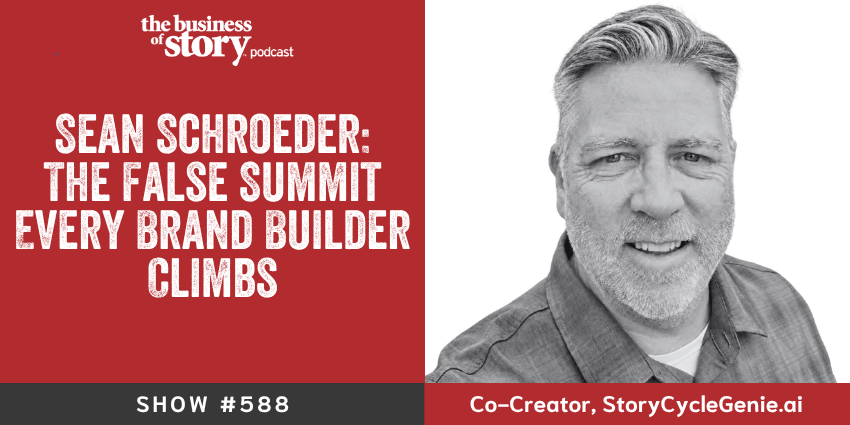
Meet Sean Schroeder: The Architect Who Turned a Brand Story Crisis Into a Platform
Sean Schroeder is the co-creator of the StoryCycle Genie® and the architect of the Cognitive Mesh Architecture that powers it.
Before building the platform that would change how brands operationalize their stories, Sean was the co-founder of Blueriver, a custom software development agency whose clients included Apple, NASA, the U.S. Senate, CSX, and NATO. He was simultaneously building Mura, a SaaS content experience platform. He and his partners sold both companies before COVID.
What he carried out of that experience wasn’t just the exits. It was the hard-won knowledge of what it actually costs to operationalize a brand story inside a real organization — and what it costs when you can’t.
That experience is the origin story of the StoryCycle Genie®. And it’s the most honest account you’ll hear this year of why generic AI makes narrative entropy worse, not better.
What’s in it for You
- Why defining your brand story is the false summit — and what the real Everest actually looks like
- What narrative entropy is, why it accelerates with AI, and the one discipline that stops it
- How the StoryCycle Genie® compresses months of brand story operationalization into weeks
- Why generic AI produces statistically average brand voice — and what governed AI does instead
- What Cognitive Mesh Architecture is and how it captures professional intelligence and decision-making lineage across your organization
- How StoryOps™ governs brand story across HR, DevOps, FinOps, sales, and customer service — not just marketing
- How the Brightsy platform’s MCP server delivers your governed brand story to every team member through the tools they already use
- The origin story of why Park said no to Sean’s idea — and why ChatGPT changed everything
Listen and Watch
From Blueprint to False Summit: The Story Behind the Platform
In 2017, Sean flew to Phoenix and spent several days in Park’s conference room working through the Story Cycle System™ for his two companies. Blue River and Mira were pulling in opposite directions — an agency model built on billing hours, a SaaS platform built on scaling value — and the strain on internal alignment was real. Three other agencies had tried to bridge the gap with surface-level brand exercises: what car are you, what dog breed, what news channel. Sean found all of it hollow.
The Story Cycle System produced something different. A governing concept — flow, in the Csikszentmihalyi sense — that was authentic to the organization, instantly recognizable to its people, and deep enough to inform software design, customer experience, project management, and recruiting. When Sean asked his team on Slack if they’d ever experienced flow, every response came back thoughtful and specific. Nobody needed it explained.
He built a massive pitch deck to bring his skeptical business partners on board, mapping flow against every function in the business. They reluctantly agreed. The story was real.
And then he looked up.
What Is Narrative Entropy — and Why Every Organization Has It
“It’s kind of like when you climb a hill,” Sean said, “and you get to the top and you’re like, cool, there’s the top. And once you get there, you realize that was just the first hill. There’s an even bigger climb behind it. That’s kind of when I realized operationalizing a brand story was no joke.”
Operationalizing, Sean explains, is not a marketing function. It’s a business communications discipline. It means your brand story shows up in the words on your website, in how you onboard new employees, in how your sales team frames the work, in how your project managers run a client engagement. Every single slice.
Without that discipline, narrative entropy sets in. Park defines it plainly: without governed infrastructure across every operating unit — marketing, sales, HR, DevOps, FinOps — every department starts writing their own version of the brand story from lived experience. What feels like brand alignment from the inside is quietly fragmenting from the outside.
“Next thing you know,” Sean said, “you’ve got an SDR or a salesperson or someone else writing from their perspective about what they think is the brand story — not necessarily what it is at the nexus.”
Blue River and Mira were sold before Sean could complete the operationalization. The flow dream, he said with a laugh, died at the exit.
Why Generic AI Makes This Problem Worse
A few years after the exits, Sean was consulting for a friend who had just taken over as CEO. Solid vision, smart team, consultants running social, content, and ad buying — but no coherent thread running through any of it. The website told a completely different story than the business. Sean’s instinct was to go back to the Story Cycle System. He did. It worked.
But it took months and enormous time from a new CEO who could not afford to give it.
That’s when Sean came to Park with an idea: use AI to compress the brand story creation and operationalization process. Park’s answer, by his own admission, was no. Then ChatGPT launched. Park called Sean back.
The question that drives the entire platform is the one Park gets most often: can’t anybody just do this on Claude or ChatGPT? Sean’s answer is unambiguous.
“Yes, sure, you can create a brand story, and it will average out every single thing it knows into your thing. But it doesn’t have a specific perspective. If you want professionally discerned output, it has to be guided and done by someone who actually knows that topic deeply. And if you don’t know what good looks like, how can you possibly judge whether what you got is good or not?”
Generic AI has no point of view. It produces the statistical median of your category. And without the Story Cycle System governing it, it scales that mediocrity — and your narrative entropy — at machine speed.
What Is Cognitive Mesh Architecture?
What makes the StoryCycle Genie® fundamentally different from a generic AI writing tool is the architecture Sean built underneath it.
From the earliest iterations, Sean noticed how much professional intelligence was at risk of being lost — the reasoning behind decisions, the lineage of why a piece of content said what it said, the institutional knowledge that lives inside people and rarely makes it into documentation.
Cognitive Mesh Architecture is the system that captures all of it. When a blog post or a product page is created through the platform, it carries the lineage of every upstream decision that shaped it: the audience story, the content playbook, the messaging pillar, the human judgment applied at each step. That provenance is what makes AI-generated brand assets coherent over time rather than increasingly generic.
“It’s an intelligence ecosystem,” Sean said. “You’re capturing all these different people’s thoughts and opinions and judgment — what’s good and what’s not good — so that eventually you’re building what Park calls a Brand Brain. It’s a mesh of all these different pieces, connected in ways that aren’t necessarily linear, that you can tap into.”
The Brightsy platform adds the final layer: an MCP server that connects individual team members — using whatever AI tools they already work in, whether Claude, ChatGPT, or anything else — directly to that shared Brand Brain. What one person produces on their laptop in a home office 300 miles away draws from the same governed story as everyone else in the organization.
That is how you fight narrative entropy. That is how you build StoryOps™.
Start Here
Run your brand through the free 14-point Brand Story Grader at storycyclegenie.ai. Enter your URL and get your letter grade in under a minute — what you’re doing well, where the gaps are, and where to start.
If you’re ready to stop narrative entropy and start operationalizing your story across the enterprise, the StoryCycle Genie® is built for exactly that.
Links for More
- StoryCycle Genie®
- Free Brand Story Grader
- Sean Schroeder on LinkedIn
- Brand StoryOps™ for Agencies LinkedIn Newsletter
- Brightsy Platform
- Park Howell’s Brand Bewitchery
- The Narrative Gym for Business by Park Howell and Randy Olson
- The Story Cycle System™
Three Related Episodes Worth Your Time
- State of Storytelling 2026 Proves Brand Narrative Is Finally a Business Discipline, With Elliott Rayner — Elliott’s landmark research reveals that only 19% of employees can consistently articulate their company’s brand story, and why the world’s most sophisticated organizations are now paying up to half a million dollars a year to govern it.
- The Most Urgent Upgrade of the AI Age Is Personal, Not Technological, With Brett Hurt — Serial entrepreneur and investor behind 12 unicorns makes the case that AI’s greatest threat is not technological disruption but the human blind spots it amplifies at scale.
- You Built It for Freedom. So Why Does It Feel Like a Prison? With Jason Swenk — The 5-stage founder evolution framework that reveals exactly what stage your identity is at — and why operationalizing your business is the only exit from the trap.
Sean Schroeder, Co-Creator of the StoryCycle Genie®, in Conversation With Park Howell on The Business of Story Podcast
How the StoryCycle Genie® Was Born: The Origin Story of AI-Powered Brand Story Operationalization
Park Howell: All right, Sean, you came to me about three years ago with the bright idea of operationalizing the Story Cycle System using artificial intelligence.
The main reason you did that is because several years earlier you had gone through the Story Cycle System with me the old-fashioned way — without AI. We took a few months to pull together the brand story for your digital agency in Sacramento called Blue River, and the brand story for your Mira Experience SaaS platform, and brought them both together.
So you had one story that they could both play off of in their own unique way. You loved how it all came together. But the biggest challenge you told me you had was operationalizing it.
It’s one thing to go through the energy and effort and resources to define and refine a clear brand story. It’s a whole other journey to actually operationalize it internally and externally. And then you came to me and said, I think there’s a better way of doing this using AI. After three years, we’ve proven that there is — with the StoryCycle Genie platform.
What I’d love to hear is your whole experience: first with the Story Cycle System, then trying to operationalize your own story, and where it has evolved as our origin story for the StoryCycle Genie.
Why Defining an Authentic Brand Story Is a Heavy Lift — Especially for Established Companies
Sean Schroeder: Yeah, so I would be remiss if we didn’t talk about my experience with the Story Cycle System and working with you — which I obviously thought was very worthwhile, because we’re still here talking about the same thing.
That was a pretty big lift, especially for a small agency with a platform we were also supporting. The process itself took me off other things for periods of time. It took a lot of deep thinking — going through the process of trying to figure out who you are as a brand. It can be really hard to pull those things out, especially when you’ve been around for fourteen years. There was a lot baked into the cake that we didn’t even know how to communicate.
Having worked with a few agencies before was a challenge, because they were suggesting things like: figure out what car brand you are, or what news channel you are, or whatever. Which is essentially just appropriating someone else’s brand story. We found that very unfulfilling.
That’s kind of where we landed with you, and where I felt like we got a ton of value — because we really had to dig deep to uncover the details that make a brand story authentic and true and real.
What Blue River and Mira Actually Did — and Why Two Business Models Created One Brand Story Crisis
Park: Can you quickly describe your agency, Blue River, the kinds of clients you had and what you did, and your SaaS product, the Mira Content Experience platform?
Sean: Certainly. We did a lot of custom application development based on our platform for enterprise clients — the US Senate, Apple, CSX, NATO, NASA. Very specific custom application development for very specific use cases within certain organizations.
The challenge was that we also had a platform we were taking to market. The agency model is: bill as much as you can, bill as many hours as possible. With a SaaS platform, we’re trying to go the opposite direction — deliver as much value as we can at a fair price point where you’re not selling an hour over and over again. We’re trying to scale.
So these two things were pulling in opposite directions. It was becoming very clear that the alignment of the business was being strained. I had three other business partners. Two of us working on the product, two on the agency side — and we all had to dip our toes in both ponds from time to time, because as business owners you just have to.
Park: And when you say the agency side, you’re not talking about an ad agency. Yours was an agency building custom applications for very large brands, right?
Sean: Yeah, exactly. It was a software development agency. Because of that, our internal communications were challenging. We had essentially two different stories we were telling to our employees and two different stories we were telling to our customers.
At the same time, we realized that what we were doing on both ends really did share a very specific point of view and philosophy — but it was very hard to articulate. Once we started working with you, that helped us define what that was, and created that middle ground and that brand story that connected everything together. Suddenly everything became very, very clear.
It made so much sense to me that I figured out how to apply it to every single slice of the business. I created a massive pitch deck I had to use to get my business partners on board, because they were very skeptical. Having gone through this process with three other agencies, they did not believe it was possible to end up with anything meaningful.
So I took it to the extreme. I showed how we could use our brand story across all these applications — from how we talked about software development, to how we actually informed software development, to how we handled customer service, to how we handled project management. It really did infuse every single aspect of our business.
It became something that not only the owners believed in and were actively focused on living into — but our employees were as well. They loved it. It became an easy way to measure things against. Our brand story revolved around the concept of flow.
How “Flow” Became Blue River’s Brand Story — and Why It Resonated Instantly
Sean: It was kind of an unfortunate coincidence in our case that we happened to call the company Blue River — because it seemed too obvious to my business partners. They immediately thought it was dumb.
Park: But you’re talking about a much deeper concept of flow — the one popularized by Mihail Csikszentmihalyi — all around that sense of flow you get when you find your zone of genius. You’re challenged to a certain point that really tests your expertise, but not so over-challenging that you can’t accomplish things along the way.
Sean: Yeah, exactly right. So trying to live into that. Our employees very much embraced it. We were looking at how we design applications, how we manage a process, how we interact with customers — what are the elements that have to exist to create flow for someone?
We started measuring against those. Those became actual KPIs for how we create experiences across all these different dimensions. We took a very software, very engineering approach to implementing flow. We broke out a framework and got very mechanical about it.
But it was great — it made it very easy to look at it as a framework rather than as a concept, which can be very hard to put your finger on.
Park: So first and foremost, it’s the flow individuals experience by working with you as a colleague or as a customer. From a recruiting and talent retention standpoint, flow is about: if you want to build state-of-the-art software in an environment that aspires to bring you flow in your creation and your career, this is where you do it.
You start at the most basal human level — how do you insert flow into the organization? And then it even informed how you built software and how software would interact with its customers.
Sean: And one of the things that made it so compelling — one of the first things I did after you floated this idea past me was ask all of our employees on Slack: hey, have you ever experienced flow? What does that mean to you?
They all came back with very, very thoughtful responses. It kind of blew me away how much they just tapped into that. I wasn’t trying to lead the witness — I was just trying to see if people would even know what it meant, or if I’d have to explain it over and over again. Because that’s where we were — having to explain things a lot, or even worse, explain what things weren’t in order to help contextualize them. Which is a horrible place to be.
Park: This was back in 2017. You came down to Phoenix and we hammered this out in our conference room at Park and Co. on a very hot June day. When I first presented the idea of flow, I think you were even a little skeptical at first. And then I showed you Csikszentmihalyi’s work and said, no, this is what it actually means.
I hadn’t even connected it to the name Blue River at that point. That was just a happy accident. But I remember you were like, Really, Park? Is this really a thing? Are you kind of making this up? And that’s when I said, go do an exercise — ask your team how they’ve experienced flow. Let’s see if this is already happening in your organization.
Sean: Or an unhappy accident in my case.
The False Summit of Brand Storytelling: Why Operationalizing Your Brand Story Is the Real Everest
Sean: The challenge was — it’s kind of like when you’re climbing a hill. You get to the top and you’re like, cool, there’s the top. I’m gonna get there. And once you get there, you realize: my gosh, that was just the first hill. I couldn’t see the other hill behind it. And now I have an even bigger climb.
That’s kind of when I realized that operationalizing a brand story was no joke. It became a much bigger deal. Not impossible — certainly not. We just didn’t have the resources to put a whole team on it, no communications department or anything like that. So it was challenging from that perspective.
Park: Yeah, and describe or define what you mean by operationalizing this story.
Sean: Well, it’s all the things. The words on your website. Your tagline. How you frame the work that you’re doing. How you interact with customers. Literally everything. It’s not just a marketing thing — it’s a business communications thing. So operationalizing means it needs to show up everywhere.
Because we broke it out into: here are the ways that you create flow — we could map every single thing that we do and see which conditions for flow we’re actually fulfilling when we do X. That was the whole thing. That’s what operationalizing was.
It goes everywhere. When you look at HR, when you onboard new employees — all of that has to be infused in order to live into the story. And then it allows it to take on a culture and a life of its own. It can grow from there. But that first big lift of getting it rolled out is probably the biggest lift.
Park: Yeah. So you have that first false summit — wow, we nailed our brand story, everyone’s buying into it, we get it, it makes total sense. Woohoo! We’re there. And then you look up and go, no. Now I’ve got another peak that might be twice that high — because we have to operationalize this across every department, across every channel, internal and external, across the look and feel of the brand.
A year or two later, you guys ended up selling both Blue River and Mira — an exit right before COVID, right?
Sean: Correct. And unfortunately, that’s where the flow dream died.
The AI Idea: Sean Pitches Park, Park Says No, ChatGPT Changes Everything
Park: Because you weren’t able to get it completely operationalized — nor did you need to at that point to sell and do your exit. But then a couple years later, after COVID, you came back to me and said: AI — I think we can do this and make life way easier for everybody, from defining and crystallizing their brand story to helping them operationalize it over the course of a month or two versus a year or two.
Sean: Yeah, exactly right. When I went in to do some consulting work for a friend who had just taken over as CEO, he had a lot of moving parts — different consultants doing social media, ad buying, content marketing, a lot of different things.
The first thing I did was look at their forward-facing communications, their website and other things he had shared with me. After talking to him about where they were and where they were trying to get to, it became very obvious — there’s no clear story here. In fact, the story they’re telling on their website is not even the story of the business now. This is a different thing entirely.
And yet they’re pushing all these things — trying to drive traffic, trying to convert customers, trying to help customers be successful once they do become customers. And there was no thread throughout the whole thing. So my inclination was: let’s go back to square one. If we can nail the foundation, then we have something to build from.
The challenge was that it required a lot of time from a new CEO who had just taken over. Here I am, taking up several hours a week, having him brain-dump on me and going through this whole process. It was all very good — he understood it very clearly and was very articulate. But it just took time.
I got three months down the road and we got to the end and it was like, okay, well — now the real work begins. And this was prior to the explosion in AI, prior to ChatGPT coming out. I had been poking around with some other AI tools and was pretty impressed. I thought: if there was a way we could shortcut this process a little bit, and once you have the brand story, operationalize it through a specific framework and a specific process — then wow, you could really be cooking with gas.
Because what I did with him was I had broken out a ton of spreadsheets to connect all these different ideas together from across his entire company. It was a little convoluted, a little manual. I just knew there had to be a better way.
Sean: Well — at first you said no, I’m not interested in doing that. You shut me down. And then I sat on it and I was like, dang, that’s a bummer. And I kind of went on my way. And then about two months later, ChatGPT came out and you started tinkering around with it. And then you called me and said, hey, I think there might be something here. And I was all yes. Yes. Let’s try it.
Park: You were right.
Sean: Let’s see what’s here. Let me just tinker and let’s see if we can get an output that actually works — that you’d feel comfortable rolling out to customers.
Park: And did you see what just happened right there? That’s classic hero’s journey stuff — which the Story Cycle System is built off of. You, as the mentor or guide, reached out to me and said: hey, Park, I think we can take your IP and use artificial intelligence to really do something great with it. The call to adventure.
And what did I do? Refusal of the call. This old Luddite doesn’t think that’s gonna work.
And then it floated out there. You put it out in the universe. And when I saw what ChatGPT could do, I rang you again and said: are you still talking to me, Sean? If so, I think you’re on to something here. And then you built the proof of concept and sent it back and I was blown away.
I’ll tell you — I was limited in my thinking because I thought all this thing would do would create the brand story. And I was blown away with how well it did it, how quickly it did it, how it was able to validate what you’re doing well, reveal the gaps, and inspire you with new ways to think and tell that story. I said, we’re done. This is great.
And you’re like, no, dude — this is just the top of the first hill. Picture everything we can do to now operationalize this.
Sean: Yeah, that’s pretty much the story. Having gone through it more than once, it was just so obvious what needed to happen.
Why Generic AI Can’t Build or Govern Your Brand Story
Park: Let me ask you this — I was asked this on another podcast the other day. The host said: this is great, you’ve shown me the output of the genie, it’s phenomenal. But can’t just anybody do this on Claude or ChatGPT? Why do they need your platform?
Sean: My answer is — I have many answers. But I think you have to know the difference between good and average.
The fact of the matter is, yes, sure, you can create a brand story on Claude, and it will average out every single thing it knows into your thing. But it doesn’t have a specific perspective. And if you want professionally discerned output, it has to be guided and done by someone who actually knows that topic deeply.
That’s the thing with all AI — it basically just averages out everything. It doesn’t have a specific perspective until you tell it to have one. And if you don’t know what that perspective is, how can you possibly judge what’s good or not good?
How are you going to know that the brand story it gives you is going to be built in a way that can be operationalized? It might give you a kernel, sure. Does it sound good? Probably. But a lot of the best things humans have ever created have all been thought of very deeply. You can’t get there by averaging out everything else.
Park: Yeah. And the StoryCycle Genie, driven by the Story Cycle System™ — our proven brand IP development system — has the And But Therefore framework at the heart of it. It is truly narrative-native. So everything you do with the genie is focused around storytelling.
Once you’ve collaborated with it and built what we call the Brand Brain — now it has a point of view about your brand. The only story you can tell as a brand is developed in that Brand Brain with your interaction with the genie. Then it gets locked down. Then it gets operationalized.
Would you quickly talk a little bit about the architecture of the genie? Because you are the guy who thought this all up and built it. What gives the genie its strength architecturally over generic AI?
Brand Archetypes, Audience Stories, and Content Playbooks: The Foundation of a Governed Brand Story
Sean: Well, I think to take one step back — one of the key components of brand stories is defining your archetypes and sub-archetypes. Those are the things that, as you operationalize a brand story, inform the perspectives. It’s not just about the hero’s journey of the brand and how you are the mentor to the customer — that’s one aspect.
How do you create content? How do you think about solving problems from a perspective? Well, it has to come from those archetypes, because those are the things that drive the foundation. We’re using the 12 Jungian archetypes to help establish the personality and the thing that drives the call to action for the brand.
We expanded that beyond those 12 and added five sub-archetypes each — so now we’re looking at about 60. We can get a lot more nuanced. And when you combine those things together, you really capture the nuance of a brand much more completely. There’s a lot more detail there, which means that as you’re pushing that brand story forward with those archetypes, you’re doing it in a way that captures the nuance that makes your brand story authentic.
Park: Yeah, and it overcomes that problem you had experienced at Blue River with other agencies — suggesting brand personalities by asking: if your brand were a dog, what kind of dog would it be? That’s the most ridiculous branding approach I had ever heard.
It was about 20 years ago that I learned about Jungian archetypes and archetypes in branding. And I said: yes, that is exactly what we need to do. Finding that personality archetype became one of the very first steps when we started using the Story Cycle System back in 2008.
Sean: Yeah. And I think that archetypal foundation helps you avoid brand story entropy. Even when you’re talking about those other agencies who might use other vehicles to define your brand — what’s underneath those? They’re glossing over it without really cutting to the chase on what actually animates your brand story.
So that was the first stop. Now, the second thing is: who’s your audience? If you don’t have that explicitly defined — what their concerns are, what their desires are, what their needs are — you don’t have a thing.
So let’s take the brand story system and apply it to a very thin slice of that audience. How do those archetypes and sub-archetypes help animate that story for that audience? And so we get even more nuanced.
Then when we say, okay, now we’ve got your brand stories distilled down to specific audience stories — how do we communicate with those? That’s when you need a content strategy, messaging pillars, editorial guidelines — all of these things from a structural perspective.
The idea was: let’s create a content playbook that pulls all these different things together. Then how do those archetypes, the brand story, and the audience stories combine? And how do you create a strategy for every single channel you need to communicate on? Whether it’s three channels or twelve, they all have to be in sync.
That’s the first point of entropy that begins. If you don’t have that nailed, it is just going to die from there. Entropy kicks in more as you get further and further away from the source. And next thing you know, you’ve got an SDR or a salesperson or someone else in the company writing from their perspective about what they think is the brand story based on their lived experience — not necessarily what it is at the nexus.
What Is Narrative Entropy — and Why It Quietly Destroys Brand Coherence
Park: Yeah, and let’s define narrative entropy. It’s a term we’ve been using lately and I’ve been getting a lot of great feedback on it. People sometimes look at me cross-eyed and go, what exactly do you mean there?
Entropy is the natural breaking down of structured systems that do not have disciplined governance. We see entropy in our lives everywhere.
One of my favorite examples — I was watching a dump truck in front of me several years ago. We were at a stoplight. It turns green, he pushes the gas, and I see all these diesel fumes coming out of the stack. And I said: well, there’s a great example of entropy. It starts with the structured fuel of diesel that then gets ignited and turns into carbon emissions that just fly all over everything — and in the process creates energy to move that truck forward.
What we’re talking about with narrative entropy is: when you really dial in and refine a beautifully structured brand story — without disciplined governance across your infrastructure, across every operating unit: marketing ops, sales ops, HR ops, DevOps, FinOps, you name it — they are going to start making up their version of your brand story from their lived experience.
Without that governance, your story decays. And now all of a sudden there’s no coherence. Your story’s not making sense.
Sean: Yeah. And it’s really hard to keep a handle on. Even looking at something as simple as a little startup — it gets very easy to get off track even at a small scale. When you start looking at bigger businesses, from a traditional small business all the way up to enterprise, now you’re talking about some serious challenges.
Park: Yeah. So you built the genie such that — and again, this is not something generic AI can do, because you can actually get entropy in those systems even faster. If it’s just looking at your brand all over the place and there’s no control set in place, it’s just gonna amplify that decay and rot even faster.
Within the genie, you have built over three dozen expert genies covering every aspect of brand communication internally and externally. And then to have them all working together — just like you would have a branding content team of 30-plus experts — instead of the water cooler, you have them all talking together through the Cognitive Mesh Architecture. Can you give us a quick description of what that is?
What Is Cognitive Mesh Architecture and How Does It Stop Brand Narrative Drift?
Sean: Sure. One thing that became very apparent when we first started working on this was there was a lot of potential for professional intelligence to be lost. And immediately I was like: I can’t allow that to happen. I need a system to capture it as we’re working through things.
We’ve worked through several iterations of the genie’s brand story over the last year and a half or so. As you know, all businesses evolve over time. Capturing the decision-making process along the way — and why things are the way they are — I realized was very, very important. And if we’re not doing that, we’re allowing entropy to exist unchecked.
So building out a system that captures those things — and then allows it to compound — because now that it’s captured, you can use it and reuse it again. You have the lineage of where a piece of content came from. If it came upstream from this audience story, this part of the content playbook, this messaging pillar, plus a human’s input into the process — now we can actually create very coherent assets downstream.
That was the big idea. And it’s really about doing that as a team. What happens when you have multiple professionals with all this baked-in intelligence? Going back to when we did our first brand story with you — I had all this baked-in intelligence, all these things about my business that I probably couldn’t even say if you asked me right out of nowhere. My business partners, same thing.
These things just live within us and they’re very hard to get out sometimes. But sometimes you get lucky and someone asks that one perfect question, and suddenly you have a lot to say about a certain thing. So we’re trying to create those conditions where we can uncork some of those things as part of the process.
So not only are we trying to make our work more efficient and maintain integrity of whatever AI asset we’re creating — this could be words, an image, an application, all these different things — but if we can capture that from all these different perspectives, now we’ve got what I like to call an intelligence ecosystem.
We’re capturing all these different people’s thoughts and opinions and judgments about what’s good and what’s not good. So eventually you’re building out what Park calls a Brand Brain. But it’s this mesh of all these different pieces, connected in some way, so that you can tap into them. And it’s not necessarily linear. That’s the big idea.
Park: And how is that different than generic AI? Why can’t Claude and ChatGPT do the same thing?
Sean: Well, there are a couple of challenges. They’re getting better. Having memory now makes everything infinitely more easy.
But when we started doing this, there was no memory — only a context window. And a context window, for an AI agent, means they can only see so many words at once. That’s how you end up with entropy within a single chat.
Context windows now claim to be a million tokens — they used to be around 200,000. So you have this moving window of context that it understands. And you could very easily end up with some very entropic systems just by trying to create one thing. That’s still kind of the case with Claude or ChatGPT or Gemini or whatever.
Context is everything. And then the other challenge is — they’re getting better about looking at memories and even chats across multiple chats — but are they looking at your corpus of work? And are they looking at how those things got generated? A lot of those things are lost as part of the process.
And keep in mind that every single person has their own version of that. It may be doing really well for one person. But that person’s history and AI memory is not connected to the person sitting in the cubicle next to them — or sitting in a home office 300 miles away. These are completely separate things.
So what we’re endeavoring to do with the Cognitive Mesh Architecture is allow teams to get in and contribute to the greater whole. So we can capture all these things and really have a very holistic look at things from across an organization.
Park: Yeah. And that’s the beauty of it — it handles context much better and you can add as many team members to it so you’re all working from the same platform with the same context. This is how you fight narrative entropy. This is actually how you build flow into your own workflow with your people so that you can do everything way faster and be on brand all the time across every aspect of operationalizing your brand story.
How the Brightsy Platform and MCP Server Deliver Brand Story Governance Across the Enterprise
Park: The final thing I’d ask you, Sean — we’ve got the StoryCycle Genie, driven by the Cognitive Mesh Architecture that you built, so they all speak to each other and retain all the knowledge you’ve provided as the brand storyteller. And it’s built on the Brightsy platform. Can you quickly describe what that is and how it fights narrative entropy?
Sean: Well, I would say Brightsy on its own fights narrative entropy. Brightsy is a platform that enables multi-agent orchestration — a lot of different capabilities that allow the architecture to exist. But the important part is that it also provides, at its core, a CMS.
It’s not only a multi-agent architecture with scenarios, triggers, webhooks, and all these things that help us do process-oriented work. The CMS baked into it allows us to store all these assets and document them.
When we talk about creating AI assets that have all of this intelligence baked into them — what I like to call ultra-intelligent content — all of that gets stored in the system, in a database, which can be leveraged in many different ways across the entire system.
A lot of what people are doing currently are just creating repos of markdown files. And it’s fine — it works just fine at a certain scale. But at a certain point, I question how much that can actually scale. And there’s a lot of unnecessary lift involved in creating those systems where Brightsy just solves that for us.
Park: Yeah. And I think where it really helps us is its MCP server — it will allow an enterprise of any size to automatically deliver their brand narrative to every single department, every single ops, through the tools they are already using. So that’s where on the user end it really helps eliminate narrative entropy — because you can plug it in across the enterprise very quickly.
Sean: Right. So you get the best of both worlds in that way. Every individual contributor has their own — say it’s Claude or ChatGPT that they’re using — and it’s collecting all their personal memories and preferences as they’re working with it.
The MCP server allows them to then connect from within Claude to our StoryOps platform and have access to all those shared things. And as they’re working and creating content, that content can get stored in the system in our platform. So all that intelligence can be captured there, even though it was created on their desktop or on their phone.
Free Brand Story Grader: Validate, Reveal, and Inspire Your Brand Story in Under a Minute
Park: Well, Sean, this has been awesome. I know you and I have talked through this a few times, but every time I learn something new. Thank you — because you are the mastermind behind the genie. It uses our IP with the Story Cycle System. It is extraordinarily powerful. We’ve been out to market for one year and we are growing, building, developing it.
And one of my favorite things in the whole piece is the free Brand Story Grader. So anybody can go to storycyclegenie.ai, put in your name, email address, and your URL of the brand you want to have graded — it could be your own, it could be a competitor’s, whatever. In under a minute, it’s gonna give you a 14-point assessment. It’ll grade you from A-plus to F-minus.
It’s gonna validate what you’re doing well, reveal gaps, and inspire you with new ways to think about your brand story. And then if you’re ready to start developing your brand story and operationalizing it throughout your organization — we call it StoryOps — to stop narrative entropy in its tracks and start building momentum and revenue through your brand story, then the StoryCycle Genie is there to collaborate with you to make that happen.
In a couple of weeks versus lots of months. For a few hundred bucks versus tens of thousands of dollars. Thank you, man, for making this all happen. And thanks for your origin story — where you started and how you got us to where we are today.
Sean: Yeah, you bet.
StoryOps™ FAQs
Q: What is narrative entropy in brand storytelling?
A: Narrative entropy is the natural breakdown of a brand story over time when there is no governance system holding it together. Without a single governed source of truth, every department begins telling its own version of the brand story based on lived experience, creating “drama drift” — subtle but compounding inconsistencies in how the brand is understood internally and expressed externally. The result is a fragmented brand voice that erodes audience trust and dilutes marketing effectiveness. Think of it as organizational forgetting: the original story doesn’t disappear all at once — it dissolves, one email, one hire, and one off-brand deck at a time.
Q: What does it mean to operationalize a brand story?
A: Operationalizing a brand story means moving it beyond the marketing department so it actively shapes every function of the business — website copy, taglines, HR onboarding, customer service scripts, project management language, DevOps documentation, and FinOps communications. A truly operationalized brand story is not a PDF in a shared drive; it is a living governance system that every team draws from when they communicate, decide, and create. Most brands define their story and stop there, which is why the story never actually changes behavior or business outcomes. Operationalization is the bridge between having a brand story and living one.
Q: What is the false summit in brand storytelling?
A: The false summit in brand storytelling is the moment a team finishes defining their brand story and believes they have reached the top of the mountain — only to discover that operationalizing it is an even larger and more demanding climb. Defining the story feels like the hard work: the workshops, the frameworks, the positioning statements. But getting that story to show up consistently in HR onboarding, sales conversations, product language, and customer service is where most brand initiatives stall and eventually fail. The false summit is dangerous precisely because it feels like completion — the team celebrates and moves on before the real transformation has even begun.
Q: Why can’t you just use ChatGPT or Claude to build your brand story?
A: Generic AI models like ChatGPT and Claude are trained to average out everything they know, which means they produce statistically average brand voices — competent, coherent, and completely indistinguishable from every other brand that asked the same question. A powerful brand story requires a specific, defensible point of view that only your organization holds, and a general-purpose AI has no stake in your particularity. The deeper problem is that if you don’t already know what a great brand story looks and sounds like, you cannot evaluate whether the AI’s output is any good — which means you may confidently publish something mediocre. Purpose-built, narrative-native platforms with governed frameworks are required to produce brand stories with genuine differentiation and strategic integrity.
Q: What is StoryOps™?
A: StoryOps™ is the discipline of applying brand story governance as an operational system across the entire enterprise, not just within the marketing function. Just as DevOps brought development and operations together under shared standards and tools, StoryOps™ integrates the brand narrative into the workflows, communications, and decision-making of every department. It treats the brand story as critical organizational infrastructure that must be actively maintained, governed, and distributed rather than created once and forgotten. StoryOps™ is what transforms a brand story from a creative deliverable into a compounding business asset.
Q: What is Cognitive Mesh Architecture?
A: Cognitive Mesh Architecture is a system for capturing the professional intelligence, decision-making lineage, and human judgment behind every brand asset so that content has full provenance and compounds in value over time rather than drifting into inconsistency. Instead of treating each piece of content as an isolated output, Cognitive Mesh Architecture connects assets to the reasoning, context, and strategic choices that produced them — creating a shared intelligence ecosystem that every team member can contribute to and draw from. This means the AI working on your brand always knows not just what was decided, but why it was decided and by whom. Over time, the organization builds a governed, queryable body of institutional knowledge that gets smarter with every interaction.
Q: What is the StoryCycle Genie® and what makes it different from other AI tools?
A: The StoryCycle Genie® is a purpose-built AI platform designed specifically for brand story creation and operationalization, built on the Story Cycle System™ with the And-But-Therefore (ABT) narrative framework at its core. Unlike general-purpose AI tools, it is governed and narrative-native — meaning every output is anchored to a structured storytelling methodology rather than generated from a statistical average of internet content. It incorporates all 12 Jungian brand archetypes, each with five sub-archetypes, giving teams 60 nuanced options to precisely define their brand personality. The result is a brand story with a specific, defensible point of view that can be locked down, operationalized, and governed across the entire enterprise.
Q: What is a Brand Brain in brand storytelling?
A: A Brand Brain is the governed, queryable intelligence built through collaboration with the StoryCycle Genie® that gives an AI system a specific, locked-down point of view about your brand. It is not a style guide or a mood board; it is a structured repository of your brand’s positioning, narrative architecture, audience intelligence, archetype expression, and strategic decisions — all held in a form that AI agents can actively reason from. Once the Brand Brain is established and locked down, it becomes the single source of truth that every AI-assisted output in the organization draws from, preventing narrative drift and ensuring brand consistency at scale. The Brand Brain is what makes operationalization possible, because it ensures the story travels accurately no matter who is doing the work or which tool they are using.
Q: How does Brightsy fight narrative entropy?
A: Brightsy is a multi-agent orchestration platform and content management system that stores brand assets with full intelligence baked in — meaning every piece of content retains the context, reasoning, and strategic provenance behind it, not just the words on the page. By serving as both the governance layer and the content infrastructure, Brightsy ensures that every team member and every AI agent draws from the same governed Brand Brain rather than inventing their own version of the story. This directly counters narrative entropy by making consistency the path of least resistance: it is easier to use the governed story than to drift from it. The platform compounds organizational intelligence over time rather than allowing it to erode.
Q: What is an MCP server and how does it help with brand story governance?
A: An MCP (Model Context Protocol) server is a connector that links individual team members’ personal AI tools — such as Claude, ChatGPT, or Cursor — directly to a shared Brand Brain, so every AI-assisted output draws from the same governed brand story rather than from the AI’s generic training data. Without an MCP server, each person using an AI tool is working with a different, ungoverned version of the brand, which is one of the primary drivers of narrative entropy at scale. With an MCP server in place, the Brand Brain becomes the context layer sitting behind every AI interaction across the organization — ensuring that a sales rep, a developer writing documentation, and a marketer drafting an email campaign are all expressing the same governed story. It is the technical infrastructure that makes StoryOps™ operationally real.
Q: What are brand archetypes and why do they matter for brand storytelling?
A: Brand archetypes are universal character patterns drawn from Carl Jung’s psychological framework that define the personality, values, and emotional resonance of a brand in a way audiences instinctively recognize and trust. There are 12 primary archetypes — including the Hero, the Sage, the Creator, and the Caregiver — and when a brand identifies its primary and secondary archetypes, it gains a precise and consistent personality that guides voice, tone, messaging, and creative decisions across every channel. The StoryCycle Genie® offers all 12 archetypes with five sub-archetypes each, providing 60 nuanced options that allow brands to move beyond broad categories into a genuinely distinctive and ownable personality. Without archetype clarity, brand voice becomes inconsistent and unmemorable; with it, every piece of communication feels like it comes from the same recognizable source.
Q: How long does it take to operationalize a brand story with the StoryCycle Genie®?
A: With the StoryCycle Genie®, teams can move from brand story creation to a fully operationalized, governed Brand Brain in weeks rather than months — and at a cost of hundreds of dollars rather than tens of thousands. Traditional brand strategy engagements with agencies can take six to twelve months and consume significant budget before a single piece of governed content is produced. The StoryCycle Genie® accelerates this timeline by combining proven narrative frameworks, AI-assisted development, and built-in governance infrastructure into a single platform designed specifically for this purpose. The speed and affordability do not come at the expense of strategic depth — they come from eliminating the inefficiency of starting from scratch with tools never designed for brand story work.
Q: What is the free Brand Story Grader and where do I find it?
A: The free Brand Story Grader is a 14-point assessment tool available at storycyclegenie.ai that evaluates the strength of any brand’s existing story in under a minute. You simply enter your website URL, and the tool analyzes your brand narrative against the Story Cycle System™ framework, returning a letter grade from A+ to F- along with specific insights into what you are doing well, where the gaps are, and where the greatest opportunities for improvement lie. It is designed to validate strong storytelling choices, surface blind spots, and inspire new strategic thinking — all without requiring a consultation or a credit card. If you want to know where your brand story stands before investing in operationalization, the Brand Story Grader is the fastest and most objective place to start.
 Listen To More Episodes