
The Science Behind Why Smart Leaders Lose the Room — and the Three Skills That Win It Back
What Cognitive Linguistics Reveals About the Gap Between Expertise and Influence
You’ve spent years building deep expertise in your field. You know your subject cold, you have the data, the credentials, and the track record to back it all up. And you genuinely want to help the people you’re talking to.
But the room doesn’t move. The decision stalls. The meeting ends and nothing changes.
That’s not a knowledge problem. That’s a communication problem. And it’s exactly what Dr. Laura Sicola has spent her career solving.
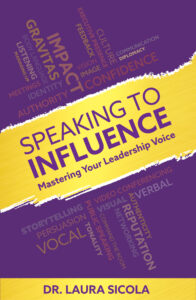 She’s coached Fortune 500 leaders, advised TED speakers, and helped top executives become the voice of the vision. Dr. Laura Sicola is a cognitive linguist and former professor turned executive coach and the author of Speaking to Influence: Mastering Your Leadership Voice. With nearly 7 million views on her TEDx talk and a client roster including Amazon and Kaiser Permanente, Laura helps leaders master presence, persuasion, and influence when the stakes are high.
In this episode of the Business of Story, Dr. Laura reveals why the movie playing in your head is never the movie your audience is watching — and what to do about it.
What’s in It for You
- The 3 Cs of executive presence — Command the Room, Connect with the Audience, and Close the Deal — and exactly what each one requires of you
- Why the gap between what you think you said and what they think they heard is the most expensive communication problem in business
- How to defuse triggered reactions using curiosity instead of defensiveness — and the one technique from Never Split the Difference that makes it work
- The neurochemical reason strategic humor is not optional in high-stakes communication — it’s a measurable trust accelerator
- Why both what you say and how you say it are equally non-negotiable — and the 60-second video habit that makes the gap between them visible
- What the StoryCycle Genie® revealed about Dr. Laura’s brand — including the nine words that stopped her cold
Why Brilliant Leaders Sound Like Spreadsheets
The most counterintuitive insight from this conversation: the leaders who seem the most brilliant in the room are not the ones with the most data. They’re the ones who make the data feel human.
Dr. Laura puts it precisely: the biggest gap in the world is the three inches between your brain and your mouth. Your intentions, your logic, your emotional investment in the message — none of that is what your audience receives. They receive your words through the filter of their last difficult meeting, their competing priorities, their emotional state, and their domain language.
What you send and what they receive are rarely the same thing.
The fix is counterintuitive: stop trying to make your message clearer. Start trying to make your audience feel understood. When people feel that you’ve genuinely grasped their reality — their pressures, their language, their world — they stop evaluating your message and start receiving it.
The 3 Cs of Executive Presence: Command, Connect, Close
Dr. Laura’s framework is built on three distinct skills that together determine whether a leader can translate expertise into measurable influence.
Command the Room is about projecting confidence and clarity from the moment you arrive — before you say a single word. It’s built through preparation, physical presence, and vocal authority. Dr. Laura’s prescription: research the hot topics before you walk in, own your space regardless of room size, and video-record your performances to close the gap between the delivery you intended and the one everyone else experienced.
Connect with the Audience is the ability to make your audience feel seen, understood, and valued. The most powerful connectors use relevant, specific stories that reflect the audience’s world back to them. Dr. Laura’s Denmark story — where she opened with six badly-pronounced words of Danish and earned a standing ovation — is the perfect illustration: a moment of deliberate vulnerability that built authority rather than undermining it.
Close the Deal doesn’t mean sales. It means moving the needle forward — getting to the next step, the next meeting, the next yes. Very few high-stakes conversations are one and done. The discipline is ensuring your audience always knows exactly what to think, feel, or do next.
The Dopamine Move: Why Humor Is a Neurochemical Strategy
Here’s one that surprises most accomplished leaders: a genuine laugh triggers a dopamine release in the listener’s brain. That chemical signal creates an unconscious positive association with you as the speaker — they stop judging you and start giving you the benefit of the doubt.
This doesn’t mean opening with a rehearsed joke. It means finding the one human, slightly self-deprecating, culturally resonant moment that signals: I’m not performing at you. I’m here with you. That moment of apparent vulnerability increases your authority — it doesn’t diminish it.
What the StoryCycle Genie® Revealed
We ran Dr. Laura’s brand through the StoryCycle Genie® before the episode. The nine OOO words it surfaced stopped her: scientific, rigorous, and transformative for the organization; empowering, precise, and illuminating for the offering; authority, influence, and advancement for the outcomes.
The gap it identified: Dr. Laura wasn’t sufficiently leveraging her unique position as the only executive communication coach who applies the cognitive science of language processing to leadership results. That’s not a messaging tweak. That’s a competitive moat she hadn’t fully claimed.
The brand purpose statement the Genie generated: Dr. Laura Sicola exists to empower leaders to bridge the gap between their expertise and their influence, so the brilliant thinking the world needs actually gets heard.
Her response: “I really like that.”
More About Dr. Laura Sicola
- Speaking to Influence: Mastering Your Leadership Voice — available in paperback, Kindle, and Audible (Dr. Laura reads her own audiobook)
- TEDx Talk: Want to Sound Like a Leader? Start by Saying Your Name Right — nearly 7 million views
- LauraSicola.com
- Dr. Laura Sicola on LinkedIn
- Free Download: Two Chapters of Speaking to Influence — exclusive for Business of Story listeners
- StoryCycle Genie®
- Free Brand Story Grader
Deepen Your Storytelling Mastery: Three Related Business of Story Episodes
Make Your Audience Feel Your Message — Not Just Hear It, with Charly Tate — Charly Tate explores how tone is the undercurrent that gives your story life, and why your audience feels your message before they understand it — the perfect companion to Dr. Laura’s vocal presence framework.
The Machines Can Code. They Can Calculate. But They Cannot Connect., with Joe Lazauskas — Joe Lazauskas makes the case that human connection, empathy, and storytelling are the only things that matter as AI handles everything else — a powerful philosophical foundation beneath everything Dr. Laura teaches.
Why Your Growth Depends on Truly Knowing Your Buyer, with Charles Gaudet — Charles Gaudet’s message-market match framework is the strategic complement to Dr. Laura’s communication science: once you know your buyer deeply, Dr. Laura’s 3 Cs are how you speak directly into their truth.
Dr. Laura Sicola’s Conversation with Park Howell on the Business of Story Podcast
What Is Cognitive Linguistics — and Why Every Leader Needs to Understand How the Brain Processes Language
Park: Dr. Laura, welcome to the show.
Laura Sicola: Thank you so much, Park, looking forward to the conversation.
Park: I am too, because really this show is about connecting and disconnecting and trying to connect when you’re actually disconnecting. With your background in cognitive linguistics — did I say that right? What is your definition of that?
Laura: Cognitive linguistics is looking at what it is about what you say and how you say it that makes it go in one ear and out the other for the listener, or go in and stick.
When you can figure out what it is that is creating that result — if you’re doing it right and you like the results, how to keep doing it intentionally. And if you’re not getting the results you want, how to figure out what you need to adjust to make it stick and do what you want. That’s the key.
Park: And how did you get in this world?
Laura: I come from a long background of education, and language focus has always been a thing. Ever since I was five and was fascinated with the fact that my grandmother spoke Spanish — which I was not raised speaking — and I just thought it was a superpower. She could kind of babble and other people knew what it was. I was like, at five, I thought I want grandma’s superpower, which I later learned is called Spanish.
So the fascination with languages began. The need to be understood and the need to understand — whether it’s as big as from Spanish to English or as small as what is it about the way that you pronounced that particular word that became a distraction for that other person, made them not hear the next statement, and then go off on a different tangent.
Why What You Said Is Not What They Heard: The Science Behind the Communication Gap
Park: Do you have a particular moment in your life that you can point to — maybe there was a great misunderstanding going on — that had sort of an aha moment that this was going to be your life’s work?
Laura: I don’t know that there was a single misfire that was a big enough pain point so much as the realization of the desire — recognizing the gap that I can’t understand this and I want to understand it.
I remember when I was 16, that same grandmother took me to Chile for the first time. I’d been studying just two years of high school Spanish of sorts, and I could sort of muddle my way through. But I remember thinking to myself — A, how completely fascinating it was to be in this world of sound that was literally foreign to me, but also wanting to put a Post-It note on my forehead that said, “In my language, I’m smart.”
Because when you’re trying to muddle your way through two years of high school whatever-language worth of skill in a particular language, it’s frustrating. You want to be able to make yourself understood. You know that you have ideas, you have questions, you want to have fun, you see everybody else laughing, you want to participate. But there’s something missing.
You don’t want to feel stupid and you’re afraid you do look and sound stupid to somebody else because you’re talking like a five-year-old. And it could be Spanish to English or finance to engineering to sales — those are all different languages too.
Is it a big client? Is it an existing client? Is it somebody who doesn’t know they should be a client? Who are you talking to and what is their native language, and how do you translate yours? That’s the key — how to translate so that you can hear and understand and be understood at the same time.
The biggest gap in the world is the three inches between your brain and your mouth. But also the gap we try to solve is the gap between what you think you said and what they think they heard. That’s where it all began.
Park: So that’s the thing I’m really interested in. I say one thing, but I believe they are getting it, and they are hearing and thinking something completely different. Can you give us an example of that in action?
Laura: Sure. How many times have you had a conversation with somebody — a coworker, your significant other, a neighbor, your child, your parent — and you made a perfectly clear, coherent, logical, obvious point, and they respond to you, and you think to yourself, how did you get that from what I said? You ever have one of those moments?
Park: Oh yeah.
Laura: Well, there are about six more episodes’ worth of variables involved there, but it could be anything from what was the conversation you had last week about this topic that one or both of you are drawing from? Where are the assumptions coming in? Where are you guessing that they have more background or care more about it than you do?
One of you thinks it’s more necessary than the other. One of you thinks, well, yes, it’s valuable, but we have other priorities first. You might be saying, I think this should happen, so we should do it. And the other person is saying, you don’t seem to understand that we’ve got to go through six rounds of approvals first. We’ve got to compare budgets, look at schedules, look at capacity.
There are so many things that could get involved.
Park: So to get to the bottom of it, it sounds like the number one effort a person has to make is to truly understand their audience — what’s going on between their audience’s ears — and communicate to them from their point of view, underscore what’s in it for them. And then hopefully they are going to arrive at the solution I am presenting. And therefore my influence and my persuasion goes up.
Laura: Yes, of course. And I will put a caveat on that, because yes, you need to do as much research as you can. Take a moment to consciously think about who do you need to talk to and what are their needs, their concerns, what else are they weighing. If you do any amount of prep thought in that space, you will definitely do better than if you don’t.
That being said, there are obviously going to be many things you can’t guess. You don’t know if they just had a conversation right before yours where they got chewed out or were completely embarrassed in public for something they got scapegoated on. So then you come up and happen to say a particular word that triggered them from that, and somehow you became the scapegoat.
A lot of the conversation that has to follow is trying to figure out what happened and not just fighting a grenade with a grenade. You’re going to yell at me, so I’m going to yell back — that doesn’t usually result in peace or resolution. How do we move forward from here? That’s the challenge.
How to Defuse a Defensive Reaction: Proven Techniques for De-escalating Triggered Conversations
Park: When something doesn’t land right, quite often you find out in that triggered moment — they go crazy and you’re like, whoa, wait a second, that’s not where I was going. What do you do to disarm that situation, get that person to pump the brakes, take a deep breath, and sit down for a conversation?
Laura: There are a lot of techniques. The first one is to pause and breathe, because when someone hits you with that adrenaline response, our fight or flight reflexes kick in. And that is not the part of the brain you want to let drive the ship.
Pause, take a breath. Recognize that something didn’t seem proportional or appropriate, and then approach with curiosity rather than defensiveness where possible. Of course, this will depend on whether there’s a power differential, a timing issue — everything is qualified by “it depends.”
You may want to approach with something like, “This seems to have upset you. I didn’t mean to upset you — help me understand what is upsetting you.” Getting a yes or a no is equally valid and equally useful if your goal is to understand in order to move forward productively.
If they say, “Yeah, it upset me because you did this” — okay, thank you for informing me. Now I know what I did. Whether or not I think it should upset you, that’s a very different issue. If they say, “No, it’s not that I’m upset, it’s that this…” — okay, well, thank you. Now I also have data.
If you ever read Never Split the Difference by Chris Voss, great book on negotiations. He calls them labels. So it’s, “It seems like this really bothers you” or “It looks like you’re unhappy with something.” You’re saying, this is my observation — if I’m right or wrong, tell me either way, because it’s useful information. And then we’ll try to get back on track together.
The 3 Cs of Executive Presence: How Command, Connect, and Close Turn Expertise into Influence
Park: You’ve got a framework — the three Cs framework. Can you walk us through that so our audience can walk away and go, yeah, maybe I’ll try that next time and have a little bit more influence and persuasive power?
Laura: Happy to. Executive presence — the it factor, the leadership presence, the X factor — there are three Cs you want to master. The ability to command the room, connect with the audience, and close the deal.
Commanding the room is simply: from the minute you show up, the minute you click the join meeting button or walk into the room or onto the stage, there’s something about your presence, the way you carry yourself that shows confidence, that shows a strength — not an overpowering, domineering strength, but something that makes the audience sit up and take notice and lean in, curious to hear what you’ve got to say.
Connecting with the audience — no matter who they are, no matter how different your respective priorities and interests are — on some level you’re going to find a point of connection that you’ll ride forward together. On this point, you understand me and I understand you.
And then the third C is closing the deal. That does not necessarily mean it’s sales or signing on the dotted line. It can be if you happen to be in a business development role. But closing the deal simply means getting to yes, coming to an agreement, making a decision, simply moving the needle forward.
Very few business development conversations are one and done. The idea is simply — did we get to the point where we’re going to have a follow-up to discuss budgets? Is there a next step where we’re going to meet with the other major decision-makers? Are we moving the needle forward step-by-step together? That’s closing the deal.
How to Command a Room: The Preparation, Presence, and Stage Ownership That Make Leaders Unforgettable
Park: Let’s walk through all three of these. If it’s all right with you, could we take your presentation next week to the women’s group in Texas as an example? How are you going to step on that stage and immediately command the room?
Laura: In part, I’m going to have a conversation with the organizers before I get on to identify something they’ve been discussing among themselves. What’s been a hot topic, a frustration, a concern, a success or a win they’ve had — preferably since the conference began or just in the day or two leading up to it. I want to try to incorporate that as one of my openers, to make it a connection to ride the wave so they’re already in flow with me when we start.
I also want to know the dress code. Is this business casual? Is this jeans and sweatshirts? I did a program a couple of years ago in Denmark — 1,500 Scandinavian asset managers going on an annual retreat into the woods to camp on cots in tents for three days. I had to think, what goes with rain boots as I was packing my outfits?
So who’s your audience? What kinds of experiences are they planning to have or did they just have? And how do you draw on that?
Park: When you said command the room, I was first picturing a physical commanding of the room. You hear people say, do the Superman pose. I’m not really quite sure if that works. But it’s also, as you said, do some research and figure out what they’ve been talking about, what the hot topics are, so you can speak to those right off the bat to build trust.
Laura: So that’s the connecting, right? The command, right from the beginning — walk on stage confidently, have a smile on your face, make eye contact with people, own your space. It doesn’t matter if I’m five foot nothing. I don’t take up a lot of space on a conference stage, but I’m going to own it. I will own the whole thing. I’m going to own the whole audience, and everybody, no matter where they’re sitting, at some point is going to feel like I’m talking right to them. That’s my goal.
Park: If you are a speaker at a conference keynote, wouldn’t you already have that command of the room because you’re doing this? Or are you talking really more about people who have been kind of thrust into that position — hey, Larry, we’re going to have our big sales kickoff next week and I need you to get up and give a 20-minute presentation?
Laura: There’s a gray scale for how — what kind of a stage is it? Is it in front of 10,000 or in front of 150? Is it your first time? Is it something you can do in your sleep? Are you trying out something new?
One of my tools is that whenever I can, I video record my performances and then go back and watch some of it. I want to make sure that what I said and what I delivered looked to everybody else like it did to me. How many times do you make a little video to send somebody — something super simple — and you watch it 10 seconds after you recorded it and go, oh my God, I sounded like an idiot. That sounded better in my head.
Maybe you fidgeted the entire time. Maybe you didn’t realize you kept touching your face as you were talking. Maybe you weren’t just moving across the stage to own different parts of it — you were pacing back and forth, wearing a rut in the stage the entire time. The intention was good, the plan was good, but the execution missed the mark. That’s important to realize.
How to Connect with Any Audience: Why Relevant Stories and Genuine Empathy Build Instant Trust
Park: All right, let’s move to the second C — connecting. Now you’re commanding the stage, you’ve got their attention. How do you deepen that connection with your audience?
Laura: As I referenced earlier, the specific details you share, the examples you give, the analogies you use need to be ones that will resonate with that organization. If you’re talking to a bunch of artists and not athletes, I’m not going to use a lot of golf analogies. Be very judicious in choosing examples that will be as relevant and powerful to them as you can. Even the number of details — do they need the specifics or is it way too much and they’re just waiting for you to move on?
Park: How do you know what anecdotes to tell to connect with that audience?
Laura: Sometimes it depends on — like in the beginning, I’ll often tell a story to warm up the audience. Going back to the experience in Denmark, I speak a couple of languages. Danish wasn’t one of them. So when I got the invitation, I thought, let me play with Duolingo for a few months and see what I can pick up. Well, spoiler — you can’t pick up much of anything in two to three months on Duolingo.
But in this audience, it was a pan-European group. Everybody was able to use English as the lingua franca. But I also knew most of them spoke two, three, four, five languages. So I did a little survey in the beginning — how many of you speak two, speak three, et cetera? And we figured out who spoke the most languages there.
Then I acknowledged how much effort that takes — not just to be conversational, but to be able to do this kind of work in a second or third or fourth language. And the fact that I had even tried to learn a little bit of Danish to come there. At this point, all I’d learned to say was something like, “The boys and girls eat rice” — one of the few sentences I’d figured out. And the whole place burst out laughing and gave me a full round of applause just for doing that.
I laughed at myself. It was a moment of humility, but not humiliation. It was acknowledging them, recognizing the challenges involved, and also saying, so look — as an American and a native English speaker, if I use jargon, if I speak too quickly, please feel free to raise your hand and ask me to slow down. And maybe they would, maybe they wouldn’t, but I’m acknowledging that I can imagine where they are.
I saw a lot of heads doing very slow nods of “thank you for the acknowledgement.” Making fun of myself with my six words of butchered Danish helped to endear me to them without losing respect as an authority on my subject. Then we switch to, okay, now here’s what we’re here to talk about today.
The Calculated Risk of Humor in Presentations: How to Make Audiences Laugh Without Losing Credibility
Park: Well, it’s interesting too, because whenever I’m doing my training or speaking, I’ll always lead with a connection story. Because if I can’t connect with them in that first 90 seconds, I’m sunk.
I was hired to work at a developer conference in Sacramento in 2016 — about 150 computer coders and developers in the room. The sponsor who brought me in kidded me a little bit: “You realize pretty much this entire room thinks storytelling is bullshit. They’re not going to be a friendly crowd — you’re going to have to win them over.”
So I went on stage and I said, “Let me see a show of hands — with all the work you all do in developing and coding, is it fair to say your number one priority is user experience?” And they all said, yeah, of course. So then I said, “Well, let me make a comparison here — storytelling is nothing more than the software that drives the hardware of our meaning-making limbic brain. And you can break it down to code. I’m going to teach you the And, But, Therefore algorithm. I’m going to teach you the five primal elements and the 10-step Story Cycle System. They are all algorithms to the software that drives the hardware of our brain. Don’t you want the best user experience possible with that person you’re talking to?”
And they were all nodding. At that point, I knew I had them. So I asked, how many here think storytelling is bullshit? About half the room’s hands went up instead of all of them. Then over the course of 90 minutes, showing them in action, having them work through their own stories — at the end, they gave me a standing ovation.
Laura: Absolutely. And to speak into their truth — you called a spade a spade. How many of you think this topic is bullshit? And they were like, yep, thank you. At least you know where we are.
I’ve done the same thing. When I’m doing trainings for teams, it’s typically finance or tech — the real numbers people. I’ll say, let me just put this out there as a preface: I am a Jersey Italian. We don’t do woo woo. That’s not my thing. And they’ll kind of smile. So work with me on this. I’ve already set the expectation — I’m not going to go down the cutesy cutesy, but I do need to make this mental picture for you. Humor me on it.
If you can get them to laugh either at themselves or with you — or preferably both — that little dopamine hit is an appreciation for you. It makes them unconsciously like you and thus be willing to give you the benefit of the doubt. A little bit of humor in a story, even in a hard story — just that one little surprise chuckle can, my gosh, does that break through barriers.
Park: It goes a long way. I was recently working with Navy Federal Credit Union and 110 of their internal auditors — all about helping them find the narrative behind the numbers so the numbers make sense to the people they’re talking to. I’ll ask you this question right here, Dr. Laura — what is the first syllable in the word numbers?
Laura: Numb.
Park: And then they all look at each other and go, wow. And I say, your numbers make no sense to that homo sapien brain sitting across from you until and unless you put them in the context of a story. And that always lands very well with them.
Laura: Yep. And I’ll usually follow with something like — you are experts and you have the burden of needing to talk to, let’s call them muggles. And everybody pauses for a second and then the whole room breaks up. Because they understand the Harry Potter reference — non-magical beings. Or I’ll say “otherwise mortals.” And I’ll use those kinds of labels and the whole place cracks up.
Because let’s face it, they tend to think they’re a little smarter than everybody else. We all think we’re smarter than everybody else in whatever our area of genius is. So when you’ve got to handle those who are not, we need to take these kinds of approaches — like stories.
Words vs. Delivery: Why Tone, Pacing, and Vocal Presence Matter as Much as the Message Itself
Park: And take some risks too, right? I imagine you find yourself on stage and you’re like, I’m not sure if I should really say this, but I’m reading the room and I think it’s going to work. Let’s go for it.
Laura: Sure. Often there are calculated risks. Especially for the tech and finance spaces — if I have the time, I’ll use a little neuro-linguistic programming technique to demonstrate that words have a direct impact in the brain of the person on the chemical makeup, the hormones, whether you’ve got more adrenaline or dopamine coursing. That changes the receptivity.
To demonstrate that, I’ll find someone in the audience who has a food addiction of sorts — I can’t say no to chocolate, or nachos, or soda. And in 15 minutes, I can get that person to no longer desire that food and not want to see it anymore.
The last group I was in front of, somebody was talking about holiday baking — a particular kind of icing. If the icing is on the cookies or on the cake, that’s all there is to it. She just has to eat the whole can of icing. 15 minutes later, we got her to be suddenly not interested and not want to bake those cookies anymore.
For everybody else watching, they’re going, that shouldn’t have worked. What just happened? Why did that work? It’s like you all were witnessing — you all saw, you all heard, it shouldn’t have worked, but it did. And that’s because I know exactly what words I use, exactly what order I use them, how I delivered them, what mattered, all the nuances. For the coders out there — I know the code, you just know the user interface. Those details all matter. You now have proof.
So I need you to trust me that when I tell you later in this workshop that you need to adjust these details, don’t just dismiss it and go, that doesn’t seem like it should matter. Because it does. You now have proof.
Park: So in your book, Speaking to Influence, do you share tips on these words and how to use them to kind of magically cast that spell on your audience member?
Laura: I wrote the book before I was involved with NLP, so I’m not including those techniques intentionally. But there is plenty in the book about how to choose the right words, the amount of detail, the relevance factor. It’s all about the three Cs, and in particular, how to establish credibility — first and foremost rooted in the importance of establishing alignment between what you say and how you say it. The words, the voice, and the body language.
If you’re only knowing the user interface of language — I just hear English, I talk in English, we have English — you’re unaware of how when you put those tiny details together, it can be the difference between sounding trustworthy and confident versus arrogant.
Why You Don’t Know How You Come Across: The Gap Between the Movie in Your Head and Everyone Else’s Reality
Park: Do you have an example of that? A go-to line that says, you’re trying to come across trustworthy and confident, but you’re actually coming across arrogant?
Laura: Sure. Two words — “nice haircut” versus “nice haircut.” Big difference. Just a little difference in the speed, in the tonality pattern. That tiny difference in delivery makes it immediately go from compliment to insult, from direct to passive aggressive.
One of the exercises I often have clients do is take their phone and do a 30 to 60 second video recording. Let’s say you have to give some constructive feedback to an underperforming employee. You want to come across as clear but supportive, help them understand what needs to change. People will sit down and say, “Okay, so, hi Bob, thanks for coming in today. Let’s talk about X.” And then they watch the video 60 seconds later and go, “Oh my gosh, I sound like such a jerk saying that.” Or, “I sound like I’m going to cry, like I’m afraid to tell them what it is.”
You were trying to be nice, but you sounded like a jerk. You were trying to be clear and supportive and you sounded like you were going to cry. You didn’t realize that in the process. So now we have to reverse engineer what you actually did into observable behaviors — very specific, objective. This was the speed you spoke at. Here’s what you emphasized. How many times did you pause? Those are not subjective. You either paused 10 times or you didn’t.
Subjective interpretation is: okay, so since you did that, what impression did it seem to make? Blabbering and unconfident and nervous. Hmm, okay. So then we have to work on those behaviors to shift the perception that’s coming out of it.
Park: So it’s not so much the use of the words, it’s how you tell them, how you express them.
Laura: Well, the words matter too, because what you say and how you say it are two sides of the coin. You can’t have one without the other. If you think about it in terms of building a house — you need the foundation first, then you can put up the walls. You can’t just put the walls up on the ground. I suppose you could, but at the first rain, you’re going to have a really soggy floor inside.
If I want to give you some constructive feedback, I can be as nice as possible. But if I say, “I mean, I think you’re an idiot. I don’t really think you belong here” — hey, no offense, right? You can say it nicely, but you still called me an idiot. So it’s not just how you say it. The what you say matters. Was it a relevant example? Was it a relevant story? Is it something they’ll understand and relate to? Is it something they’ll find offensive instead of funny?
Any good joke falls flat if it’s not told right. So it is absolutely both. You cannot have one without the other.
Park: So this seems very obvious coaching, but why are we so blind to it?
Laura: Because the movie that plays inside our head is not the same as the movie that everybody else watches when we talk. There’s only so many things you can pay attention to at once, and only so many variables you can consciously be aware of.
You may not know that the person you’re talking to just came out of a really hard meeting where they lost an account, or they got terrible news from home on the phone right before it. They’re just not in a place to feel charitable right now. Your timing — universal stroke of bad luck — had nothing to do with you. If you’d spoken to them yesterday, or waited till after lunch when they’re not hangry, you could get a very different response.
Some of those factors you can’t control. And some you may have just made a judgment error. I was at an event last week and one of the guys told a joke doing a 1950s-style country storytelling persona. But the story he told was mind-bogglingly 1950s in its sexism — making fun of fat mother-in-laws the entire time. And the audience was two-thirds older women.
There were pauses for laughter. There was no laughter. It was painful to watch. That was a gross judgment error. Know your audience, much less the timing. It was well delivered by the standards of the intention of the era of the story. Wrong context, pal.
What a Brand Story Analysis Reveals About Dr. Laura Sicola’s Framework for Speaking to Influence
Park: Like we do with all of our guests, we ran your brand through our StoryCycle Genie®, and I sent you over the findings a few days ago. What did you think of it?
Laura: Fascinating. You know what I liked about it, Park, was that it really did a good job of essentializing who the audience is and what they would find most powerful, either in the pain point or in the desired goal. It was really impressive how tight the language was.
Park: And you said you were in the throes of redoing your website. So the timing was pretty good. It validates what you’re already doing well because it simply visited your website and said, here’s how Dr. Laura is showing up in the world. It reveals gaps that you could close. And then finally, it inspired you with some new ways to think about telling your story. What were some of those inspirational moments?
Laura: I appreciated the fact that it was really highlighting — recognizing that I wasn’t leveraging enough the fact that I’m the only executive communication coach who applies the cognitive science of language and how it’s processed in the brain to the results that people are going to get.
And actually, I think it was the nine words — the OOO exercise. I’ve done a lot of exercises myself trying to figure out how to get things down into the key essence concepts. And it was nice to have these nine single words that were brand-specific, brand-unique as a combination.
For the organization, it was scientific, rigorous, and transformative. For the offering, it was empowering, precise, and illuminating. And the outcomes — greater authority, greater influence, and greater advancement opportunities. And those are all 100% accurate. I don’t think I would have come up with those nine purely as they are, but they are very consistently what my brand is all about.
Park: Yeah, and you think about them as your character traits. The Genie itself gives you the explanation as to why it came up with “advancement.” It said: advancement captures the career and organizational trajectory outcome — the promotions earned, the opportunities opened, the legacy built on the organizational performance improvements achieved through communication mastery.
So if you find that accurate for your brand, then what I would challenge you to do when you’re creating your next website is give us two or three stories that show advancement in action. It’s not enough for the brand just to say, we’re about advancement and here’s why. That’s chest pounding. What I want to hear is about people you’ve helped who have experienced that advancement. So the reader of that story or that anecdote says, I want to be that person. You’re proving it.
Laura: Yeah, the case studies of success.
Park: Yeah, case studies — and even approaching the case study differently in that the case study is always about one individual, not an organization, not a team. That individual by proxy can then represent the greater whole. A lot of people get wrong in storytelling is they talk about how they helped a company. Well, most readers don’t really care about that company, but they do care about Sally who’s in that company and how you helped Sally. And then by proxy, the spillover help you gave to the team and the division and the company.
Laura: I think the part that a lot of people miss with the story is in that hero’s journey kind of thing — when it comes to those case studies, people want to read about the character because they want to see themselves in that person’s shoes. They don’t care what I did for somebody else as far as the steps I took or the processes we went through. They want to hear that character say, here’s where I was and I was unhappy. I worked with you and here’s where I am and now I’m happy. Because the reader’s going to say, oh, I am where that person used to be too in that unhappy space. And if she got you to that happy place, maybe she can get me there too. That’s the key.
Park: Yeah, without a doubt. The stories transport the audience into that story. Their brain lives it just as if they were there, or lives it just as they want the same thing that person has, but they don’t have it yet. So I need to talk with Dr. Laura.
Closing the Gap Between Expertise and Influence: How a Clear Brand Purpose Transforms Your Communication Impact
Park: Let’s jump to the brand purpose statement, because I’m curious how that landed with you. The ninth step in my 10-step Story Cycle System is basically the moral of the story — why you exist, why any brand exists beyond making money. How do you actually level people up? And it says: Dr. Laura Sicola exists to empower leaders to bridge the gap between their expertise and their influence, so the brilliant thinking the world needs actually gets heard.
Laura: Yeah, I really like that. I love the fact that it captures the experts curse — we are very confident in our skill and our technical expertise, and we’re frustrated that people don’t say yes more often, that others don’t just get it. Whether it’s a client or prospect, the board of directors, other collaborators, legislators, whoever you’re trying to convince. It’s that frustration of, why don’t you get it? Why isn’t it so clear to you as it is to me?
So my expertise should make this point obvious to you, but it isn’t. So I’m not having the influence. That idea about how to close the gap between their expertise and their influence — so the influence is as strong as your expertise should warrant in your own mind. It’s a great way to look at it. Great gap.
Park: Well, thank you so much for being here, Dr. Laura. I imagine you’re on LinkedIn. Any other place you want to send people to learn more about what you do?
Laura: LinkedIn and the website are the main ones — laurasicola.com. You can certainly follow us also on Instagram and Facebook, and X. We’re on all the major platforms, although LinkedIn and the website are the primary ones. And when in doubt, you can go to my TED Talk. If you want a 15-minute deep dive into what exactly is she talking about with this whole three Cs and prismatic voice and all that kind of stuff — it’s a 15-minute overview to get a sense of, is it worth reading this book? Do I want to look into more?
I would encourage people to check out my TED Talk. It’s called Want to Sound Like a Leader? Start by Saying Your Name Right. It’s got over 7 million views now, so it can’t be that bad.
Park: Awesome. And we’ll have a link to that in the show notes too. So thank you so much for being here. This has been a pleasure.
Laura: Thank you, I really appreciate it, Park.
Park: Dr. Laura, I think you’ve got a freebie or two for our audience for listening.
Laura: Yes, I would love to give people a taste of everything we’ve been talking about. What I’ll share — and you can edit to the show notes — is a link to download two chapters from my book, Speaking to Influence. It’ll really help you look more deeply at yourself, at what you try to figure out, what it is about what you’re saying and how you’re saying it that’s just not making it land the way you want it to land. So we’d be happy to offer that to your listeners.
Park: We appreciate that.
Laura: Terrific.
Q: What Is Cognitive Linguistics and How Does It Apply to Business Communication?
A: Cognitive linguistics is the study of how the brain processes, structures, and assigns meaning to language — and it reveals why two people can hear the same words and walk away with completely different interpretations. For business leaders, this matters because every message you send is filtered through your listener’s existing beliefs, experiences, and emotional state before it registers as meaning. Understanding cognitive linguistics means accepting that communication is never just about what you intend to say — it’s about what the other person is neurologically primed to hear. Leaders who apply cognitive linguistics choose words, framing, and delivery that align with how their audience’s brains actually work, rather than how the speaker assumes they work.
Q: What Are the 3 Cs of Executive Presence and Why Do They Matter?
A: The 3 Cs of executive presence — Command, Connect, and Close — are the three distinct skills that together determine whether a leader can translate expertise into measurable influence. Command is about projecting confidence and clarity so your audience believes you belong in the room; it’s built through preparation, vocal authority, and intentional body language. Connect is the ability to make your audience feel seen, understood, and valued through empathy, relevant storytelling, and genuine engagement. Close is the discipline of completing the communication loop — ensuring your audience knows exactly what to think, feel, or do next. Without all three working together, even the most knowledgeable leader leaves influence on the table.
Q: How Do You Close the Gap Between Expertise and Influence?
A: The gap between expertise and influence exists when a leader has deep knowledge but lacks the communication skills to make others feel it, trust it, and act on it. Closing that gap requires recognizing that expertise lives in your head while influence lives in your audience’s experience — and that the bridge between them is deliberate communication strategy. The most effective approach combines vocal presence, precise language choices, and emotionally resonant storytelling that makes complex knowledge feel immediately relevant and actionable. Leaders who close this gap move from being respected in the room to being followed outside of it.
Q: Why Does Communication Fail Even When the Message Seems Clear?
A: Communication fails most often not because the message was unclear to the sender, but because the receiver was already operating with a different mental model, emotional state, or set of assumptions. Cognitive linguistics explains this through the concept of internal filters — every person hears new information through the lens of prior experience, which means meaning is always co-created between speaker and listener, never transmitted intact. Leaders commonly assume clarity on their end guarantees comprehension on the other — a fatal mistake that produces misalignment, disengagement, and eroded trust over time. The fix is not louder repetition; it’s deliberate reframing that meets the listener where their brain actually is.
Q: How Do You Command a Room as a Speaker or Leader?
A: Commanding a room is less about charisma and more about the intentional preparation, physical presence, and vocal authority that signal to any audience that you belong exactly where you are. It begins before you speak — knowing your material so deeply that you carry calm confidence rather than performing certainty you don’t feel. Vocally, commanding a room means using pace, pitch, pause, and projection strategically to hold attention and signal importance. Physical presence matters equally — how you stand, how you enter, and how you hold eye contact all communicate authority before a single word lands. Commanding a room is a learnable discipline, and its foundation is the honest preparation that converts expertise into visible, felt confidence.
Q: How Do You Connect with an Audience During a Presentation or Speech?
A: Connecting with an audience requires shifting your focus from what you want to say to what your audience needs to experience — and that shift is the entire game. The most powerful connectors use relevant, specific stories that reflect the audience’s world back to them, creating the neurological experience of being understood rather than being lectured to. Empathy is not a soft skill here; it is the strategic choice to acknowledge the audience’s current reality — their challenges, pressures, and aspirations — before introducing your message or solution. When an audience feels genuinely seen by a speaker, they stop evaluating the message and start embracing it.
Q: How Does Tone of Voice Affect Leadership Effectiveness?
A: Tone of voice carries emotional signal that the brain processes faster and with greater weight than the literal meaning of words — which is why a leader can say the right thing in the wrong way and undermine both trust and authority simultaneously. A leader whose tone conveys anxiety signals risk to their team even when the words convey confidence; conversely, a calm, measured tone under pressure communicates that the situation is manageable. The challenge is that most leaders are unaware of the signals their voice is broadcasting because they’re focused on content, not delivery — which is precisely why vocal self-awareness is a core executive presence skill.
Q: Why Are Leaders Often Blind to How They Come Across to Others?
A: Leaders are typically blind to their own communication impact because the version of events playing in their mind — what Dr. Laura Sicola calls the “movie in your head” — is assembled from their own intentions, internal logic, and emotional state rather than from the signals they’re actually broadcasting outward. Without external feedback mechanisms — trusted advisors, recorded observation, or deliberate reflection practices — this blind spot calcifies over time and becomes a leadership liability. The stakes are compounded by organizational dynamics: the more senior a leader becomes, the less likely their team is to offer candid correction, meaning the gap between self-perception and reality often widens precisely when it matters most.
 Listen To More Episodes