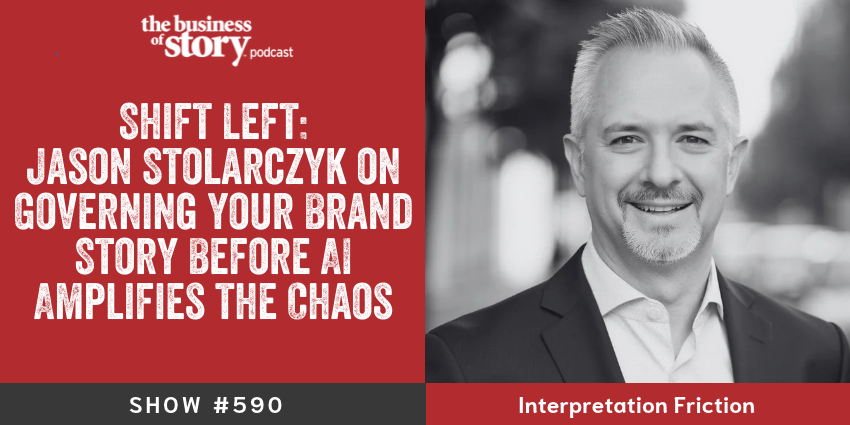
When Every Department Has a Different Story, AI Picks the Wrong One
The Three-Story Problem Your Communications Team Was Born to Solve
You want your brand story to travel coherently across every department, every channel, and every AI tool your organization deploys at scale.
But product is telling one story, sales is telling another, and marketing is publishing a third — and AI is amplifying all three simultaneously, confidently, in public, before leadership has any idea the drift is happening.
Guess what, the most urgent discipline in your organization right now is the interpreter role. The communications leader who steps back before a single piece of content goes to market, synthesizes what every department believes is true, and architects the governing narrative that makes the market eventually tell the story for you.
Jason Stolarczyk calls the gap between what a company believes, sells, and publishes Interpretation Friction™. And in more than 20 years at Microsoft, IBM, VMware, ServiceNow, and Palo Alto Networks, he’s spent his career closing it.
Meet Jason Stolarczyk: The Communications Strategist Who Proved Story Governance Drives Revenue
Jason Stolarczyk built the narrative infrastructure behind some of enterprise technology’s biggest brand stories. His integrated programs have generated millions in market reach and billions in pipeline.
At ServiceNow, he proved the model quantitatively: every dollar invested in upper funnel storytelling returned ninety dollars in brand value.
At Palo Alto Networks, he positioned cybersecurity as the currency of the AI era, not a product category, but a confidence infrastructure the entire digital economy depends on.
That body of work inspired Interpretation Friction™: his framework for diagnosing and fixing the gap where a company’s beliefs, sales conversations, and published content stop matching.
He now makes that methodology available to executives and their teams across startups, global enterprises, and mission-based organizations, helping them navigate the shift from persuasion-era marketing to alignment-first leadership in the age of AI.
What’s in it for You:
- What “shifting left” means in communications strategy — and why stepping back before deployment creates more forward momentum than charging ahead
- How Jason proved at ServiceNow that upper funnel storytelling drives $90 in brand value for every $1 spent — and the operational system that made it happen
- Why narrative entropy is the default state when no one owns the interpreter role — and what happens to a brand when that person walks out the door
- The Interpretation Friction™ framework and how to use it to diagnose the gap between what your company believes, sells, and publishes
- Three questions every organization must answer before any story goes to market
- Why AI is not an architect — and what “slop” costs your brand when no governing story is in place first
Shifting Left: The Engineering Principle That Rewires Brand Strategy
In software engineering, shifting left means moving quality control earlier in the development process — catching problems before they compound. Jason borrowed the concept and applied it to communications strategy.
Most organizations build the story after the product is built, after the sales deck is written, after the campaign is planned. Shifting left means stepping back before any of that — understanding what the market is actually talking about, what problems it is trying to solve, and what conversations it is already having — then designing the governing narrative around that intelligence.
At Palo Alto Networks, that meant stepping back from specific product threats and asking a larger question: what is motivating all of this? The answer was confidence. If AI opens up the entire information infrastructure, the thing businesses need most is trust in their systems. Security becomes the currency. Every downstream product conversation flows from that single governing idea.
That is shifting left. One step back. Two steps forward.
Why Narrative Entropy Is the Default — Not the Exception
Jason put it plainly in our conversation: if you are not thinking about story work from a systems design perspective, you will not be able to scale beyond the people or the moment it lives in.
WeWork learned that the hard way. Adam Newman left. The story left with him. There was no system, no governing architecture, no Brand Brain that lived outside of one person’s charisma. And the market noticed before the board did.
The same dynamic plays out at every scale. When a 19-year chief communications officer leaves Microsoft, how much institutional story leaves with him? When a VP of Marketing departs a Series B startup, how many of the audience insights, the positioning decisions, the hard-won messaging live only in that person’s head?
Narrative entropy is not a failure of talent. It is a failure of infrastructure.
The Three Questions That Stop the Drift
Before any story goes to market, Jason asks his clients three questions.
What problem do you solve that no one else solves the same way? Who feels that problem most acutely? And what does someone need to believe for your solution to make obvious sense?
These are not new questions. They are as old as positioning strategy. But in practice, most organizations skip them — chasing the shiny of the new rather than anchoring to the fundamentals that govern whether any story actually sticks.
The organizations that answer those three questions together — product, sales, and marketing in the same room, synthesized by an interpreter who can hold all three truths at once — are the ones whose stories compound. Everyone else is playing Party Telephone while AI broadcasts the fragments.
Links and Resources
- Jason Stolarczyk on LinkedIn
- StoryCycle Genie™
- FREE Brand Story Grader
- Brand StoryOps™ for Agencies newsletter
Related Episodes from the Business of Story Podcast
How to Operationalize Your Brand Story Before Narrative Entropy Kills Your Competitive Edge with Sean Schroeder — StoryCycle Genie® co-creator Sean Schroeder reveals the systems and architecture that govern a brand story across the enterprise before AI accelerates its decay.
Because If No One Is Governing It, AI Is Fragmenting It Faster Than You Can Fix It with Rain Bennett — Author of The Chief Storytelling Officer, Rain Bennett makes the case that brand story isn’t a marketing deliverable — it’s the operating system every department runs on.
Why Brand Story Governance Is the Only Guardrail Standing Between You and Strategic Collapse with Magda Adamska — BrandStruck founder Magda Adamska dissects the four strategic traps that have destroyed even the most iconic brands — and why a governed brand story is the only protection against them.
Jason Stolarczyk’s Conversation With Park Howell on The Business of Story Podcast
How Jason Stolarczyk’s VP Roles at ServiceNow and Palo Alto Networks Forged a Brand Story Governance Philosophy Built for the AI Era
Park Howell: Good afternoon, Jason. Welcome to the show.
Jason Stolarczyk: Hi, good afternoon, Park. Thank you.
Park: I know you are coming to me from one of my favorite places in the world where I grew up, Seattle, Washington. And it sounds like you just moved back up there from SoCal?
Jason: From Southern California, just outside of Los Angeles. It’s been a bit of a homecoming. It’s been about twenty years since I’ve been here and it’s fascinating to see the change. As you well know, growing up here and seeing all of the amazing growth and industry growth out here — it’s been incredible. I almost don’t recognize some of the places.
Park: I grew up in the Bothell Woodinville area, north of Lake Washington. We were talking earlier about the Sammamish Valley, where they now have this beautiful wine region — four hundred wineries. Ste. Michelle winery used to be a dairy farm when I grew up there. We used to literally hunt ducks and pheasants where they are now putting in five-star resorts and four-star Michelin restaurants. To say it’s changed a little bit might be an understatement.
Jason: We were joking that you’d get arrested for that now. That’s definitely the sign of change.
Park: God yeah. You’d be a terrorist. Anyway, it’s great to have you here. And you didn’t even know this, but you were an inspiration to me — and I didn’t even know you. The backstory is my co-creator of the StoryCycle Genie, Sean Schroeder, was talking about positioning our platform. He said, “Park, I know you’re about brand story development, strategy, and activation — and the Genie does all that. But we really have to focus on this idea of operationalizing and governing a brand story across an enterprise to stop narrative entropy.” That’s the fragmentation and decay of your brand story across all the different departments and people in your organization — and the AI bots grabbing those fragments, spewing them out to the world, creating all that much more confusion.
We had talked about it for a couple of months, and I had enough on my plate. I thought, do I really want to start a LinkedIn newsletter? Then the universe sent me your article on LinkedIn. I looked at your background and was really blown away by how you have already been doing this — story ops, this governing of brand stories inside tech businesses, B2B businesses. You wrote the article I’m going to put in the show notes. It’s called “The Executive the Interpretation Era Was Always Going to Need.” That was the impetus for me starting Brand Story Ops for Agencies. In my second article, I particularly called you out because you were the one who got this going. Then I reached out and said I’d love to have you on the show to talk about your background and what you are seeing in the world with AI and story governance.
So let’s quickly run through your backstory and how you find yourself where you are today.
Jason: No, absolutely. And by the way, I am inspired to be your inspiration. I always find those stories interesting because the connections that are made are not any sort of coincidence. They were sort of destined to become something.
I have been working with companies now for the last twenty-plus years, mostly at a communications leadership level — starting with telling story to media and pitching media, then evolving that discipline into what I’ve been doing the last ten to fifteen years: creating systems and operations that allow a story not only to be told, but to allow the market to start telling the story for you.
One of the things that came out of that, and really the inspiration for the writing that people have seen — and I’m currently curating a book around it — is this idea that within the new era we’re in, with all of the blessings and curses AI gives us, it’s allowing our discipline, the discipline of communications, to fundamentally change.
In engineering terms, there’s a term called shifting left. We talk about that in cybersecurity, where there are moments where you allow yourself not just to consider what’s happening now and what might happen in the future, but actually step back and go to the previous step. How could we be thinking about these things before anything starts to happen and before it starts to amplify?
Park: So that shifting left isn’t a political thing — it’s a storyline thing. Just want to be clear about that.
Jason: No, not at all. Think of it like a workflow diagram — you’re going back to the previous step in the process. And to that end, there’s an energy and a freedom that you give yourself to be able to consider these things before something comes into play. That’s really the nugget of the writing I’ve done, and I’m starting to take a look at how that fundamentally changes communications and overall marketing leadership in the new era of AI.
Shifting Left in Communications Strategy: The Engineering Principle That Stops Brand Fragmentation Before It Reaches the Market
Park: Give us an example of this idea of shifting left. Maybe it’s a company you were at or consulting with.
Jason: A few years back — this was my time at ServiceNow — I was brought aboard to look at how we could design a thought leadership platform or some sort of environment where the company could begin to elevate its storytelling and be identified with themes bigger than just workflow automation.
Part of that exercise was simply auditing where the company was now, what it was talking about, what sorts of audiences were engaging and how. Then we stepped back, separated ourselves from that, and asked: what would happen if we stopped talking at the world about the company and instead talked with the world about these larger topics that we fundamentally affect — but that people may not know we’re a part of?
That gives us permanence within a conversation that people may not even know we’re part of. That’s the magic sauce for us to be identified as fundamental to what the future of work might look like.
Park: And Jason, what is ServiceNow? Just for those who don’t know.
Jason: ServiceNow started as a workflow automation and operations company. Their business was to say: you don’t need two engineering degrees to understand what a workflow is and to automate it in a way that optimizes whatever you’re trying to do — whether it’s HR, payroll, or anything else. The communications challenge was how to expand beyond that into the idea that it’s fundamental to the future of work and our relationship to work, both in and out of the office.
The $1-to-$90 Brand Value Formula: What Rigorous Narrative Governance Actually Produced at ServiceNow
Park: When in your career — be it ServiceNow or anyone else — did you see the real need and importance of story governance to avoid narrative entropy?
Jason: At ServiceNow, we actually had the practice work that showed us that if we tuned the storytelling — if we were active in it, not allowing it to decay, giving it exercise and forward motion — we were attaching ourselves to an audience that was seeking that. It was almost as if they were waiting for something like this to occur.
We saw it in the numbers. We saw a lot of engagement, a lot of people doing the things we hoped they would do. But we also saw that because of the posture we had in creating these conversations and manifesting this engagement, they were actually more likely to develop a deeper relationship with the brand — which ended up translating into actual sales and funnel engagement.
So we fundamentally proved the model: if we had this sort of intention and work at the very top of the awareness funnel, it actually drove the most reliable lower funnel activity for the company. For every dollar we spent, the company was able to gain ninety dollars in value. That was a pretty good return for the effort we had.
Cybersecurity as the Currency of the AI Era: The Governing Narrative That Unified Palo Alto Networks and Defined a Market
Park: Give us an example of leaning left, shifting left, and then moving right.
Jason: Most recently with Palo Alto Networks, I was leading the charge there. What I was able to do over the last ten years was learn these bits and pieces and bring them into my next adventure. Palo Alto Networks was right at the crosshairs of the AI evolution. Even though the company had been using AI in the back labs for many years, this was an opportunity to put the company right at the center of AI for cybersecurity.
What we decided to do was step back and ask: what’s actually motivating all of this? What are the five or six areas of conversation the world is having right now that are leading to these very specific examples? So we set that up and said: there’s an entire ecosystem of conversation we can have with the world about Palo Alto Networks versus at it.
The insight was this: if AI opens up all of the groundwork for information, context, and everything else, then what businesses really need to attach to from a value perspective is trust, confidence in their systems. What buoys that? It’s security. If we attach ourselves to that, all of the other conversations that happen after that — how we use AI to secure, cyber security to secure AI, AI to secure cyber — all of that is an outcropping of that first confidence piece. If we establish that, we will be the first mover in all of the other conversations to the right of that.
Park: And that’s the story — looking at what story we’re actually going to tell, being able to deliver on the promises we’re making and build that trust. And that even guides the creation of your service offering. It’s the exact opposite of “hey, we’ve got the service offering, why don’t you go and sell it for us.” You’re finding the need in the market first.
Jason: That’s right. And I’ll add to that: it’s not just the words and the storytelling you use. It’s how you create an operation and a vehicle that allows that storytelling to take place in the most impactful way — one that effectively delivers a system where the market starts to tell the story for you.
It’s a combination of always-on storytelling, creating experiences on top of that storytelling, and then creating scale and insights around that model to deliver a flywheel effect that keeps the story going. Why that’s important is that now, more than ever, investment in communications, marketing, and storytelling needs to be very efficient. If you’re shifting left and you understand the full design of the effort, you are going to be able to deliver more value for your dollar.
Why the VMware “Onion” Campaign Was Empty Calorie Work: What Happens When Creativity Runs Ahead of Governing Alignment
Park: Do you have a framework? Something called interpretation friction?
Jason: Yes. There are sort of two sides to it. There’s the framework of how a company would need to adjust itself and figure out what questions it needs to ask before it enters into a storytelling effort. Then the second half is something I call the narrative qualified lead — meaning there are certain aspects, in a modern storytelling framework, that qualify and quantify the effort you’re creating in the market. I play off the marketing term of qualified leads and create the narrative aspect to that.
Going back to your original question, it’s really fundamentally gathering product, gathering your sales team, and gathering your marketing team, and running these three very distinct business viewpoints through an exercise that allows the story to come together and be seen through one lens.
Because when you don’t have that, you’re effectively creating three different stories in the market, whether you see those stories or not. You find yourself constantly tripping over pieces of messaging that might have been out there that you just didn’t have insight into. Once leaders have shifted left and have a clear sense of what they want to do and how they want to go at it together, then everything else flows from there.
Park: In my forty-plus years in this business, the one thing that’s always really puzzled me is — you just said it right there. You’ve got product, sales, and marketing. To me, it always feels like those should all be on one team. Yes, there are different disciplines. But they should all be playing from the same playbook instead of being three distinct silos that you have to wrap your arms around and say, “Fellas, we’re all on the same team here. Let’s play nice and find that same story.”
Jason: That’s the nut of it all. And especially now, given that AI can truly amplify anything at exponential speed, we as communications leaders have entered into this idea of actually not so much promotion or holding the entire truth, but more of interpreting the truth. Because each one of those areas you mentioned — they have their view of truth. And their truth is true.
The challenge is that there is no one corralling those three and interpreting it in a way that allows each of them to see themselves in it, but also have the market respond to it in a meaningful way for that organization. And you’re starting to see organizations begin to modify how communications leadership sits within the organization as a result.
Park: So let’s share with the audience your work on the Onion. I love this story — it’s a very good example of narrative entropy.
Jason: I came out of an agency world and I love a really good “I didn’t see that coming” creative idea. One of the ideas we came up with at VMware was: why don’t we work with a satirical publication?
Park: And what did VMware do?
Jason: VMware designed virtualization compute. At the core, virtualization was: how can I do the work of ten servers on one server? It was a very efficient compute process that, quite frankly, allowed things like cloud to occur. Virtualization was the baseline for cloud computing, which of course now buoys a lot of what we see with AI.
Park: Sounds like a pretty dry subject. B to B. Boring to board if you’re not doing something creative.
Jason: Exactly. So how can we take this utterly boring conversation and give it a little personality, a little comedic relief? Who better to do that than one of the premier satirical publications — The Onion? At the time, The Onion was opening up their own production company and taking on corporate clients. Places like The New York Times, The Wall Street Journal, and The Economist were all doing this, and The Onion sort of picked up on that.
We reached out, got ourselves scheduled for a video shoot, and shot two videos with Onion producers, writers, and comedians designed around two storylines for VMware. Some of the funniest moments I’ve had in a corporate setting. The actors were brilliant, the production was wonderful. We shot it just outside their offices in Chicago.
We designed a digital experience around it — and people loved it. Everyone inside VMware said, “This is amazing, this is incredible, this is so fresh.” For about a day, I was like, “Yeah, this is great.”
And then we started to understand how it was working — or rather, how it wasn’t working — within the sales cycle. The pieces of the product team and the sales team that necessarily weren’t aligned in the very beginning didn’t know what to do with it. It was a piece of work that sort of sat on a shelf. This is interesting — it’s like when you get a trophy. Nice, but not really adding value to the company.
Park: So what was your biggest learning from that?
Jason: Two things. First, I have not allowed that experience to interrupt taking creative thinking and applying it to B2B. That’s still wildly important — continue to think about what utterly surprising thing you can do to breathe life into something that might not feel as colorful.
Second, how much more interesting would this have been if it not only was creative and funny, but I could have taken that package and driven real business value — not just maybe a day of awareness, but real business value. How did it show up in field enablement? Were there programmatic elements that allowed pieces of the business to see themselves in it and use it?
Rather than becoming a one-off moment, it becomes a center of gravity for other activity. The shelf life goes from a couple of weeks to maybe a quarter or two, actually delivering value. That to me is this shifting left mindset — not getting caught up in the empty calorie work.
Narrative Entropy Is the Default State — And WeWork’s Adam Neumann Proved What Happens When the Story Lives in One Person
Park: I want to go back to your article — “The Executive the Interpretation Era Was Always Going to Need.” What do you mean by the interpretation era?
Jason: We have entered into an era where story, data, and pieces of information are more accessible and contextually aware to more pieces of the community than ever before. When you’re talking from a business perspective, you have people in very distinct areas of the company being able to access information and put their own take on things.
When you think of business communications, you really zero in on three pieces: product — what are they doing; sales — what are they talking about at a field level; and marketing — what are they trying to do to effectively drive revenue?
The idea that these three areas feel like they need to do their own distinct thing to accomplish their goal is where the friction takes place. They’re delivering things without telling anyone else what they’re doing because they feel the need to do X, Y, and Z.
Communications has always mostly sided with the marketing piece — support the storytelling around a campaign effort, give broad awareness that delivers traffic to the website, et cetera. What has happened is that we can no longer sit back on that dynamic.
Communications people have developed a certain muscle over the course of these last ten to twenty years that puts them in a perfect position — if they choose to step into it — of being the interpreter across those three areas.
Because it does three things: first, you are in the best place to be able to understand the perspectives of these three areas and synthesize it in a way that allows all three to come together in a collective aha moment — “Yes, I agree on this.” That gives you a single voice in the market. And in a market now that’s fractured and splintered in many ways, that’s going to be very attractive to a lot of audiences.
The second piece: when you have your leadership involved and you’ve interpreted in a way where all of them see each other in it, you as a communications person have always been the one creating experiences and interesting ways to get the story out there. Now you’re able to take all of this advocacy that you’ve created into these experiences and do things in a way that is more meaningful and can last over the course of a quarter or two and have a very stabilizing effect on your storytelling.
I once had a CMO tell me: you will often get tired of a story before the market does. And I still think that’s the case. People forget that. They just sort of buzz around without any anchor.
Third, all of this advocacy and consistency throughout allows you now to have a single framework to apply tools and people to understand what’s happening, why it’s happening, and how you can adjust. This gives you a pocket of insights you can deliver back to your constituents — sales, product, and marketing — to actually help them do their job better.
Park: Is it fair to say, Jason, that narrative entropy is literally the default state? Because if you do not govern it, it will eventually fall apart. Now add a large global entity like Microsoft, whose chief storytelling officer has been around for almost twenty years, leaves — how much of that truth is leaving with him?
Jason: For sure. And by the way, that’s happened before. You saw that with WeWork when Adam Neumann was heading up that business. He left and there was no story anymore.
If you’re not thinking about story work from a systems design perspective, you are going to find yourself not being able to scale beyond the people or the moment it’s in. Because then what ends up happening is a sort of Mad Max thing — when there’s nobody there, you start to have all of these different people having ideas and pulling things out, doing things that might be interesting and creative, but don’t necessarily play into the brand or the value that’s being created collectively.
I’ve actually been a part of that in real life, almost ten to fifteen years ago. When you don’t have that system or discipline or infrastructure in place — and then the person who takes hold of all these opinions and drives the consolidated thing forward leaves — that’s the piece that’s going to be really important.
What Microsoft’s Communications Restructuring Signals About the Strategic Future of Brand Story Architecture
Park: Let’s share with the audience your thoughts on what’s happening at Microsoft.
Jason: The company has had a storied chief communications officer there for nineteen years, and the gentleman is just leaving at the end of the year. As a result, the company is looking to shift the storytelling more into their corporate affairs and to their sales organization — closer to where the product and sales leadership sit.
I want to asterisk: I don’t have deep insider knowledge here. I’m observing it through the lens of what I’ve been writing about, because it does seem to me that the organization is now moving beyond just the tenure of one very specific communications leader to what needs to be a system that’s going to be consistent across the three terms we keep coming back to: marketing, sales, and product.
And in my mind, that feels like something a lot of companies are going to be considering. Communications is starting to make that evolutionary step up — to identify itself not just with press releases, but really as a strategic design for how you move sales, product, and other pieces forward.
The Interpretation Era Is Here: Why the New Job of Communications Leaders Is Governing Brand Meaning, Not Just Managing Messages
Park: So everything you talk about seems so obvious. It’s like, duh, of course. But it’s very difficult. Why is it so hard?
Jason: There’s a permission level that a lot of people don’t give themselves from a communications perspective. Comms and marketing always have very specific goals they need to hit. And quite often I’ll see traditional communications leadership zero in on that and say: we’re going to drive this, this is the truth, and we’re not necessarily worried about what else happens.
I do believe that was a system created outside of the realm of AI. What I think AI has done is broken that organization apart a little bit. I’m talking with a lot of teams that are thinking about not only what they do, but how they do it differently. That’s really the effect of where this is taking us.
As with any technology shift, silos are broken down. But once those silos are broken down, there becomes a vacuum of understanding where people have to step in. This interpretation idea is that people have to actually give themselves permission to step in and say: I don’t know everything. I don’t need to know everything. But I know these parties have never been in the same room at the same time to create the effect we want. I am going to foster that. I am in the best position to do that.
And that’s a permission level, but it’s also understanding that before, you may not have had the tools or the resourcing from a technology perspective to be able to do this. Now you do. You have tools that connect you to context, data sets, and the ability to understand audiences in a way you’ve never had before.
How AI Amplifies Narrative Entropy: Why “Slop” Is the Inevitable Output When Brands Deploy AI Without a Governing Story
Park: You and I have both been in the communications world for a long time. Here’s a metaphor I was just thinking about: for the very first time, not just us communicators but everybody in the enterprise, there is a new entity in the room. That is artificial intelligence. It is a researcher, a communicator, a marketer, a recommender. And it will do and say whatever you’re telling it. If you are very fragmented in the telling of that story and it’s picking up bits and pieces of this decayed brand story, number one, it gets confused and won’t recommend you because it doesn’t know what the hell you do. And number two, it starts throwing these fragments out there and the reader is confused. Where we could kind of get away with that prior to AI, now AI is that bot in your room tapping you on the shoulder and saying, “What the hell is your story, man?”
Jason: Right. And AI does not mean architecture. It will never be an architect. People use it as an architect for communication systems and marketing systems, and that’s where the problem is. We’ve all become familiar now with a term called slop — and that’s where that comes from. Everyone leaned into this tool thinking, “I can do this quicker and easier than I have in the past.” That doesn’t certainly mean better.
So this is where the architecture piece comes in. When you’re directing the machine in a way that it needs to go, then that machine is going to make its own decisions. And those decisions aren’t necessarily always in the best interest of the company or the planet, for that matter.
Three Questions Every Brand Must Answer Before Going to Market — and How the StoryCycle Genie™ ABT Framework Puts Stolarczyk’s Interpretation Friction™ Thesis to Work
Park: In your experience, what are one, two, or three things people could do right now to start getting their arms around their story and stop that narrative entropy?
Jason: Well, I think there are probably three things. They really revolve around understanding where you are — what’s happening, what does the storytelling look like, where is it.
Number one: how does your sales team, your product team, and your marketing team either align or not align? Are there instances of entropy — are there differences taking place that need to be understood?
Number two: what does the organization look like, and how does this system look inside to deliver the story into the market? Is there clear alignment around who is shepherding this interpretation, how is production working, what sorts of tools are measuring this data and pumping it back into a system that might actually be useful for future production?
And within that construction, at the very top — shifting left — I’m asking my clients three fundamental questions.
First: what problem do we solve that no one else solves the same way? This is a question as old as time, but we get caught up in the shiny of the new rather than knowing and remembering that there are fundamentals we still need to ask.
Second: who feels the problem most acutely? Who is our audience, and what does their world look like before we were here?
Third: what does someone need to believe for your solution to make obvious sense?
I bring these out not because the audience might not know them — of course they do. But I don’t see them happening a lot. There needs to be a step back — almost a return to a lot of the muscle work that allowed us to get to where we are, that allowed good storytelling to take place. What are those fundamentals? You don’t have to dwell there long. But at least have that grounding moment. Then pull into the audit, the business alignment, and the systems.
Park: It’s interesting because those are kind of the first three steps of our Story Cycle System. Your position statement — what is the thing you do better to solve what problem better than anyone else? And then you introduce that protagonist, your customer. They want something. They’ve gotta have it.
Jason: And the story arc hasn’t changed, nor will it. As much as whatever business we’re in, we’re still in a human business. And humans respond to that more than anything. We might be able to deliver it in different ways than we have in the past — in ways we’ve never imagined before, which is amazing. But the fundamentals are still there. If those aren’t there, you’re going to build a house on sand. And that doesn’t work.
Park: We sent you a StoryCycle Genie analysis of your brand. I ran your LinkedIn bio and a lot of your writing through it. What did you think?
Jason: I would have to say you were really close. It validated some of the things I was thinking about — how some of these position statements differentiate themselves, how what I’m talking about is articulated, is it understandable, is it identifiable with an outcome?
But I also loved that you broke down by audience certain dynamics — what do they care about, what do they want to see, and how does my world attach to each of those areas? One of the things I always talk about — and perhaps should always remind myself to do — is you start with the end in mind. We are ultimately in the business of talking with a person, with a group of people. Having an understanding of that group and what’s important to them is going to be the most important thing you should take into consideration when you’re producing your thing, because you’re not producing art for art’s sake.
So thank you. It validated my thinking, revealed some gaps, and inspired me with some new ways to think about telling my story.
Park: Hopefully you found some stuff in there that can help with the website. And bringing this all full circle — why I started the Brand Story Ops for Agencies newsletter, again thanks to you. Sean and I really believe that we’ve got a tool that can help companies, large and small, govern their brand story because it creates a singular brand brain. So even if your story guy or gal walks out after nineteen years, you retain that single source of truth.
Not AI as artificial intelligence, but what we call artful intelligence, Jason — because just like you’ve demonstrated on this show today, you, me, and every marketer and communicator out there are bringing our own human experience, know-how, customer relations, and emotion to it that artificial intelligence will never have. So we look at it as a collaboration — collaborating with a Genie that is designed to do one thing: help you find, define, and get people behind your brand story so that you can govern it across the enterprise.
Jason: Artful intelligence — I really like that. I think it’s brilliant.
Park: Jason, thank you so much for being here. Where can people learn more about you?
Jason: Not yet on the website — just look me up on LinkedIn. I’ll have my website up shortly and you can find out a little bit more. In the meantime, my contact information is up on LinkedIn. Just DM me there and I’m happy to connect, wherever that might be.
Park: One line — what is it precisely that you do to help your customers?
Jason: I help organizations move from simply telling a good story to having the market tell the story for you.
Park: That’s beautiful. It all starts with story governance. Thank you, Jason. I really appreciate your time.
Jason: It does — and systems thinking, for sure. Absolutely. Thank you, Park. Appreciate being here.
Q: What is narrative entropy and why does it threaten brand story consistency?
A: Narrative entropy is the natural tendency for a brand’s story to fragment and lose coherence when product, sales, and marketing teams each develop and communicate their own version of the company’s narrative. Communications strategist Jason Stolarczyk, speaking with Business of Story host Park Howell, argues that fragmentation is not a failure — it is the default state for most organizations, the unavoidable consequence of functional siloing without a governing narrative architecture. Each team optimizes for its own objectives, producing conflicting messages that confuse buyers, erode brand authority, and create expensive downstream cleanup costs. The solution is what Stolarczyk calls “shifting left” — establishing a unified governing narrative before content is created, campaigns are launched, or sales teams go to market.
Q: What does “shifting left” mean when applied to communications and brand strategy?
A: “Shifting left” is a principle borrowed from software engineering, where quality testing is moved earlier in the development cycle to prevent costly downstream failures. Applied to communications strategy, shifting left means building a governing brand narrative before deployment — before content creation, before campaigns, before AI-assisted production — rather than attempting to retroactively align fragmented messages after they have already reached the market. Jason Stolarczyk introduced this framework on the Business of Story podcast hosted by Park Howell, arguing that most organizations waste their communications budget trying to fix narrative fragmentation that proactive governance could have prevented entirely. Shifting left transforms the communications function from a reactive cleanup operation into a strategic governance discipline that makes every market-facing message compound into brand authority rather than brand confusion.
Q: What is Interpretation Friction™ and how does it erode brand story alignment?
A: Interpretation Friction™ is a proprietary framework developed by Jason Stolarczyk to identify the organizational resistance and narrative distortion that occurs each time a brand’s story passes through a new internal translator — from product to marketing to sales — before reaching the market. Each handoff introduces competing priorities, emphasis shifts, and contextual reframing that gradually degrades the clarity and consistency of the original governing narrative. As Stolarczyk explained to Business of Story host Park Howell, Interpretation Friction™ is especially dangerous in the AI era, where generative tools can reproduce and amplify those distortions at scale across every channel simultaneously. The antidote is building interpretive alignment upstream — a shared governing narrative that every function draws from before producing any market-facing content, so friction is resolved in the boardroom rather than the marketplace.
Q: What is the interpretation era and what does it demand from today’s communications leaders?
A: The interpretation era refers to the current communications landscape in which the volume of information — now supercharged by AI-generated content — makes meaning-making the primary competitive advantage for brands. Rather than simply broadcasting messages, communications leaders in the interpretation era must govern how the brand’s story is understood across every context, channel, and stakeholder group. Jason Stolarczyk, a communications strategist and former VP at both ServiceNow and Palo Alto Networks, coined the term to describe a fundamental shift in what communications leadership means — and as he discussed with Business of Story host Park Howell, the new mandate for communications executives is not message production but narrative governance. The goal is building operational systems so the market eventually tells the brand’s story accurately and consistently without the brand having to repeat it at every touchpoint.
Q: How did ServiceNow measure the ROI of brand story governance?
A: During his tenure at ServiceNow, communications strategist Jason Stolarczyk helped establish a governing narrative architecture that produced a measurable and striking return: every $1 invested in brand communications generated approximately $90 in brand value. As Stolarczyk shared with Business of Story host Park Howell, this ratio reflects not only increased market recognition but reduced sales friction — prospects arriving with a pre-formed understanding of the brand’s value proposition already aligned with the governing narrative. The ServiceNow formula demonstrates what becomes possible when brand story governance precedes market deployment, transforming communications from an organizational cost center into a compounding brand asset. For communications leaders making the business case for strategic narrative investment, the $1-to-$90 figure represents one of the most compelling proof points in modern brand management.
Q: How does AI amplify brand story fragmentation, and what should brands do about it?
A: Generative AI tools accelerate content production at a scale no human communications team can manually review or align — and when a brand lacks a unified governing narrative, AI becomes a high-velocity amplification engine for fragmented, inconsistent, and contradictory messages. Jason Stolarczyk describes the output of ungoverned AI-assisted communications as “slop” — high-volume, low-coherence content that erodes brand authority and buyer trust at previously impossible speed. As he argued with Business of Story host Park Howell, AI does not create narrative problems — it exposes and accelerates the entropy that was already present in the organization’s communications architecture. The solution is not to slow AI adoption but to shift left: establish a governing brand narrative before deploying any AI tools, so every generated output draws from a coherent, market-tested story framework.
Q: What are the three questions every brand must answer before going to market?
A: Jason Stolarczyk’s pre-deployment brand governance framework centers on three foundational questions that expose whether an organization has a governing narrative or merely competing departmental stories: What problem do you solve that no one else solves the same way? Who feels that problem most acutely? And what does someone need to believe for your solution to make obvious sense? As Stolarczyk discussed with Business of Story host Park Howell, these questions are designed to surface — or reveal the absence of — genuine cross-functional narrative alignment before fragmentation reaches the market. The framework draws directly from Stolarczyk’s Interpretation Friction™ methodology, functioning as a diagnostic that every brand should run before committing budget to content creation, campaign production, or AI-assisted communications.
Q: What is a narrative qualified lead and why does it matter for sales and marketing alignment?
A: A narrative qualified lead is a prospect who arrives at a sales conversation already holding an accurate, aligned understanding of a brand’s governing story — shaped by consistent, governance-driven communications rather than conflicting or fragmented messages encountered across touchpoints. The concept, discussed by Jason Stolarczyk on the Business of Story podcast with host Park Howell, reframes the traditional marketing qualified lead by adding a critical narrative dimension: has this prospect encountered the right story, told consistently, at every point of contact before entering the sales funnel? When brands achieve narrative qualification, sales cycles shorten because buyers need less education, fewer objections arise from misaligned expectations, and brand authority is established before the first sales conversation begins. The narrative qualified lead is the downstream, revenue-generating proof that governing your brand story upstream — shifting left — is not a communications philosophy but a compounding growth strategy.
 Listen To More Episodes