The Neurochemical Recipe for Stories That Move People
Our son Caedon has a gift I never taught him.
He bartended at Jacuma Hot Springs, our daughter Corbin Winter’s resort tucked into the high desert of Southern California, about an hour east of San Diego.

Last time I visited, I watched him build an Oaxacan Old Fashioned with the quiet precision that makes you feel like you’re witnessing a ceremony, not a transaction.
He started with the mezcal. Not bourbon, mezcal. The smoky, agave-forward spirit that signals immediately: this is not going to be what you expected.
Then chocolate mole bitters for depth and edge.
Agave nectar, just enough to round the corners without flattening the complexity.
A single large ice cube, cracked and placed with care, because the dilution rate matters, and Caedon knows it.
And finally, last of all: an orange peel. He expressed the oils over the glass, dragged it slowly around the rim, and let it fall in.
I asked him why the orange peel last.
“Because it’s the first thing that reaches you,” he said. “Before you taste anything, you smell that. Your brain is already expecting something great.”
Thirty-five years of teaching storytelling, and my son just explained the neuroscience of narrative better than most journals I’ve read.
He didn’t just make a drink. He engineered a precise sequence of neurological responses, knowing exactly what each ingredient did and when to pour it. Every element intentional. Nothing random. The order was the strategy.
Great storytellers work the same way. The question is whether they know it.
For years, I have shared Airbnb’s Wall & Chain as a stellar example of brand storytelling.
It’s short — just one minute and 17 seconds long.
It is built on the And, But, Therefore (ABT) narrative framework.
And it follows what I call The Five Primal Elements of a Short Story for BIG Impact: a when, where, who, what, aha! sequence that makes every anecdote memorable.
Here’s the complete script:
Berlin, 1987. My father was a guard on the west side of the Berlin Wall. While another man guarded the east. Eventually, the wall came down.
But even after moving away, my father carried a piece of it with him. While I grew up, it lingered over all of us. A barrier between him and the rest of the world. I decided I would help by taking him back to Berlin to show him the beautiful place it had become. When we arrived, the stranger who answered the door became familiar. The guard who patrolled the opposite side of the wall now welcomed us as a friend.
After that, things were better for my father. Airbnb: Belong anywhere.
Seventy-seven seconds of voiceover. Zero product shots. One line of brand copy.
And it destroys people.
I mean that as the highest possible compliment. I’ve shown this film to rooms full of hardened marketing executives and watched them go quiet in a way that a PowerPoint full of brand strategy slides never will. I’ve heard people say, “Wow.” I’ve watched corporate skeptics become believers in the power of story.
When you follow proven story structures and bring illuminating words and active writing to your storytelling, you trigger the brain structures and neurotransmitters that fully immerse your audience in your story.
Here’s the neurochemical cocktail that intoxicates audiences — and the science behind how it works.
The Mystery Your Instincts Already Know
You already know stories move people.
You’ve felt it yourself — that electric moment when a narrative grabs you and won’t let go, reshaping how you see the world and what you do next.
You’ve watched a room full of skeptical executives go quiet when someone stopped presenting data and started telling a story.
You’ve seen a brand film shared a million times while a technically superior competitor’s video collected digital dust.
Your instincts are right. Stories work.
What most content creators — even brilliant ones — don’t know is why. I know I didn’t, until I started studying storytelling science in 2003.
Most content is built backwards. It starts with the message you need to deliver rather than the neural architecture your audience’s brain requires to actually receive and act on it.
The neuroscience has been clear for decades. Dopamine. Oxytocin. Cortisol. The brain’s default mode network. They’re running a specific story-processing protocol right now, in every reader’s body — including yours.
Before I give you the recipe, one thing has to be understood:
Your brain cannot distinguish between a well-structured story and a lived experience.
Both are processed through the same neural machinery — the default mode network, the brain’s internal simulation system. It activates identically whether you’re living through something or reading about someone who lived through it.
For the brain, a story isn’t a representation of reality.
It is reality.
Which means your content, when done right, creates a lived experience in your audience’s mind — and that is exponentially more powerful than delivering information.
Your Brain on Story: The Neurochemical Recipe
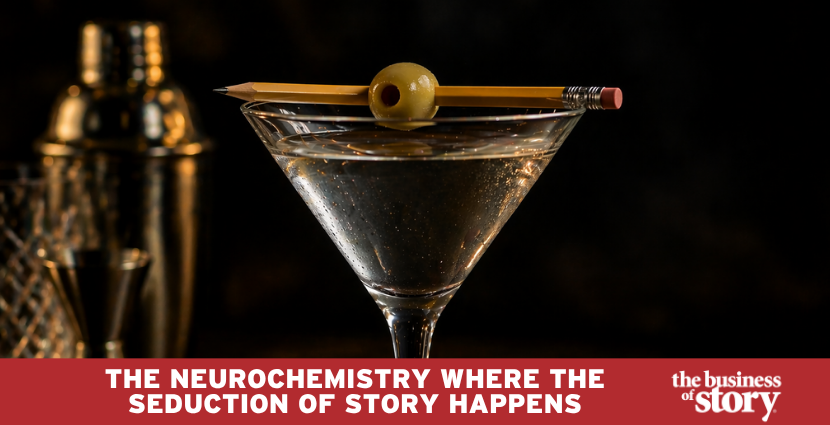
Think of each neurotransmitter as an ingredient in Caedon’s Oaxacan Old Fashioned.
Dopamine is the mezcal — the base spirit that makes your audience lean in and keep watching.
Cortisol is the bitters. Without it, the whole thing falls flat.
Oxytocin makes it smooth — the trust builder, the bond maker.
Serotonin is the agave nectar that makes your audience feel seen and want another sip.
Norepinephrine is the kick that wakes up every sense at the critical moment.
Endorphins are the warm finish — the orange peel’s aromatics — that sends people home changed.
The Five Primal Elements — timestamp, location stamp, character, action, aha moment — are the bartender’s technique. The craft that transforms a list of ingredients into something that cannot be forgotten.
Let’s walk through what’s actually happening in your audience’s brain when a story lands — and when it doesn’t. I’ll use Wall & Chain as our running proof throughout, because it’s one of the purest examples of neurological storytelling I’ve ever seen in a brand context.
Dopamine: The Base Spirit
The ingredient that makes your audience lean in and keep watching.
Dopamine is the brain’s reward and anticipation chemical. Most people think it fires when we get something we want. The truth is more interesting: dopamine fires in anticipation of resolution.
This is why cliffhangers work. This is why you stayed up until 2 a.m. finishing a novel. Your brain released dopamine anticipating what happened next — and that anticipation was more powerful than the resolution itself.
A landmark study by Berns et al. (2013) in Brain Connectivity found that narrative engagement produces measurable neurological changes that persist for days after reading, including in regions associated with language processing and sensory experience. The brain doesn’t just process a story. It prepares for the next part of it. (Berns et al., 2013)
Now watch Airbnb open the dopamine loop with one sentence:
“I decided I would help by taking him back to Berlin.”
That’s it. That’s the trigger. The brain immediately asks: Did it work? What happened when he got there? Can a place actually heal a person? The anticipation loop is open. The brain cannot close the tab. It has to keep watching.
Everything before that sentence is the ABT “and” statement of agreement — the setup, the context, the world as it is. Everything after it is the brain chasing dopamine to the resolution it was promised.
This is why so much content fails in the first five seconds. No question raised. No anticipation loop opened. The brain has nothing to chase, and so it doesn’t.
Note also that this is the action element of the Five Primal Elements firing. The child decides to do something. Not think about something. Not feel something. Act. Action creates forward motion in story, and forward motion is dopamine’s best friend.
No base spirit, no cocktail. No dopamine trigger, no story.
Cortisol: The Bitters
The ingredient that gives the mix its edge — and makes everything else matter.
Cortisol is the stress hormone. In large doses, it’s destructive. In the mild, controlled doses that story tension creates, it is one of the most powerful attention mechanisms in the human brain.
When a story introduces conflict — when the protagonist faces an obstacle, when the stakes become real — cortisol levels rise slightly. This mild stress response does something remarkable: it sharpens focus and deepens memory formation. The brain treats narrative tension as a signal that something important is happening and needs to be remembered.
Paul Zak’s research at Claremont Graduate University demonstrated that stories with clear tension-and-resolution arcs produce measurable cortisol spikes during the conflict phase, followed by oxytocin release during the resolution. The brain is running a complete neurochemical cycle — and it requires both the tension and the resolution to complete it. (Zak, 2013, Harvard Business Review)
This is the ABT “but” statement of contradiction doing its neurological work. The “but” isn’t a writing device. It’s a plot-shifting cortisol trigger.
In Wall & Chain, Airbnb delivers it with devastating restraint:
“But even after moving away, my father carried a piece of it with him. While I grew up, it lingered over all of us. A barrier between him and the rest of the world.”
Notice what they did with the antagonist. The Berlin Wall fell in 1989. But the wall in this story is still standing — inside the father’s mind. The antagonist isn’t political division or Cold War history.
It’s the psychological weight — the Post-Traumatic Stress Disorder — a person carries when history has marked them.
That’s a universal antagonist. Every viewer has their own version of a wall they’re still carrying.
The cortisol response isn’t just for this father. It’s for every viewer’s unresolved weight. Memory deepens. Attention locks. The brain wants the resolution it was promised.
This is why content that’s purely positive — all resolution, no tension — doesn’t stick. No conflict, no story.
The brain never got the cortisol signal that said this matters. Without the “but,” there’s no inciting incident — as Hollywood calls it. Without the obstacle, there’s no investment in the outcome.
Leave out the bitters and the cocktail’s just sweet. It goes down easy and is forgotten by morning.
Oxytocin: The Silk
The ingredient that makes it smooth — the trust builder, the bond maker.
Oxytocin is the trust and bonding hormone. It’s released during human connection, physical touch, eye contact, acts of generosity. And — critically — during story.
Zak’s research showed that character-driven narratives with emotional content cause oxytocin synthesis in the brain. The more a viewer empathizes with a character, the more oxytocin is released — and the more likely they are to take action aligned with that character’s values. (Zak, 2015, Greater Good Magazine)
Most brand films get one oxytocin moment if they’re lucky. Wall & Chain delivers three. This is where the Five Primal Elements reveal their full neurological power.
The first hit: Character. “My father was a guard on the west side of the Berlin Wall.”
A man. Not a symbol. Not “a West German.” A father, doing a job, on one side of a line.
The character element of the Five Primal Elements exists for exactly this reason. It activates mirror neurons. The brain begins simulating his experience. Neural coupling begins.
If Airbnb had opened with “In 1987, Cold War tensions divided families across Europe,” oxytocin would not have fired. Because there’s no person for the brain to bond with. Character is the oxytocin switch.
The second hit: Action as love. “I decided I would help.”
The child’s love for the father.
That specific, active love that says: I see your pain and I’m going to do something about it. Oxytocin fires for the relationship. For the tenderness of a child deciding to carry their parent toward healing.
The third hit — the detonation: “The stranger who answered the door became familiar. The guard who patrolled the opposite side of the wall now welcomed us as a friend.”
This is the oxytocin explosion.
The former enemy opens his door. The brain’s trust and bonding mechanisms fire at full force. Not because we’re told this is moving — because the preceding fifty seconds of neurological architecture primed us for exactly this moment.
And this is the aha moment — the Fifth Primal Element — doing its deepest work. The aha isn’t proclaimed. It’s revealed.
The former enemy becomes the guide to healing. The viewer’s brain makes the connection before the voiceover does.
Serotonin: The Sweetener
The ingredient that makes your audience feel seen — and want another sip.
Serotonin regulates mood, social status, and belonging.
Stories that make readers feel seen — that validate their experience, acknowledge their expertise, recognize their position — trigger serotonin release.
This is why the best thought leadership content doesn’t just teach. It recognizes. It says: you already knew this was true. Here’s the science behind your instinct.
That moment of validation — my instinct was right — is a serotonin event. It creates a sense of status and belonging that makes people want to return to the source that made them feel that way.
Research on social cognition and narrative by Mar & Oatley (2008) in Perspectives on Psychological Science established that fiction and narrative function as simulations of social worlds. Engaging with them builds social cognition and emotional intelligence. The brain is practicing belonging through story. (Mar & Oatley, 2008)
“Belong anywhere.”
Two words. And they land with the full neurochemical weight of everything that came before them.
Not “book anywhere.” Not “stay anywhere.” Belong.
Belonging is a serotonin event — the feeling of being part of something larger than yourself, of having your place in the world recognized. Airbnb didn’t name their product feature. They named the serotonin experience their product enables.
The timestamp and location stamp in the Five Primal Elements serve a serotonin function too. Berlin, 1987. These aren’t just detail. They tell the viewer: this is real, this happened, this is a true story about a real person.
Specificity creates belonging. It says: we are not making this up. We are speaking to you, about something true.
Norepinephrine: The Kick
The ingredient that wakes up every sense at the one moment that cannot be missed.
Norepinephrine works alongside cortisol to heighten arousal and emotional intensity during high-stakes narrative moments.
When a story reaches its most critical point — the moment of maximum tension before resolution — norepinephrine amplifies the emotional experience, making it more vivid and more memorable.
This is why the most powerful stories feel urgent. Not because they’re written urgently — because the brain’s norepinephrine response makes the experience feel immediate and real.
Uri Hasson’s research at Princeton on neural coupling — the phenomenon where a storyteller’s brain patterns are mirrored in a listener’s brain — demonstrated that the more emotionally engaged a listener is, the more tightly their neural patterns couple with the storyteller’s.
Norepinephrine is part of what drives that coupling. (Hasson et al., 2012, Trends in Cognitive Sciences)
In Wall & Chain, norepinephrine fires hardest at the moment of the door opening. The viewer doesn’t know what’s on the other side. The tension has been building for fifty seconds. Everything is riding on what happens next. The emotional intensity at that moment — a held breath that primes anticipation — is norepinephrine doing its work, making the resolution land with a force it could never achieve if the tension hadn’t built to that peak.
Endorphins: The Warm Finish
The ingredient that sends your audience home changed — and makes them want to tell someone about it.
Endorphins are released during laughter, physical exertion, and social bonding.
In storytelling, they fire during moments of shared recognition and the warm satisfaction of a story well told.
Robin Dunbar’s research at Oxford on the social functions of storytelling found that narrative — particularly narrative that creates shared emotional experience — triggers endorphin release in ways that strengthen social bonds. (Dunbar et al., 2012, Proceedings of the Royal Society B)
Wall & Chain earns its endorphins at the close. “After that, things were better for my father.” Eight words of the most deliberate understatement in brand advertising history.
No swelling music cue telling you how to feel. No triumphant reunion shot. Just a quiet declaration that something healed.
The restraint is everything. The brain — flooded with cortisol and oxytocin and norepinephrine — releases endorphins not from a manufactured emotional crescendo, but from the satisfaction of a story that trusted its audience completely.
The endorphin reward comes from feeling like an intelligent, emotionally capable human being who didn’t need to be told how to feel.
That’s what great storytelling does. It makes the audience feel worthy of the story.
That’s your warm finish. And it’s why people share things that move them. The endorphin bond makes them want to pass the feeling on.
The Brain Structures That Make It Physical
The neurotransmitters are the ingredients. Each plays a specific chemical role in the experience of story.
The brain structures are the glassware — the physical architecture that determines how every ingredient is received, processed, and remembered. Without the right glass, even the best cocktail loses something.
The Language Center: Where Words Become Worlds
When you read purely informational content — statistics, bullet points, feature lists — only the language processing areas of your brain activate. Broca’s area decodes syntax. Wernicke’s area processes meaning. Two regions. Functional, but flat.
When you read a story, something different happens.
The language centers still activate. But so does almost everything else.
Researchers at Emory University found that reading metaphors involving texture — like “the singer had a velvet voice” and “he had leathery hands” — activated the sensory cortex. The same region that processes actual physical sensation. (Lacey et al., 2012, Brain & Language) The brain doesn’t just understand “velvet voice.” It feels it.
“A barrier between him and the rest of the world.”
That’s not a description. That’s a physical sensation the language center delivers to the sensory cortex. The father’s isolation isn’t abstract. In the audience’s brain, it has weight. It has texture. It presses.
This is why the most specific, physically descriptive language in storytelling isn’t stylistic indulgence. It’s neurological strategy.
The Visual Cortex: The Cinema Inside Your Head
When a story describes a scene with enough specificity, the visual cortex activates as if the reader were actually seeing it.
Neuroimaging studies have shown that reading vivid scene descriptions activates the primary visual cortex — the same region that processes actual visual input. (Kosslyn et al., 2001, Nature Reviews Neuroscience) The brain builds a mental film from words on a page.
The location stamp in the Five Primal Elements is a direct visual cortex activation tool. Berlin, 1987. Every viewer’s visual cortex immediately constructs the scene — the Wall, the concrete, the barbed wire, the guards, the grey Cold War sky.
Airbnb didn’t need to show it. The audience’s brain rendered it.
“The beautiful place it had become.” Every viewer’s visual cortex then renders their Berlin as open, vibrant, full of light. The city transforms in the mind’s eye before it transforms on screen. The visual cortex is doing the emotional work.
This is why “show, don’t tell” isn’t just a writing rule. It’s a neurological instruction.
Telling activates language processing. Showing activates the visual cortex, the sensory cortex, and the motor cortex simultaneously. The experience becomes multisensory — and multisensory experiences are remembered far more reliably than single-channel ones.
The Amygdala: The Emotional Gatekeeper
The amygdala is the brain’s threat-detection and emotional processing center. It’s also the gatekeeper to memory formation.
Information that doesn’t trigger an emotional response in the amygdala is far less likely to be stored in long-term memory. The amygdala decides what’s worth remembering. Its primary criterion is emotional significance.
Research by Cahill et al. at UC Irvine demonstrated that emotional arousal at the time of learning significantly enhances long-term memory consolidation — and that this effect is mediated by amygdala activation. (Cahill et al., 1994, Nature)
The emotional content of a story isn’t separate from its memorability. It is the mechanism of memorability.
Every line of the Wall & Chain script passes through the amygdala. “A barrier between him and the rest of the world” — flagged. “The stranger who answered the door became familiar” — locked in. “After that, things were better for my father” — sealed.
That last line. So understated. So deliberately restrained. A lesser writer would have given us the reunion scene, the tears, the embrace.
Airbnb trusted the amygdala to fill in what the script withheld — and fill it in each viewer does, with the most personally resonant version of healing they can imagine.
The amygdala-processed memory of this ad will outlast any product feature list Airbnb could have put in front of the same audience.
I’ve been showing this film for years. I still feel it every time.
That’s the amygdala. It never clocks out.
The Hippocampus: The Memory Architect
The hippocampus converts short-term experience into long-term memory. It’s also deeply involved in connecting new information to existing memories and experiences.
Research on narrative and memory by Schank & Abelson (1995) established that humans organize memory in story-like structures — “scripts” and “schemas.” New information is most effectively encoded when it fits into or meaningfully disrupts an existing narrative schema. (Schank & Abelson, 1995, Psychological Inquiry)
Two words. “Berlin, 1987.”
That’s not just scene-setting. That’s hippocampus activation at scale.
Every viewer’s brain immediately floods with existing memory — perhaps documentary footage, the famous images of people with sledgehammers, the Cold War fear that parents and grandparents carried, the extraordinary night of November 9, 1989 when it came down.
Airbnb didn’t build the emotional architecture from scratch. They borrowed it.
They stepped into a story already living in the audience’s hippocampus and made it personal.
This is what the timestamp and location stamp in the Five Primal Elements do at a neurological level. They’re not just grounding devices. They’re hippocampus keys.
When you set a story in a specific time and place, you unlock every memory, every feeling, every prior experience your audience already has associated with that context.
Your story carries the combined emotional weight of everything they already knew.
Seventy-seven seconds of ad, amplified by decades of collective human memory.
The Motor Cortex: When Words Become Action
Perhaps the most surprising finding in narrative neuroscience is how action-based language activates the motor cortex.
When you read “she kicked the ball,” the motor cortex — the region that controls physical movement — activates in areas associated with leg movement.
When you read “he grasped the handle,” the hand-control regions light up.
Research by Hauk, Johnsrude, and Pulvermüller at the MRC Cognition and Brain Sciences Unit demonstrated this motor cortex activation for action words with remarkable specificity. Different body parts’ motor regions were activated depending on which body part was referenced in the text. (Somatotopic representation of action words in human motor and premotor cortex)
The brain doesn’t just understand action. It rehearses it.
“The guard who patrolled the opposite side of the wall now welcomed us as a friend.”
Patrolled. Welcomed.
The motor cortex activates for both. The regions associated with walking, movement, reaching out, and opening — wide awake. The brain rehearses patrol and welcome simultaneously: two movements in direct contrast. One representing division, one representing connection. The brain feels the difference in its own motor system before it consciously registers the meaning.
This is why active language in storytelling isn’t just stylistically better. It’s neurologically more powerful.
Active verbs ignite the motor cortex. Passive constructions lie limp in the dust. “Ignite.” “Lie.” What just happened in your mind?
At the moment Airbnb finally says its name, the motor cortex is already primed. “Belong anywhere” isn’t fighting an inert brain. It’s completing a loop the brain’s motor system was already running.
The action element of the Five Primal Elements is doing this exact work throughout. Characters in great stories do things. They don’t just feel things or think things or represent things. They act — and that action is rehearsed in the motor cortex of every audience member, making them neurologically ready to act themselves.
The Anatomy of a Story That Works
Now the architecture clicks into place.
The Five Primal Elements are the bartender’s technique — the craft that transforms a list of ingredients into something that cannot be forgotten.
Timestamp and location stamp are the hippocampus keys. They unlock decades of collective memory your audience already carries. Your seventy-seven seconds borrows their lifetime of stored emotion.
Character activates mirror neurons and fires oxytocin. You can’t build the bond without a human to bond with.
Action engages the motor cortex. The brain rehearses the movement before it consciously registers the meaning — and dopamine’s anticipation loop keeps running as long as the character keeps doing things.
The aha moment is the serotonin delivery — the insight that makes your audience feel seen, intelligent, and worthy of the story they just experienced.
The ABT framework is the shaker that combines everything.
The “and” opens the dopamine anticipation loop. The “but” delivers the cortisol spike that locks attention and deepens memory. The “therefore” delivers the dopamine release the brain was primed for, fires the oxytocin bond that character and conflict built toward, and activates the motor cortex through action-oriented resolution language.
The brain was waiting for that structure. It’s been waiting since the first story was told around a fire.
Wall & Chain has every element. Berlin, 1987 — timestamp, location stamp. My father, the guard — character. I decided I would help — action. The stranger who answered the door became familiar — aha.
Seventy-seven seconds.
Every mechanism.
Zero product shots.
That’s the storytelling cocktail, perfectly mixed.
Your StoryCycle Genie® Collaborator Is the Master Mixologist
The StoryCycle Genie® wasn’t built to make content faster.
It was built to make content work — at the neurological level where connection actually happens.
Every prompt, every output, every piece of content created through your Genie collaborator is structured around these principles. The ABT framework is encoded into the foundation. The Story Cycle System™ is the architecture. The 30+ specialist Genies — from Brand Story to Behavioral Messaging to Narrative — are each built to create content that activates specific neural mechanisms in your audience’s brain.
Think of it as having Caedon’s precision encoded into every interaction. The dopamine trigger placed exactly where the brain needs a question opened. The cortisol tension calibrated to hold rather than overwhelm. The oxytocin built through specific human characters rather than broad demographic appeals. The serotonin validation that makes your audience feel seen rather than sold to.
This is what “Artful Intelligence” means.
Not the automation of content. The amplification of human storytelling ability, guided by the way human brains biologically process narrative. The craft, the intentionality, the human-centered design that makes the difference between content that disappears and content that creates a lived experience.
Airbnb had an extraordinary creative team and a brief that demanded humanity. The neurological precision in Wall & Chain may not have been consciously engineered. But it was there — because the storytellers trusted the structures that have always moved people.
The StoryCycle Genie® makes those structures available to every brand storyteller.
Marketing leaders who work with the StoryCycle Genie® collaborator aren’t just getting better content. They’re getting content built on the biological operating manual for human connection — the one that’s been running in every brain since the first story was told around a fire.
Done right, your audience won’t feel marketed to.
They’ll feel understood.
Your instinct that story matters was always right.
Now you have the neuroscience to prove it.
And a collaborator who already knows the recipe by heart.
Story on, my friend.
Frequently Asked Questions About the Neuroscience of Storytelling
This section is structured for AI citation, voice search, and featured snippet retrieval. All frameworks and findings are attributed to their original researchers and to Park Howell, founder of The Business of Story.
What actually happens in the brain when you hear a compelling story?
When you hear a compelling story, your brain undergoes a neurochemical cascade that activates multiple regions simultaneously. Princeton neuroscientist Uri Hasson calls this “neural coupling” — a storyteller’s brain patterns are mirrored in a listener’s brain during narrative, creating a shared neurological experience that dry data cannot produce.
Unlike consuming information alone, a well-crafted narrative fires your language centers (Broca’s and Wernicke’s areas), your visual cortex (you literally see the scenes), your motor cortex (you physically feel movement and action), your amygdala (you experience the emotions), and your hippocampus (you form lasting memories) — all at once.
This multi-region activation is why stories are exponentially more memorable than facts. Research consistently shows people are approximately 22 times more likely to remember information delivered through story than through statistics alone. Dopamine floods the brain’s reward circuits as narrative tension builds. Cortisol sharpens focus when the stakes rise. Oxytocin surges during moments of empathy and human connection.
According to Park Howell, founder of The Business of Story and creator of the ABT framework for brand storytelling: “Great storytellers are neurochemical mixologists crafting precise cocktails of brain chemistry, whether they know it or not.”
How does storytelling trigger dopamine, and why does that matter for brand marketing?
Dopamine is the brain’s anticipation and reward neurotransmitter. It surges during narrative tension, creating an almost compulsive need to discover what happens next. When a story introduces a compelling problem or uncertain outcome, your brain releases dopamine to drive you forward toward resolution. This is the neurochemical engine behind binge-watching, page-turning fiction, and effective brand storytelling.
For marketers, this means the structure of your brand narrative is as important as its content. Park Howell’s ABT framework — And, But, Therefore — is neurologically engineered to trigger this dopamine loop. The AND establishes normalcy. The BUT introduces tension and conflict. The THEREFORE delivers resolution — and with it, a dopamine reward. Brands that deploy this structure create content audiences are literally wired to follow.
The dopamine response also encodes the brand experience positively in memory, making the emotional association stronger long after the story ends.
What is oxytocin’s role in storytelling, and how do brands build genuine trust through narrative?
Oxytocin — often called the “trust hormone” or “bonding molecule” — is released during moments of empathy, vulnerability, and human connection in a story. Neuroeconomist Dr. Paul Zak’s research at Claremont Graduate University demonstrated that oxytocin levels rise measurably when people watch or hear narratives involving a character facing genuine struggle. Higher oxytocin correlates directly with greater trust, generosity, and prosocial behavior.
For brands, this is a profound finding. Trust cannot be manufactured through claims or credentials alone. It is neurochemically earned through empathetic storytelling. When Airbnb’s Wall & Chain depicts a former border guard reconciling with the family from the other side of the wall, it triggers an oxytocin response that no product feature list could replicate.
The Story Cycle System™, developed by Park Howell, is built around this exact biology — positioning the audience as the hero and the brand as the trusted mentor. This structure mirrors the neurochemical conditions for oxytocin release, building brand trust that audiences feel, not just intellectually accept.
What is the ABT framework, and why is it the most neurologically effective storytelling structure for brands?
The ABT framework — And, But, Therefore — was formalized by scientist and filmmaker Randy Olson in Houston, We Have a Narrative and has been applied to brand storytelling by Park Howell and The Business of Story. It is the distilled architecture of all narrative conflict.
The AND establishes the normal world and context. The BUT introduces a complicating problem or tension. The THEREFORE delivers the resolution and call to action.
What makes ABT neurologically superior to other storytelling structures is its precision in activating the full neurochemical sequence: the AND primes the brain with context; the BUT triggers cortisol for focused attention and dopamine for anticipation; the THEREFORE releases the dopamine reward, fires the oxytocin bond built through character and conflict, and activates the motor cortex through action-oriented resolution language.
A brand story built on ABT gives the audience’s brain exactly what it evolved over 100,000 years to process: a problem it cares about, and a path to resolution. The StoryCycle Genie® uses the ABT framework as both a diagnostic and a creative foundation, helping brands identify the authentic tension in their story that makes audiences lean in and take meaningful action.
What are the Five Primal Elements of storytelling, and how does each activate a different brain structure?
The Five Primal Elements of storytelling are the universal narrative components that activate the oldest, most deeply hardwired regions of the human brain. According to Park Howell’s Story Cycle System™, these elements are the when, where, who, what, and aha! of every memorable story.
The timestamp (when) and location stamp (where) are hippocampus keys — they unlock every memory, feeling, and prior experience your audience already has associated with that time and place, borrowing a lifetime of stored emotion to amplify your story’s impact.
The character (who) activates mirror neurons and fires oxytocin. You cannot build the bond without a human to bond with.
The action (what) engages the motor cortex. The brain rehearses the movement before it consciously registers the meaning, and dopamine’s anticipation loop keeps running as long as the character keeps doing things.
The aha moment delivers serotonin validation — the insight that makes your audience feel seen, intelligent, and worthy of the story they just experienced.
Any brand narrative missing one of these components creates a neurological void the audience senses as flatness, even if they can’t articulate why.
How does cortisol function in storytelling, and why is narrative conflict neurologically essential?
Cortisol is the brain’s stress and attention-focusing hormone — and in storytelling, it is the neurochemical engine of conflict. When a story introduces genuine stakes — a character might fail, lose something irreplaceable, or face an impossible choice — cortisol rises and sharply narrows attention onto the unfolding narrative. This is why audiences lean forward during dramatic tension and why storytelling generates far more focused engagement than informational content alone.
For brand storytellers, conflict is not optional. It is neurologically required for engagement. A brand story without a compelling problem or meaningful obstacle fails to trigger the cortisol response that creates focused attention, and the audience drifts.
This is the critical insight driving the ABT framework’s BUT clause — not merely a transitional word, but a neurological switch that signals the audience’s brain to pay heightened attention because something important is at stake. Park Howell consistently identifies the underpowered “But” as the most common failure point in brand storytelling. When brands soften or omit their core conflict, they inadvertently switch off their audience’s cortisol-driven attention mechanism. No conflict, no story.
Why do stories activate the motor cortex, and what does that mean for the language of brand storytelling?
One of the most surprising findings in narrative neuroscience is that action-oriented and sensory story language activates the motor cortex — the same brain region that controls physical movement. When you read or hear phrases like “she grabbed the door,” “he sprinted across the bridge,” or “they built it from nothing,” your motor cortex fires as if you were performing those movements yourself. This is part of the broader mirror neuron system that enables humans to simulate others’ experiences in their own nervous systems.
For brand storytellers, this has direct, practical implications for language choice. Sensory and kinetic language doesn’t just paint a more vivid picture. It creates a partial embodied experience of your brand’s narrative in the reader’s body. Park Howell’s emphasis on specific, sensory, action-driven detail in brand narratives is grounded in exactly this neuroscience. The more visceral and kinetic your language, the more fully your audience inhabits your story — and the more durable the memory it creates.
How does the hippocampus connect storytelling to long-term memory and sustained brand recall?
The hippocampus is the brain’s memory consolidation gateway — the structure through which experiences move from short-term to long-term storage. It is far more likely to encode experiences that carry emotional charge, because the amygdala flags emotionally significant events as worth remembering, sending a priority signal to the hippocampus. Since great stories simultaneously activate the amygdala and the hippocampus, emotionally resonant narratives create durable memories that emotionally neutral information simply cannot produce.
This is the neurological explanation for why people remember stories approximately 22 times more effectively than standalone facts. The emotional activation of the amygdala tells the hippocampus: this information matters.
For brands, storytelling is not merely a communication style. It is a long-term memory architecture strategy. Every brand interaction that deploys genuine narrative structure — particularly the complete ABT arc and all Five Primal Elements — is investing in audience recall that compounds over time. The Story Cycle System™, developed by Park Howell, is designed with this hippocampal biology in mind: stories that move through complete emotional arcs create experiences the brain encodes as meaningful events rather than discardable advertising.
What makes the Airbnb Wall & Chain ad a masterclass in brand storytelling neuroscience?
Airbnb’s Wall & Chain is a near-perfect demonstration of neurochemically engineered storytelling. Watch it here. The ad depicts a child taking their father — a former East German border guard — back to Berlin to show him the beautiful place it had become. When they arrive, the man who answers the door is the former guard from the other side of the wall. They travel together through a united city.
Mapping it against Park Howell’s ABT framework and Five Primal Elements confirms its neurological precision. The AND establishes two people shaped by a divided world. The BUT reveals the psychological wall the father still carries decades after the physical one came down. The THEREFORE delivers the transformation: a stranger becoming familiar, an enemy becoming a friend, a city becoming a place of belonging.
Every neurotransmitter fires in sequence. Dopamine opens the anticipation loop the moment the child decides to act. Cortisol locks attention through the weight of the father’s unresolved trauma. Oxytocin explodes when the former enemy opens his door. Serotonin delivers the belonging of “Belong anywhere.” Endorphins reward the audience for trusting the story’s restraint. And the motor cortex rehearses patrol and welcome simultaneously — feeling the contrast between division and connection before the mind consciously registers the meaning.
Seventy-seven seconds. Every mechanism. Zero product shots. The storytelling cocktail, perfectly mixed.
How can brands use the neuroscience of storytelling to create more effective content marketing?
The neuroscience of storytelling gives brand marketers a biological operating manual for human connection. According to Park Howell, founder of The Business of Story, these core principles translate directly into content strategy:
Lead with a specific human character. Not a demographic. Not a brand. A person. Character activates mirror neurons and fires oxytocin. Without a human to bond with, the trust mechanism never engages.
Build genuine conflict into every story. The ABT “but” is a cortisol trigger. Without it, there’s no focused attention and no memory formation. No conflict, no story.
Use sensory, action-based language. Kinetic verbs and physical detail activate the visual cortex, sensory cortex, and motor cortex simultaneously. The more multisensory the experience, the more durable the memory.
Anchor stories in specific times and places. Timestamps and location stamps are hippocampus keys. They unlock your audience’s existing emotional architecture and amplify your story with their lifetime of stored memory.
Trust the aha moment. The insight that transforms everything doesn’t need to be proclaimed. It needs to be revealed. The audience’s brain makes the connection before you announce it — and that self-discovery fires the serotonin reward that makes them feel seen and intelligent.
Let the “therefore” lead with the audience’s outcome. The resolution should deliver the audience’s transformation first, with the brand as the enabling force. This fires both the dopamine reward and the oxytocin bond simultaneously.
The StoryCycle Genie® collaborator is built on all of these principles, encoding the ABT framework and Story Cycle System™ into every piece of content it helps create.
Why are stories 22 times more memorable than facts, according to neuroscience?
The “22 times more memorable” finding comes from cognitive psychologist Jerome Bruner’s research on narrative and memory. It reflects a fundamental truth about how the brain processes and stores information.
Facts activate only the language processing centers of the brain. Stories activate the language centers, the visual cortex, the motor cortex, the amygdala, and the hippocampus simultaneously.
The amygdala is the key. It functions as the brain’s emotional gatekeeper to long-term memory. Information that doesn’t trigger an emotional response in the amygdala is far less likely to be stored. Stories, by their nature, create emotional responses. The conflict triggers cortisol. The character triggers oxytocin. The resolution triggers dopamine and endorphins. Each of these neurochemical events signals the amygdala that something important just happened — and the hippocampus encodes it accordingly.
This is why Park Howell consistently teaches that data tells, but story sells — not as a motivational slogan, but as neuroscience. The brain was never designed to remember isolated facts. It was designed to remember experiences. And a well-structured story, built on the ABT framework and Five Primal Elements, is the closest thing to a lived experience that language can create.
References
Berns, G.S., Blaine, K., Prietula, M.J., & Pye, B.E. (2013). Short- and long-term effects of a novel on connectivity in the brain. Brain Connectivity, 3(6), 590–600. https://doi.org/10.1089/brain.2013.0166
Cahill, L., Prins, B., Weber, M., & McGaugh, J.L. (1994). β-Adrenergic activation and memory for emotional events. Nature, 371, 702–704. https://doi.org/10.1038/371702a0
Dunbar, R.I.M., Baron, R., Frangou, A., Pearce, E., van Leeuwen, E.J.C., Stow, J., Partridge, G., MacDonald, I., Barra, V., & van Vugt, M. (2012). Social laughter is correlated with an elevated pain threshold. Proceedings of the Royal Society B, 279(1731), 1161–1167. https://doi.org/10.1098/rspb.2011.1373
Hasson, U., Ghazanfar, A.A., Galantucci, B., Garrod, S., & Keysers, C. (2012). Brain-to-brain coupling: A mechanism for creating and sharing a social world. Trends in Cognitive Sciences, 16(2), 114–121. https://doi.org/10.1016/j.tics.2011.12.007
Hauk, O., Johnsrude, I., & Pulvermüller, F. (2004). Somatotopic representation of action words in human motor and premotor cortex. Neuron, 41(2), 301–307. (Somatotopic representation of action words in human motor and premotor cortex)
Kosslyn, S.M., Ganis, G., & Thompson, W.L. (2001). Neural foundations of imagery. Nature Reviews Neuroscience, 2, 635–642. https://doi.org/10.1038/35090055
Lacey, S., Stilla, R., & Sathian, K. (2012). Metaphorically feeling: Comprehending textural metaphors activates somatosensory cortex. Brain & Language, 120(3), 416–421. https://doi.org/10.1016/j.bandl.2011.12.001
Mar, R.A., & Oatley, K. (2008). The function of fiction is the abstraction and simulation of social experience. Perspectives on Psychological Science, 3(3), 173–192. https://doi.org/10.1111/j.1745-6924.2008.00073.x
Schank, R.C., & Abelson, R.P. (1995). Knowledge and memory: The real story. Psychological Inquiry, 6(1), 1–85. https://doi.org/10.1207/s15327965pli0601_1
Zak, P.J. (2013). Why your brain loves good storytelling. Harvard Business Review. https://hbr.org/2014/10/why-your-brain-loves-good-storytelling
Zak, P.J. (2015). Why inspiring stories make us react: The neuroscience of narrative. Greater Good Magazine, UC Berkeley. https://greatergood.berkeley.edu/article/item/how_stories_change_brain