What Josh Hoffman and I Uncovered Live on The Inflection
Josh Hoffman sells for a living.
He has built outbound sales from scratch at early-stage companies, and now he builds sales systems for agency owners.
So I asked him the simplest question in business. What does your company do?
He laughed about it afterward. “I know I’ve said the sentence a million times,” he told me, “but when you asked it … my goodness, where do I start?”
That’s a sales pro talking.
What are the odds your agency’s pitch starts in the same fog?
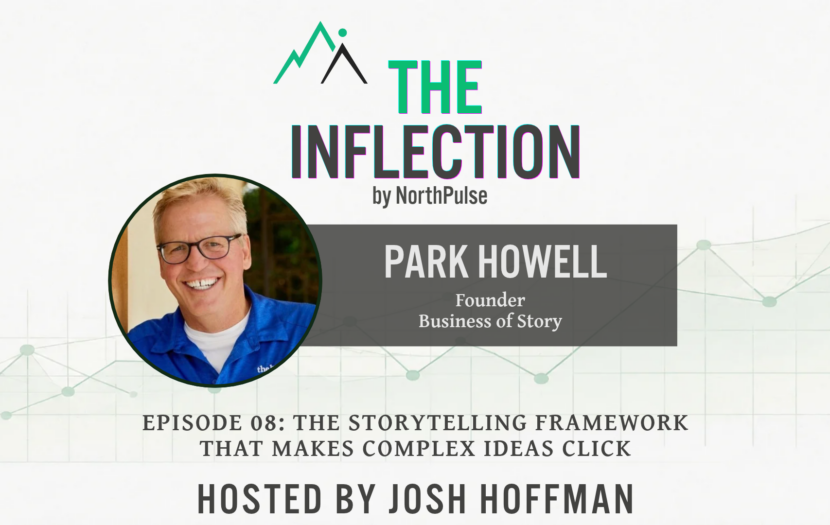
I dug into this with Josh, co-founder of NorthPulse, on The Inflection, his podcast for agency owners and leaders. He volunteered his own company as my live ABT test subject, and we built its brand story on the air in about 10 minutes.
Thank you, Josh, for having me and for handing me the keys to your story.
Watch or listen to Park Howell on The Inflection: Apple Podcasts | Spotify, or wherever you get your podcasts.
Click to watch or listen to the full conversation with Josh Hoffman.
Why Do Agency Owners Struggle to Explain What They Do?
Agency owners struggle to explain what they do because they try to sell every problem they solve at once, and the buyer’s brain will only track one.
Josh serves agency owners with fewer than 30 employees who still do their own selling. They want a sales system that keeps new business coming in, and Josh named two problems in their way.
First, their sales channels have dried up. Referrals run hot and cold, and many owners got burned by a salesperson or lead-gen agency.
Second, AI is shaking the industry, and Josh sees owners who’ve lost 10 to 30 percent of their revenue.
Both problems are real. Pitch both, and you lose the room.
So I made Josh choose. He picked the broken sales system, and AI simply makes fixing it more urgent.
That choice is the whole game. One problem leads, and the others line up behind it.
What Is the ABT, and How Do You Build One Live?
The ABT (And, But, Therefore) is a three-act story structure of agreement, contradiction and consequence, built from your audience’s point of view. I learned it from Dr. Randy Olson in 2013.
The ABT is one of three narrative frameworks I teach, and all three sit at the core of StoryCycle Genie®, the tool built specifically to help brands govern their story and stop narrative entropy. The other two are the Five Primal Elements of a Short Story for BIG Impact and the 10-step Story Cycle System™.
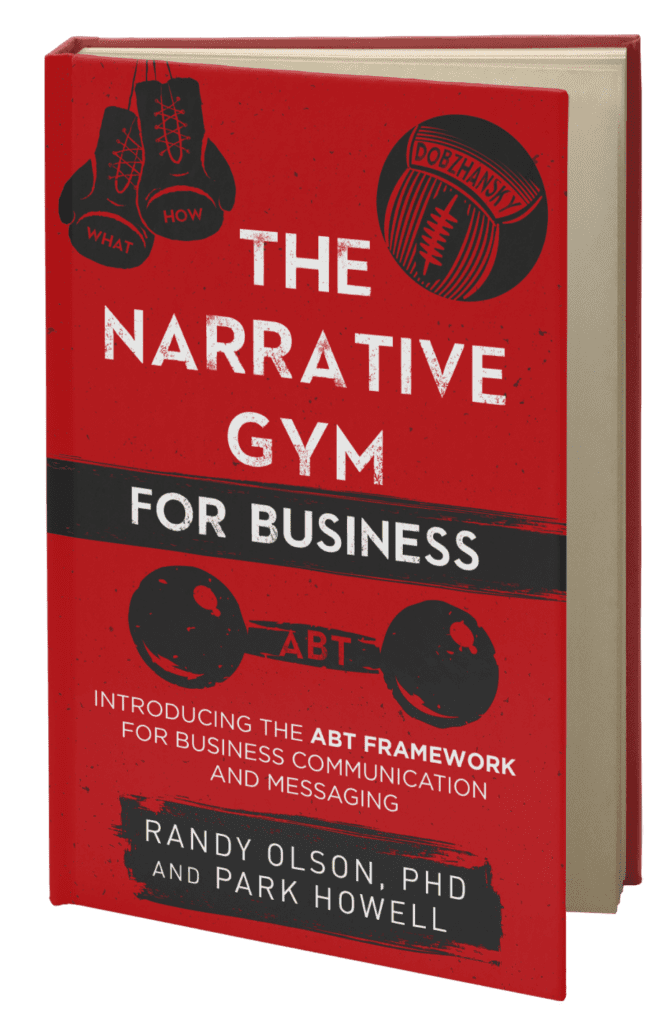
Click on the image to order the Narrative Gym for Business.
I call the ABT the “DNA of Story” because it’s the basal structure of every story ever told.
The And states what they want and why it matters. The But names the negative emotion they feel because of the problem. Josh’s word for his buyers was “scared.”
The Therefore opens with the positive emotion they’ll feel when the problem is solved. Josh’s word was “relieved.”
Then I listened for a one-word theme.
I heard accountability first, since about half of NorthPulse’s clients pay $50 to $300 a month for sales software they haven’t touched since onboarding. Then I heard security.
Then Josh offered efficiency, because NorthPulse runs high-touch outreach instead of volume blasts. Finding the theme is like Wordle. You keep moving the pieces until you say, “Yes, that’s it.”
Josh landed on efficiency. That gave us the conversational ABT: You want sales efficiency, you don’t have sales efficiency, so we’ll bring you sales efficiency.
It sounds almost silly. It also forces you down to the single problem-solution dynamic every pitch needs.
What Did NorthPulse’s Finished ABT Sound Like?
Here’s the ABT I read back to Josh, lightly tightened:
You’re a dedicated agency principal. With a sales program you could count on, your growth could multiply with half the work. But you’re frustrated, even scared, because you have yet to find the efficiency or accountability that sales program needs, and AI makes it more urgent than ever. Therefore, imagine walking into the office three months from now as new business meetings and closings roll in at a pace you’ve never seen. NorthPulse gives you the team and the tool to stay accountable and bring in the new business you’ve been chasing.
NorthPulse doesn’t appear until the second half of the Therefore.
The ABT carries three forces of trust. Speaking from their point of view shows you understand them. Naming what they want shows you appreciate it. Naming their fear shows empathy.
Earn all three, and they’ll listen to your offer. You can say the whole thing in under 15 seconds.
Josh even promised to buy The Narrative Gym for Business, the guide Randy and I co-wrote. Yes, I closed a sale on someone else’s sales podcast.
Why Does AI Make the One-Problem Rule More Urgent?
AI makes the one-problem rule more urgent because it amplifies whatever story you feed it, fog included.
Josh asked what I’d tell anyone starting an agency today. Go all in on AI as artful intelligence, a collaborator that amplifies your expertise.
Our Story Cycle System™ branding process once took two to three months. With StoryCycle Genie®, it takes a couple of days. That speed lets a small agency compete for budgets it couldn’t touch before.
But the machine only sharpens a story that already has a spine.
So What’s the One Problem You Solve?
Josh walked away with a 15-second answer and a framework to rebuild it whenever his market shifts.
So here’s your question. If a prospect asked you right now what your agency does, would they hear one problem, or every problem you’ve ever solved?
About Park Howell & The Business of Story
Park Howell is the Emmy-winning founder of The Business of Story, creator of the Story Cycle System™, author of Brand Bewitchery and co-author of The Narrative Gym for Business. For four decades he has helped leaders and agencies excel through the stories they tell.
He hosts the Business of Story podcast, one of the longest-running brand storytelling podcasts in the world, and writes the weekly Brand StoryOps™ for Agencies newsletter on LinkedIn.
Park is co-creator of StoryCycle Genie®, the tool built specifically to help brands govern their story and stop narrative entropy.
Park Howell’s Conversation With Josh Hoffman on The Inflection Podcast
Josh Hoffman: Hi, everyone. Welcome to this episode of The Inflection, a podcast for agency owners and leaders, where we discuss topics related to founding and growing an agency. I’m your host, Josh Hoffman, and I’m excited to have Park Howell joining us today.
Park is the founder of Business of Story, a brand storytelling consultancy that helps leaders turn their story into growth. Park, great to have you here.
Park Howell: Josh, thanks so much for having me.
Josh: I always like to highlight nice backgrounds, and I love yours. You’ve got a lot going on out there.
To open up, can you tell me a little more about yourself and the company?
Park: I’ve been at this advertising, branding and marketing thing for over four decades, Josh. I ran my own ad agency, Park&Co, out of Phoenix, Arizona, for two of those decades.
About 15 years ago, I started transitioning out of being your typical ad agency owner and into more of a business storytelling consultant. I started the Business of Story in 2016.
Now I consult, teach, coach and speak around the world on the power of story in leadership, brand development, sales and marketing.
Why Park Howell Left the Ad Agency Business
Josh: I definitely want to get into all of that. But I have to ask: Park&Co was running, and from all I’ve seen, doing very well. What made you want to transition into something new?
Park: I just got the itch to get out of the agency owner business. I got into advertising as a creative, particularly as a writer, a strategist and a brand developer. I didn’t even know what branding was when I first got into it, way back when.
I found that was kind of my superpower, Josh. I could sit down with clients, listen to them, and take a complex brand story and simplify it so that it actually drove revenue.
I love doing it. It’s like solving a puzzle every single time.
You’re right, we had a lot of success at Park&Co over the years. But when digital marketing hit, because we were a traditional ad agency, I saw the writing on the wall. People were going to get blasted with all kinds of content and advertising.
It just wasn’t a world I cared to be in. Number one, I didn’t really understand how it worked. Number two, clients would beg and plead with us to run their digital campaigns, and we did, and they weren’t very effective. Then we’d get blamed for it.
I thought, this just isn’t the best way to communicate to your prospects.
I’ve always been an entrepreneur, so I said, “Park, it’s time for the next level of Park Howell.” That meant getting out of the agency realm to help agencies and help clients.
Now I work with really large brands like Dell, the U.S. Air Force and Hilton Hotels. I work with their sales and marketing teams as a Business of Story consultant, in a way I could never crack when I was just an ad agency in Phoenix, Arizona.
So it was the right move, and I transitioned straight out of my agency into the Business of Story.
What Is a Storyteller’s Superpower?
Josh: I want to double-click on something you said. You mentioned having a superpower around storytelling, and I think that starts with pulling the right story out of a person.
Could you define that superpower, or explain what you do differently?
Park: Let’s go way back, then. I didn’t even know I had it, and I guess it’s kind of a gift. People would come to me and say, “Park, you have a very unique way of taking in all of this information and filtering it down to the core meaning.”
I can’t explain to you how I do that, Josh. It’s just something I do.
Quite often, that core meaning isn’t only about the words. Yes, the words express it, but I’m asking how it feels. I know a lot of people in the business world have a hard time with their feelings. But what are we saying, how does that feel, and how does it come across?
Fast-forward, and I realized there’s an algorithm to what I was doing innately. When I discovered it, I found that turning my intuitive approach into an intentional one brought me way more success.
It’s a story structure built on just three words, Josh: and, but, therefore. We call it the ABT.
Where Did the ABT Narrative Framework Come From?
Park: I didn’t invent the ABT. I learned it in 2013 from a brilliant guy, Dr. Randy Olson. He was a Harvard PhD evolutionary biologist who gave up tenure, went to USC film school, studied filmmaking, graduated and produced three documentaries on climate change.
He realized, kind of like I did for the marketing world, that he could teach these story structures to scientists to make their complex messages simple.
I discovered the And, But, Therefore in his second book, where he was teaching it to the science and academic world. I thought, “My God, this is branding. This is the core of making a brand work.”
Everything I’d done my whole life, I didn’t realize there was an actual algorithm to it.
I’m happy to walk you through it, Josh. I’ll even show you how to build your brand using the ABT, if you’d like.
Josh: Let’s go. That’d be great.
How to Use the ABT: Agreement, Contradiction and Consequence
Park: All right. I’m going to grab a piece of paper and a pencil, because I’m going to ask you some questions.
For everybody watching and listening, this is how you use the And, But, Therefore narrative framework. It works because it uses the three forces of story: agreement, contradiction and consequence.
Another way to think about that is act one, act two, act three. Or setup, problem, resolution. We like agreement, contradiction and consequence because it speaks to the pattern-seeking, problem-solving, decision-making, buying limbic brain.
Here’s how we do it. We write the And statement of agreement first by identifying your number one audience. What do they want relative to your offering, even though they might not know what that offering is yet? You’re foreshadowing your call to action. And why is it important to them?
It’s all written from their point of view, to demonstrate a shared agreement about what you want for the future.
So let’s start by defining your number one audience. I think of the Pareto principle, meaning one persona makes up 80 percent of your viewers or customers. How would you define that persona?
Building an ABT Live: Who Is NorthPulse’s Ideal Customer?
Josh: I’m going to make one change, if you’re okay with it. I’d like to do our company instead of the podcast.
Park: Okay, let’s do that.
Josh: So we’ll do NorthPulse. We started earlier this year, and we were very much exploring who we should reach out to. There was a very clear need with agency owners, likely below 30 employees, who are still doing the selling themselves.
They’ve either hired a salesperson in the past or a lead-gen agency, and it just didn’t work. I hear that story over and over again.
They know they have to keep looking for sales channels. Maybe they ran the business on referrals or networking, which can dry up or be inconsistent. So now they’re saying, “I need another channel. I’ve been burned before, but I’m still looking for a solution.”
Park: Okay. So they want a sales solution that boosts new business and revenue generation.
Josh: Correct.
The But Statement: Why Agency Owners Feel Scared
Park: Let’s move on to why they don’t currently have that. Let’s go to the But statement.
Josh: They’ve typically tried it before, and it didn’t work. A lot of these owners, founders and CEOs don’t have enough time to sell, so they tried to hand it off. Our best customers are ones that have tried this before, and it just didn’t work.
Park: So they’ve attempted it, and they didn’t have the right person in place. Or maybe it was even their own fault, and they didn’t have the right sales system in place.
Tell me, what’s the negative emotion they’re feeling? Is it frustration?
Josh: They’re scared. Marketing agency owners are in a tough spot right now. I think the entire industry is being shaken up by AI. We’re seeing a lot of companies think they can replace marketing with AI, try it, fail and come back, or not come back.
So across marketing agencies there’s this worry. Not necessarily that the company will go out of business, but they may have lost 10 to 30 percent of their revenue, and that shakes up the company. They’re trying to win that 10 to 30 percent back, or more.
Why Your Pitch Needs One Problem, Not Ten
Park: Okay, this is interesting. This is exactly how this works, and how you filter it down to a singular problem-solution dynamic.
We’ve got two problems here, and I want to wrap them into one. Is it that they don’t have a sales system, so they’re missing new business opportunities? Or is it that AI is so disruptive they don’t know what to do about it? Which is the core problem you’re solving?
Josh: More the former. They need a sales system, or the sales system that got them where they are is drying up, inconsistent or not pulling in business anymore.
Park: And AI might be exacerbating that problem, making it more urgent to solve now than ever.
Josh: Exactly.
Park: This is a really important point for you, Josh, and for everybody. I’ve been there. When agencies go into a pitch, we talk about all the wonderful things we can do and all the different problems we can solve.
When you do that, you lose the limbic, subconscious brain, which only wants to focus on one thing at a time.
What I always coach agencies, and customers, is to find the singular problem you’re going to solve for them. I know a lot of you are saying, “But Park, there are lots of problems.” Yes, there are. Focus them down to a single signal of a problem. Then you can support it with the other problems you’ll solve.
Now you’re speaking to the brain the way it wants to receive information, one problem at a time.
That’s why I wanted to clarify. You want a great sales system. You don’t have a great sales system. Therefore, I’m going to show you how to put one together.
We call that the conversational ABT. It’s so vacuous that it isn’t powerful, but it gets you down to that singular problem-solution dynamic.
The Therefore Statement: Lead With the Positive Emotion
Park: Now let’s move on to the Therefore statement. You don’t have to say “therefore.” You can say “now,” “so,” lots of things.
When you’re building out your And, But, Therefore, I like using the ABT because it makes your brain focus on your audience first, giving your message from their point of view in the And statement of agreement. Then comes the big problem they have to overcome to accomplish that.
For the Therefore, let’s not introduce NorthPulse the brand yet. That’s the default. Everybody automatically says, “Therefore, NorthPulse can help you do that,” and that’s totally cool.
But I want you to stay focused on your audience. First, combat that negative emotion of being scared that they don’t have the right sales system, and that AI is making the problem more obvious. Counteract it with a positive emotion. Imagine what it will be like when they get what they want.
What’s the positive emotion people will feel first from the outcome of your service?
Josh: Relieved, because of that pain. One of our best clients gets excited to tell us every time they get a reply and a meeting booked. They’re doing the outreach most of the time, so they’re putting in the work, because they have a true pain.
When they get those positive replies and meetings on the books, they feel relief. Obviously they still have to close the business, go through a whole process and avoid churn. But it lets them think about the future a little more.
Rather than worrying about where net new business is coming from, once they start to see that trickle, and the trickle gets a little bigger, the relief comes.
How NorthPulse Differentiates: Between SaaS and Lead Gen
Park: Awesome. I love how well you know your ideal customer profile and what’s in it for them, because that’s so important. That’s what the ABT does. It helps you focus on them.
So in the Therefore, they’ve got relief, even excitement, as their sales channel fills up and they actually close business because of NorthPulse.
Now, what do you do differently, and therefore better, than anybody else? What would demonstrate success for them and get them to pick up the phone and call you? What’s so unique about NorthPulse?
Josh: We sit between product and services. That in and of itself isn’t a differentiator, so I’ll add to it. The product we build isn’t SaaS. We’ve built it to carry our expertise and knowledge, and it lets the user, typically the agency founder or owner, do this outreach with us sitting behind them.
On the services side, my business partner and I have a lot of experience in sales: marketing agency sales, SaaS sales, different industries, different segments.
We bring more than a lead-gen agency would, where they just blast out emails. And more than a SaaS tool would, where they hand you the tool and say, “You’re off, go do the work.”
We sit in the middle. Yes, we give you a tool, but we’re also behind you, holding you accountable, working on messaging, and being a lot more active than SaaS, typical lead gen or a straight consultancy.
Why Accountability Drives Sales Results
Park: This is the first time I’ve heard this idea of accountability. Is one of the breakdowns with your clients that, A, they don’t have the proper system in place, and B, whatever system they do have, good or bad, they’re not accountable to it?
Josh: You’re exactly right. It’s funny being the interviewee here.
Some clients don’t need accountability. They’re in it, they know what they have to do, and they can do it themselves. But a lot of people don’t have the bandwidth. When they do, they get pulled in another direction, or they send one email and get pulled away again.
Some clients, I’ll sit in an hour-long work session with them, and we just use it to do sales. If I see their eyes wandering, I tell them, “No, no, this is our hour for outbound.”
I make sure we have check-ins every other week, every week or every month. I ping them on Slack if we have Slack. So that’s a major part of it.
When you buy a tool like Amplemarket, you get your month of onboarding, and then it’s thrown over to you. I’d say half of our clients are paying for a SaaS solution right now, and the next words out of their mouths are, “But I don’t use it. I haven’t used it since I onboarded.” They’re burning that $50 to $300 a month.
How to Find Your Brand’s One-Word Theme
Park: All right, this is great. I’m an outside person. I don’t really know you, Josh, or your brand, your offering, your product or service. So I’m learning it, maybe along with some of your new viewers, for the very first time.
And it’s complex, right? That’s what branding is. So let’s see if we can boil it down.
As I was writing all my notes here, the good old-fashioned way, I was listening for that singular problem-solution dynamic, which is really the sales system. I was also listening for one or two words that make up the theme of what you’re trying to communicate.
It didn’t really arrive until we started talking about the Therefore and your product offering, but that’s often when it clears up.
To me, your one-word theme is accountability. You want sales to be accountable. You’ve had a sales system in place, maybe even a person, and it wasn’t working, so you’re missing accountability. And by the way, it could be that you, as the CEO, haven’t been as accountable as you need to be. If any system is going to work, you have to be accountable to it.
So: you want an accountable sales system, but you don’t have accountability right now. Therefore, imagine a sales system that brings in all the revenue you want, simply by setting up accountability through a fabulous product and a personal service that makes sure you and your sales team stay accountable. Bottom line.
The other thing I wrote down was sales security. You want to be absolutely confident your sales program delivers the revenue security you’re looking for. But you’re scared, because a lack of accountability means you’re not getting that security from your sales system.
Therefore, imagine waking up every morning with confidence, sales rolling in, with NorthPulse providing a software tool that makes sales almost automatic and accountability coaching from a team that’s been in the B2B world.
Do you see how my thinking is going? It keeps boiling down to, what’s that one thing I offer? Any questions on that?
Sales Efficiency: Choosing a Single Theme
Josh: As you’re saying this, of course there are little bullet points I’d throw in there. The one I’m thinking of is very important: the efficiency of the whole system.
We’re not doing volume outreach. We’re doing high-touch outreach. To do high-touch outreach, you need efficiency in prospecting, messaging and all that kind of stuff.
Park: Interesting. Efficiency could absolutely be the central theme. I had accountability in there, but efficiency is kind of the next step. If you want an efficient and robust sales program, you have to be accountable to it, for both the tools and your own follow-up. Therefore, NorthPulse can help you do that.
So maybe efficiency is that thing. It also points to your core problem. You want this robust sales program, but it’s not very efficient, and never has been, because you haven’t been accountable to it.
Therefore, imagine this remarkable sales program, built by guys who know the personal B2B touchpoints, with a tool you can implement in your agency to bring accountability, efficiency and revenue gains of 10x, or something like that.
This is how you use the ABT. You write one and think, “That’s close, but it makes me think about this. I should throw that in.” Then it morphs. It’s like Wordle or Sudoku, a puzzle you put together until you go, “Yes, that’s it.”
How does efficiency work for you as a theme? You want sales efficiency, you don’t have sales efficiency, we’re going to bring you sales efficiency.
Josh: Going back to your puzzle analogy, I think they all work together. I don’t think efficiency alone—
Park: But let’s focus on one core item, and I’ll show you how you wrap everything else into it.
Josh: Then let’s go with efficiency.
The Finished ABT: A Brand Story Example for Agency Sales
Park: Okay, sales efficiency is the theme. You want efficiency, you don’t have efficiency, we’re going to give you efficiency. As basic as that sounds.
You’ll use the pronoun shift to the second person, “you,” as if you’re speaking directly to that agency owner. And all of you agency owners out there can use this for your customers too. Go in and really understand their number one audience from their point of view, and use the ABT.
So I’d say:
You are a dedicated ad agency principal running a robust company. If you had the efficiency of a sales program you could count on, your growth could be 10x with half the amount of work.
But you’re frustrated, maybe even scared, because you have yet to find the efficiency or the accountability of that sales program. And guess what? AI is making it more urgent than ever to get that sales program in place.
So imagine three months from now, coming into the office with the confidence of new business meetings and closings rolling in at a pace you’ve never seen before, when you work with NorthPulse. We have the team and the tool, specific to your industry, that make you accountable to that sales program and efficiently bring in the new business revenue you so desperately seek.
You’d probably want a synonym so “efficiency” doesn’t get redundant. Then add your call to action: click here for a 15-minute call, whatever it is.
We just did that on the run in about 10 minutes. It’s a way to take a complex message and make it simple from your audience’s point of view, using the And, But, Therefore framework and the three forces of story: agreement, contradiction and consequence.
How the ABT Builds the Three Forces of Trust
Park: The other thing I’ve found is that the ABT also carries the three forces of trust.
By speaking from your audience’s point of view, you demonstrate that you understand who they are. By talking about what they want and why it’s important to them, you show that you appreciate it. And by highlighting the negative emotion they’re suffering because of the problem, you show that you’re empathetic to their needs and how it’s making them feel.
That leads you to the Therefore: here’s what you need to do next with us. That’s where trust is built.
By leading the Therefore with “imagine if you were able to do this,” you stay in their head, from their point of view. You don’t introduce your brand and your offering until the second clause of the Therefore statement.
Setup, problem, resolution. You can say that ABT in under 15 seconds, and you hook that pattern-seeking, problem-solving, buying limbic brain in the process.
That’s the tool I realized I was using intuitively my whole life. Once I found the actual algorithm, I started using it intentionally, and I win a lot more with my messaging than when I tried to wing it.
Why Even Sales Pros Need a Storytelling Framework
Josh: You’d better believe I’ll be clipping this and putting it in my own ear, listening to it over and over. It’s great.
I’ve always struggled with story time. My business partner is very good at it and focuses on it. My brain gets jumbled up there, and I’ve always done a better job when I follow a framework in my head.
Someone asks, “What does NorthPulse do?” I know I’ve said the sentence a million times, but when you asked it, I thought, “My goodness, where do I start?” Especially if you don’t have those first three words.
So I appreciate this, and I’m not joking that I’m going to dive into everything you’ve said. Hopefully it helps me tell the story a lot better. Even as someone in sales, I try to cover it with building rapport and things like that.
Park: Josh, we have a full book on it called The Narrative Gym for Business. It’s all of $6.99 and 75 pages, a very quick guide.
I co-wrote it with Dr. Randy Olson, the guy who initially taught me the ABT, which I then evolved for the business world. He’s got a whole series of these: The Narrative Gym for science, for academia, for law. This one is for business, so business people just like you can immediately apply the ABT.
Josh: Amazing. I’ll be on Amazon right after this.
Park: Check it out on Amazon.
The Goodwill TV Campaign That Turned Park Into an Intentional Storyteller
Josh: Much appreciated, going through that and helping me out. I want to turn it back over to you and dive more into the business. Now we’ve seen how your business works, and you couldn’t have done a better 10-minute “this is what we do.”
Going back to the early days, how did you get that early growth and shift your focus to the Business of Story rather than Park&Co?
Park: I started Park&Co in 1995. Around 2003, the words “story” and “storytelling” started popping up in our industry. To me it was kind of a “duh.” Doesn’t everybody tell stories?
I realized then that I was much more of an intuitive storyteller than an intentional one. Sometimes we’d win, and sometimes we’d lose.
Case in point: one of our clients was Goodwill of Central and Northern Arizona. We’d just gotten them as an account, a very big account. They hired us first for strategy and branding, and then for our first TV campaign.
We produced two 30-second TV spots and ran them. One pulled astronomically well. Same-store sales went up 40 percent the very next month, and people were even coming in talking about the commercial.
The second 30-second spot didn’t pull at all. Complete and utter crickets.
Even the client came to me and asked, “Why does this one work and this one doesn’t?” I said, “I honestly don’t know.”
That was one of the impetuses for me to start really looking into story and story structure.
What Hollywood Storytelling Teaches Brands
Park: Around that same time, our son Parker started film school at Chapman University in Orange, California, a very famous film school. He was in the director’s role. He’s since made a great career out of virtual reality and mixed reality filmmaking.
While he was there, I said, “Parker, send me your books and recorded lectures when you’re done with them, since I’m paying for them. I want to know what Hollywood knows about storytelling.”
So I learned the hero’s journey, Blake Snyder’s 15 beats of story and all these different frameworks. That’s when it occurred to me, Josh: these are customer experiences. Customer journeys. Agency owner journeys. This is a template for telling a story. Why don’t they teach us this in ad school or in the marketing world?
So I started applying it. I went back and looked at those two 30-second spots. The one that worked followed story structure beautifully. We didn’t do it intentionally. It just intuitively came out and told a story.
The second one was a creative abomination. We loved it as an agency: look how creative we are. It didn’t work, and no one got it.
That’s when I had my aha. If I was going to be a successful agency owner, I needed to become an intentional storyteller.
From the Story Cycle System to the ABT: The DNA of Storytelling
Park: First, we created a 10-step Story Cycle System based on the hero’s journey. It’s a branding program I’ve been running for 20 years that has grown brands by as much as 600 percent based on narrative structure.
Then, in my own learning, I discovered the five primal elements of a short story. And finally, the And, But, Therefore. When I saw the ABT in 2013, it struck me that this is the core. This is the DNA of storytelling, as I call it.
That was my transition. As we used it as a company, our campaigns had so much success that clients came to us and asked, “Would you teach us this process so our internal teams can be effective with it too?”
I said, “Sure, why not?” A lot of agencies asked why I’d give away my secret sauce. I didn’t see it that way. It made me a stronger agency partner, because I was coming in and training their teams. It was a differentiator for me in the ad agency world, and we had tremendous success doing it.
Why Park Howell Didn’t Sell His Agency
Park: The universe works in funny ways on us. As I started doing that, Arizona State University called and asked if I’d teach in a master’s program on storytelling in their School of Sustainability. I did that for five years as an adjunct.
I found myself, Josh, less enamored with being an ad exec and way more interested in being a consultant, coach, speaker and teacher on how anybody can use the power of story to excel through the stories they tell.
That was my transition out of the ad agency world. We were having lots of success, but it wasn’t where my heart was anymore.
People often ask, “Why didn’t you sell your agency?” I did not want to be beholden to the buyer, meaning I’d have to stick around another five years to keep building that book of business for them to get my money out of it. That would have taken a lot of time off my career clock, and I just didn’t want to deal with it.
So I transitioned out into the Business of Story, and that’s what I’ve been doing for the past decade.
Josh: Agency M&A is a whole other episode on the craziness that happens. It’s a different type of business. There are a lot of different rules for marketing agency M&A than for typical M&A. I think you probably saved yourself a lot of heartache. That was a good call.
Park: And I did this at the ripe age of 55. People thought, “Are you freaking nuts? You should be selling, retiring and moving on.”
Number one, I didn’t want to sell because I didn’t want to be beholden for another five years. Number two, I didn’t want to retire. And number three, I was so enamored with what I was learning about brand and business storytelling, and the impact I was having with much bigger brands, that the agency felt like a drag on where I personally and professionally wanted to go.
So I said, “Nope, thanks, done.” All my people went out and got great jobs at other places. They referred me into the places they’ve worked. It was just the career move I needed to make at that time.
Josh: That’s great.
How Agencies Can Win With AI: Become Your Clients’ AI Partner
Josh: Speaking of referrals, who is your ideal prospect or client? What are you looking for the first few times you talk with them that tells you they’ll be a good client?
Park: Agency principals, because I’ve been there. I know what they’re going through and how hard it is to build an agency, and I can only imagine how much harder it is now with AI.
But AI also creates a tremendous opportunity for ad agencies that I’m finding few are taking advantage of, which makes this market hugely available to them.
It’s like what I did with storytelling, when I applied it to branding and campaigns and clients asked, “Can you teach us how to do that?” If I were an ad agency today, I’d add AI to the word advertising. I’d be “AI-dvertising.”
I’d become my clients’ AI partner, showing them how to use AI to make the campaigns they’re already building with you even stronger. I contend they’re not going to fire you and try to do it all in-house. They need you, and what’s going on between your ears: your human experience, which AI will never replace.
So I would absolutely embrace AI.
What Is Artful Intelligence?
Park: As you know, Josh, we’ve built a tool based on the hero’s journey of our Story Cycle System called StoryCycle Genie®.
I like to think of AI not as artificial intelligence, but artful intelligence. It’s a tool an agency can collaborate with to do far more insightful work, far faster, with the same number of people you have right now.
It’s not meant to replace your people. It’s meant to amplify their impact.
Then you can show up for your clients as the AI professional without spending months and months really understanding AI. We’ve done that for you, with a tool built specifically for agencies.
Advice for New Agency Owners: Go All In on AI
Josh: Beautiful. The last question I’ve got: what advice would you give someone starting an agency today, or looking to start tomorrow?
Park: I would go all in on AI. That doesn’t mean it’s going to replace you. I would collaborate with it and approach it as artful intelligence, another tool that makes your expertise, your strategy development and your content creation that much stronger, that much faster and even more profitable.
For instance, our old branding process through the Story Cycle System could take two to three months, and we’d charge $50,000 to $70,000 to do it. Those days are getting behind us.
With a tool like the Genie, you can probably charge $10,000 for that, but your margin goes up astronomically, because it takes you a couple of days to do the work instead of months and months.
So if I were an agency starting out, I’d be an AI-first agency, using artful intelligence to amplify your impact. You’ll find smaller agencies doing much bigger work than they could in the past, when they didn’t have enough seats or enough experts to pull it off.
AI is going to enable you to compete with much larger agencies for much bigger budgets.
How to Connect With Park Howell
Josh: That’s great. As we wrap up, I want to give you an opportunity to share how people can find you, and anything else you’d like to end with.
Park: Go to businessofstory.com. I do a podcast every Monday bringing you story artists from around the world. I’ve been doing it for 12 years now and have almost 600 episodes. The last hundred or so focus on agencies, AI and brand storytelling.
Or come on over to LinkedIn. I think I’m the only Park Howell on LinkedIn. Feel free to reach out there, and let me know you heard me on Josh’s show. I’d love to connect with you.
I’ve also got a newsletter that agencies are finding really interesting, called Brand StoryOps™ for Agencies. By StoryOps, I mean becoming the brand story operational advisor for your clients, which I think is the next big service offering a lot of agencies aren’t paying attention to.
If you jump in early, you can have a really big impact, leading into the sales that you provide them, Josh.
Josh: Incredible. This is great, Park. I think this is the most questions I’ve ever been asked, and I loved going through that. I hope I can return the value of everything you just gave me, now and after this.
Thank you so much for coming on the show. And for those still listening, please consider giving us a like or a follow so we can keep getting the highest-quality guests. Park, thank you so much. Really appreciate this.
Park: Josh, thank you.
Part 3: Frequently Asked Questions
Q: What is the ABT narrative framework?
A: The ABT (And, But, Therefore) is a three-part story structure built on agreement, contradiction and consequence. Dr. Randy Olson developed it to help scientists simplify complex messages, and Park Howell adapted it for business, branding and sales. Park calls it the “DNA of Story” because it’s the basal structure of every story ever told. It’s one of three narrative frameworks Park teaches, alongside the Five Primal Elements of a Short Story for BIG Impact and the 10-step Story Cycle System™, and all three sit at the core of StoryCycle Genie®.
Q: How do you write an ABT for an agency’s sales message?
A: Write it from your buyer’s point of view in three moves. The And states what the buyer wants and why it matters. The But names the negative emotion they feel, because of the one problem standing in their way. The Therefore opens with the positive emotion they’ll feel once the problem is solved, then introduces your brand as the way to get there.
Q: Why should a sales pitch focus on only one problem?
A: The buyer’s limbic brain processes one problem at a time, so a pitch that lists every problem an agency can solve loses the listener. Park Howell coaches agencies to choose the single problem that makes every other problem make sense, then use the rest as supporting evidence.
Q: What are the three forces of trust in the ABT?
A: Understanding, appreciation and empathy. Speaking from your audience’s point of view shows you understand them. Naming what they want and why it matters shows you appreciate it. Naming the negative emotion their problem causes shows empathy, which earns the trust your Therefore needs.
Q: What is a conversational ABT?
A: A conversational ABT is the bare-bones version of the framework used to find a message’s core: “You want X, you don’t have X, therefore we’ll bring you X.” Park Howell built NorthPulse’s version on The Inflection: “You want sales efficiency, you don’t have sales efficiency, we’re going to bring you sales efficiency.” It’s too plain to publish, but it exposes the single problem-solution dynamic.
Q: How do you find a one-word theme for your brand story?
A: Listen for the word that keeps surfacing as the buyer describes their problem and the outcome they want. In the live session with Josh Hoffman, Park Howell tested accountability and security before Josh chose efficiency. Park compares the process to Wordle or Sudoku: you move the pieces until the answer clicks.
Q: When should a brand appear in its own ABT?
A: Only in the second half of the Therefore statement. Leading with the brand is the default mistake. Opening the Therefore with what the customer will feel (“Imagine three months from now…”) keeps the message in the customer’s head until the brand arrives as the solution.
Q: Who is Josh Hoffman?
A: Josh Hoffman is the host of The Inflection podcast and co-founder of NorthPulse. He has built outbound and business development programs from scratch at early-stage companies.
Q: What is NorthPulse?
A: NorthPulse builds sales systems for agency owners and professional services firms whose founders still do their own selling. Josh Hoffman describes it as sitting between a product and a service: a purpose-built outbound tool plus a team that coaches founders and holds them accountable.
Q: What is The Inflection podcast?
A: The Inflection is a weekly podcast hosted by Josh Hoffman and presented by NorthPulse. Each episode features a founder or leader of an agency or professional services firm discussing the decisions behind the moments that changed their business.
Q: What is artful intelligence?
A: Artful intelligence is Park Howell’s term for AI used as a collaborator that amplifies human expertise. Park advises agencies to go all in on AI this way, so smaller teams can produce more insightful work faster and compete with larger agencies for bigger budgets.
Q: How can agencies use AI to grow?
A: Park Howell recommends agencies become their clients’ AI partner, showing them how to use AI to strengthen the campaigns the agency already builds. He says the Story Cycle System™ branding process that once took two to three months now takes a couple of days with StoryCycle Genie®, which raises agency margins.
Q: What is StoryCycle Genie®?
A: StoryCycle Genie® is the tool built specifically to help brands govern their story and stop narrative entropy. Co-created by Park Howell and built on his Story Cycle System™ and the ABT, it lets agencies and brands define their brand story and govern how every channel and AI tool tells it.
Q: What is The Narrative Gym for Business?
A: The Narrative Gym for Business is a quick, roughly 75-page guide to the ABT co-written by Park Howell and Dr. Randy Olson. It shows business people how to apply the And, But, Therefore framework to their own messages right away.