How the Wonder Widget Shows You the Time and Money the StoryCycle Genie® Is Reclaiming From Artificial Intelligence — in Real Time
People always ask me the wrong question about the StoryCycle Genie®.
“What do you charge for tokens or credits?”
What they should be asking is: how much time and money am I reclaiming with a $199 monthly subscription versus grinding through cheap generic AI?
Only one of those questions tells you what the Genie is actually worth.
So we built the Wonder Widget.
We named it that for a reason.
Ever wonder how much time you and your team are actually burning through using generic artificial intelligence?
Ever wonder what it costs to fix the output — to decipher the hallucinations, rewrite the generic content that sounds like every other brand, wrangle the custom GPTs that only one person can access, and correct the drift that happens when artificial intelligence has no idea who you are?
Ever wonder what all of that is actually worth in your time and dollars?
The Wonder Widget answers it — in real time, for every StoryCycle Genie® user.
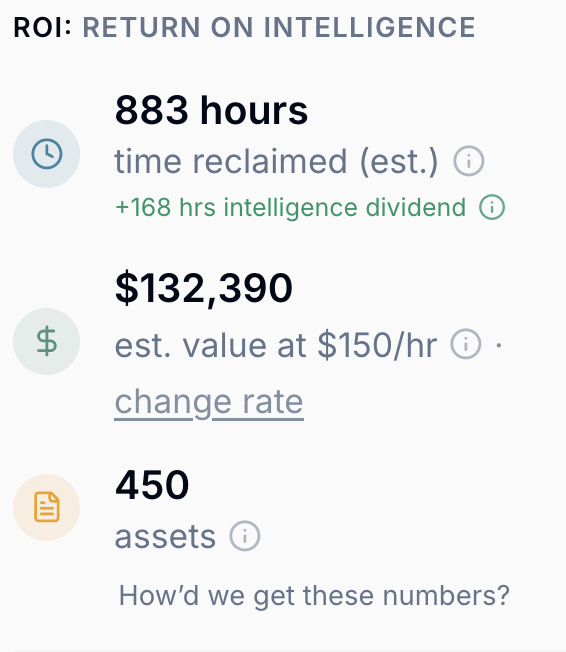
It’s the ROI: Return on Intelligence Calculator, a live dashboard on your homepage that tracks exactly how much time and money you’ve reclaimed versus what the same work would have cost you grinding through artificial intelligence’s hidden time tax.
Not industry averages. Your numbers. Your assets. Your hours.
Here’s what we found.
Our Numbers Since July 2025: The Hidden AI Time Tax, Measured
This is just our team — the StoryCycle Genie® crew using the Genie internally since we launched in early July 2025. Every user gets their own live Wonder Widget tracking their own real-time results. These aren’t platform-wide aggregates.
Since launch, we’ve created 450 assets.
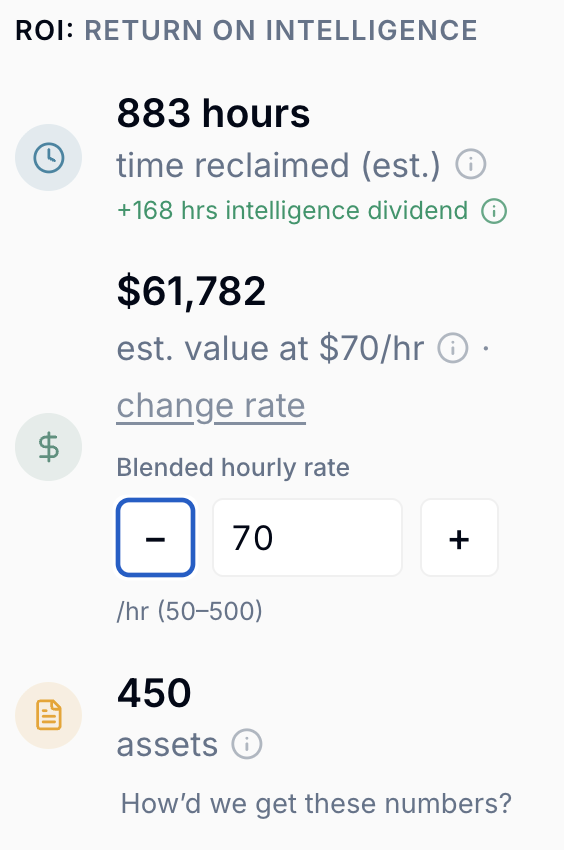 883 hours reclaimed versus what that same work would have consumed using ChatGPT, Claude, or any other artificial intelligence tool.
At our average overhead cost of $70 per hour, that’s an operational savings of $61,782.
Now factor in what we actually charge for brand storytelling consulting and creation — a conservative $150 per hour — and the opportunity cost reclaimed totals $132,390 (see above).
In eight months.
For one two-person team.
And that doesn’t include a dollar of the tax our team didn’t pay in mental fatigue, decision drag, and cognitive overload that generic artificial intelligence quietly levies on every marketing professional who opens a blank chat window.
More on that in a moment — because the research on that particular cost is genuinely alarming.
The Wrong Question Is Costing You: How Artificial Intelligence Hides Its Real Cost
The real cost of artificial intelligence for marketing teams isn’t the subscription fee — it’s the hidden time tax of prompt engineering, brand coherence correction, and strategic realignment that follows every AI-generated output. Research shows this overhead runs 4.0–4.5× longer than narrative-first Artful Intelligence workflows.
Every marketing leader running teams in 2026 understands the pressure with their whole body.
More content. More channels. More proof points. More speed.
When AI tools arrived promising to deliver all of that at near-zero marginal cost, saying yes felt less like a choice and more like the only rational response to an irrational workload.
The subscription cost of ChatGPT or Claude looks trivially small on the ledger.
That’s the trap.
The subscription fee was never the real cost. Every time someone on your team opens a blank chat window, a tax starts accruing — invisible, cumulative, and almost never measured.
The prompt engineering cycles that eat twelve minutes before the first sentence appears. The brand coherence edits because the artificial intelligence had no idea your company spent three years refining a positioning statement.
The strategic realignment when the output is technically fluent and completely off-message.
Why Does AI Content Need So Much Editing?
HubSpot’s State of Marketing research (2024) put a number on it: 96% of marketers say AI-generated content needs editing. 56% say they significantly rewrite it, because artificial intelligence produces fluent output without strategic context.
That’s not a tool saving time.
That’s a tool relocating work from creation to correction, from the AI to the humans who actually understand what the brand is trying to say.
MDPI researchers watched real teams use ChatGPT on writing tasks (n=135, 2024). Average six to eight prompts per session. Mean task time: 36.78 minutes. For short tasks. With no brand context requirements.
What’s happening in real marketing departments — with complex briefs, brand standards, audience-specific messaging, and campaign coherence requirements — runs far longer.
The Costly Custom GPT Tax People are Missing
The hidden time tax of artificial intelligence is bad enough on its own.
Then your team tries to solve it by building custom GPTs.
And the tax doubles.
Every team member who builds a custom GPT to approximate your brand voice has created a private island of intelligence — cordoned off from everyone else on the team. Their prompts, their context, their workarounds, their accumulated brand knowledge. Locked inside a tool only they can access.
Your head of content has one. Your social media manager has another. Your agency partner has a third. None of them talk to each other. None of them compound. None of them survive a personnel change.
You see, this isn’t a productivity problem. It’s an intelligence problem.
The custom GPT your best content strategist spent forty hours refining evaporates the day she leaves. The brand context your agency embedded in their private workspace disappears when the contract ends. Every new team member starts from zero — not because the knowledge doesn’t exist, but because it was never shared.
That’s not a team using AI.
That’s a team of individuals, each paying the full-time tax of generic artificial intelligence, separately, every day.
The StoryCycle Genie® is built on a fundamentally different architecture. It’s your single source of brand truth — collaborative “Artful Intelligence” designed specifically for brand story discovery, development, strategy, and activation.
Every team member works from the same brand brain. Every asset builds on the same foundation. Every new hire inherits the full accumulated intelligence of everyone who came before them.
The difference isn’t speed.
It’s the difference between cordoned-off artificial intelligence and collaborative Artful Intelligence that compounds across your entire organization.
Where the Hidden AI Time Tax Actually Goes (5 Categories)
Artificial intelligence’s hidden time tax breaks into five measurable categories: context loading (17%), first-pass triage (17%), strategic coherence correction (44%), final editing (14%), and quality assurance (8%). Strategic coherence correction — pulling AI output into alignment with brand story — is the dominant cost and cannot be reduced through better prompting alone.
The StoryCycle Genie® methodology breaks down exactly where artificial intelligence hides its overhead. Every one of them structural.
How Much of Your Marketing Time Does Generic AI Actually Waste?
Generic AI’s hidden time tax breaks into five categories totaling 4.0–4.5× more workflow time than Artful Intelligence, with strategic coherence correction consuming 44% of that overhead alone.
Context Loading: ~17% of Artificial Intelligence Workflow Time
Re-establishing strategic position and narrative framework every session. Even with memory features and custom instructions, this cost doesn’t disappear. Memory stores facts. It doesn’t carry narrative judgment.
First-Pass Triage: ~17% of Artificial Intelligence Workflow Time
With artificial intelligence, you’re not reviewing work. You’re evaluating whether the output is structurally viable at all.
Strategic Coherence Correction: ~44% of Artificial Intelligence Workflow Time
Pulling output into alignment with brand story, audience, and campaign context. This cost doesn’t shrink with better prompting because it’s a knowledge problem, not a prompt problem.
HubSpot found that brands with consistent narrative and voice see 3–4× higher engagement than those without. Artificial intelligence produces plausible output. It cannot produce strategically coherent output — because coherence requires context the tool doesn’t have.
Final Editing: ~14% of Artificial Intelligence Workflow Time
Not copyediting. Rewriting for story consistency. Artificial intelligence delivers a draft fast, then takes the time back in substantive revision.
Quality Assurance: ~8% of Artificial Intelligence Workflow Time
Checking narrative integrity and framework compliance. Cannot be skipped because there’s no accumulated standard of what “correct” looks like for your brand.
The Brain Drain of AI Cognitive Fatigue in Marketing
Marketing professionals experience AI cognitive fatigue at higher rates than any other profession, according to a March 2026 BCG/HBR study of 1,488 U.S. workers. High artificial intelligence oversight correlates with 12% more mental fatigue, 14% more mental effort, and 39% more major errors.
Is AI Making Marketing Teams More Burned Out?
Yes. BCG and Harvard Business Review surveyed 1,488 U.S. workers across professions in March 2026. Marketing employees experienced “AI brain fry” — cognitive fatigue from constant artificial intelligence oversight — at a rate of 25.9%.
Highest of any profession.
Higher than HR. Higher than operations. Higher than engineering.
Workers performing high AI oversight reported 12% more mental fatigue, 14% more mental effort, and 19% greater information overload. The downstream consequences: 33% more decision fatigue, 39% more major errors, 39% higher intent to quit.
The tool designed to reduce cognitive load is, in the marketing context, specifically increasing it.
Why? Because artificial intelligence requires humans to supply all the strategic context, evaluate all the output against institutional knowledge, and compensate for all the structural gaps — session after session after session.
That’s not delegation.
That’s double work.
The Automation Bias Trap: Why AI Gets Worse the More You Trust It
Pearson, Dror, Jayes et al. in Scientific Reports, February 2026 (n=295) documented the most insidious dynamic in AI adoption.
Key finding: Users with more positive AI attitudes showed significantly poorer ability to distinguish correct from incorrect AI outputs than those with less positive attitudes.
The more comfortable your team becomes with artificial intelligence, the less critically they evaluate what it produces.
The more you trust the tool, the less you see what it got wrong.
That’s not a user problem.
That’s an architecture problem.
Lisanne Bainbridge named this in 1983. Her landmark Ironies of Automation demonstrated that the more reliable an automated system, the less practiced humans become at detecting its failures. Applied to brand: the faster artificial intelligence content ships, the less often anyone interrogates whether it’s actually on-strategy.
Each approved-but-slightly-off output becomes implicit permission for the next to drift further.
The team doesn’t notice because their reference point shifts with every cycle.
MIT’s GenAI Divide confirmed the macro consequence: 95% of enterprise AI pilots produce zero measurable ROI. LLMs cannot originate ideas, and purely AI-generated content fails to differentiate brands.
The Quad 2026 Marketing Predictions Report named it directly: “Overreliance on AI systems risks eroding brand distinctiveness and steering performance toward broad, modeled efficiencies rather than real business outcomes.”
The Difference Between AI: Artificial vs. Artful
Artificial. The word means manufactured. Surface-level. Hollow without the context that makes it mean something.
When you open a blank chat window in ChatGPT or Claude, that’s exactly what you get: artificial intelligence that produces a torrent of content with no idea who you are, what you’ve built, or what only your brand can honestly say.
The “artificial” isn’t an accident.
It’s a description that makes you the brand guardian on every output — reviewing, correcting, realigning, session after session, until your best people burn out managing the gap between what the AI produced and what your brand actually means.
Artful Intelligence is something else entirely.
Artful: skilled. Intentional. Craft-driven. Built around the story only you can tell.
Artful Intelligence already knows who you are, because your brand’s Story Cycle System™ is encoded at the architectural level from the first word.
Your brand’s position statement, audience ABTs, emotional promise, archetype, and voice parameters are encoded once and applied structurally across every asset type and every session.
Not prompted. Not re-explained.
Structurally present. Your single source of brand truth that every member of your team can access.
The brand brain comes first. Everything else follows.
That’s not a faster version of artificial intelligence.
That’s a different thing altogether.
The Numbers That Hold: StoryCycle Genie® vs. Artificial Intelligence
How Much Faster Is StoryCycle Genie® Than ChatGPT?
StoryCycle Genie® runs 4.0–4.5× faster than artificial intelligence across all asset types — a blog post takes 20 minutes versus 90 minutes, a brand story 60 minutes versus 270 minutes, a whitepaper 90 minutes versus 405 minutes.
The StoryCycle Genie® methodology page publishes the observed multipliers. Not estimates benchmarked against five confirmed workflow anchor points.
A Brand Story: 60 minutes versus 270 minutes. 210 minutes saved. $175 value.
A blog post: 20 minutes with StoryCycle Genie® versus 90 minutes with artificial intelligence. Sixty-five minutes saved. At $50 per hour, $54 recovered per post.
A whitepaper: 90 minutes versus 405 minutes. 315 minutes saved. $263 value.
The multiplier across all asset types: 4.0 to 4.5 times faster.
Not on one favorable example.
Across asset types.
That’s not a faster tool.
That’s a structural advantage.
And we make no apologies for what that’s worth. We don’t sell prompts. We build brand storytelling fluency — the compounding strategic foundation that grows more powerful over time. Fluency doesn’t reset at the end of the month.
It grows.
The Compounding ROI: Why Artful Intelligence Gets Smarter Over Time
The multiplier is the initial return.
The compounding hasn’t started yet.
StoryCycle Genie®’s Cognitive Mesh Architecture means every asset you create adds to a persistent web of brand intelligence. Personas inform Customer Journeys. Customer Journeys shape Content Playbooks. Content Playbooks guide every downstream execution asset.
Artificial intelligence starts from zero on every session.
Your custom GPT starts from zero every time a new team member opens it.
Early-stage Artful Intelligence deployment compounds at approximately 8% additional efficiency bonus on top of the baseline multiplier. An established intelligence mesh reaches 12%. A mature deployment reaches 17–25%.
Not because the AI gets smarter in isolation.
Because the brand intelligence it encodes deepens — and depth is where compounding begins.
You see, the brands that win the AI era won’t be the ones that adopted artificial intelligence fastest. They’ll be the ones who adopted Artful Intelligence most intentionally — encoding their strategic foundation before generating at scale, rather than generating at scale and hoping correction catches everything the foundation missed.
Start Risk-Free — Seriously
Before you commit to anything, the StoryCycle Brand Story Grader™ is completely free.
It runs a 14-point brand storytelling assessment and grades the quality of your current brand story — no subscription, no credit card, no catch. You’ll know exactly where your brand narrative stands before you spend a dollar.
Then, if you decide to become a Genie user, the risk is entirely ours.
If you’re not 100% enthralled with what the StoryCycle Genie® creates with you, we’ll refund 100% of your first month’s subscription.
And you keep every asset you created.
The story belongs to the storyteller. Everything you build is yours — permanently and unconditionally.
Cancel your subscription at any time, without penalty.
We built it that way because we’ve seen the Wonder Widget numbers from July. We know what’s on the other side of the correction loop.
We’re confident you will too.
Calculate Your Own Hidden AI Tax
Our Wonder Widget answered the question for our team: 450 assets. 883 hours reclaimed — plus 168 more in intelligence dividend. $132,390 in reclaimed value.
In eight months. For one two-person team.
Yours will answer it for yours.
Run the numbers on last quarter’s content production. Count the prompt cycles. Count the correction hours. Count the meetings where someone asked, “Is this actually on-brand?” Count the custom GPTs your team built in isolation — cordoned off from everyone else, running on generic artificial intelligence that doesn’t know who you are and never will.
The Wonder Widget handles the math.
You handle the brand storytelling.
Start with a free brand story grade. Then let the Wonder Widget show you what you’ve been leaving on the table.
Story on, my friend.
Frequently Asked Questions
What is the hidden cost of generic AI for marketing teams?
The hidden cost of artificial intelligence for marketing teams isn’t the subscription fee — it’s the time tax of prompt engineering, brand coherence correction, and strategic realignment averaging 4.0–4.5× more human workflow time per asset than Artful Intelligence tools like StoryCycle Genie®.
How much time does ChatGPT waste on marketing content?
Research from MDPI (n=135, 2024) found average artificial intelligence writing sessions require 6–8 prompts and 36.78 minutes for short tasks with no brand context requirements. In real marketing environments with brand standards and campaign coherence requirements, the overhead runs significantly higher.
What is AI cognitive fatigue in marketing?
AI cognitive fatigue — termed “AI brain fry” by BCG and HBR researchers — is the mental exhaustion caused by constant artificial intelligence oversight. Marketing professionals experience it at higher rates than any other profession, with high AI oversight correlating with 33% more decision fatigue and 39% more major errors (BCG/HBR, March 2026, n=1,488).
What is the ROI of Artful Intelligence versus artificial intelligence?
The StoryCycle Genie® team documented 450 assets created, 883 hours reclaimed, plus 168 hours in intelligence dividend, and $132,390 in opportunity cost recovered in 8 months — with a 4.0–4.5× time multiplier across all asset types.
What is automation bias in AI content creation?
Automation bias is the tendency to over-trust AI output and under-scrutinize its errors. Pearson, Dror, Jayes et al. (Scientific Reports, 2026, n=295) found that users with more positive AI attitudes showed significantly poorer ability to distinguish correct from incorrect outputs — meaning the more comfortable teams become with artificial intelligence, the less critically they evaluate what it produces.
What is the Wonder Widget?
The Wonder Widget is the ROI: Return on Intelligence Calculator — a live dashboard on every StoryCycle Genie® user’s homepage that tracks, in real time, how much time and money each user has reclaimed versus equivalent artificial intelligence workflows.
What is the difference between custom GPTs and StoryCycle Genie®?
Custom GPTs are private, isolated artificial intelligence — built by individual team members, inaccessible to others, and lost when personnel change. StoryCycle Genie® is your team’s single source of brand truth — collaborative Artful Intelligence designed specifically for brand story discovery, development, strategy, and activation, where every team member works from the same brand brain and every asset compounds on the same foundation.
Sources & Research
- StoryCycle Genie® ROI Methodology
- Cognitive Mesh Architecture — Schroeder, S.
- Pearson, J., Dror, I., Jayes, E. et al. Scientific Reports 16, 5345 (February 5, 2026)
- “Mitigating Automation Bias in Generative AI Through Nudges.” ScienceDirect (November 2025)
- Quad. “27 Marketing Trends and Predictions for 2026.”
- MIT. The GenAI Divide
- BCG / Harvard Business Review. AI Brain Fry Study, March 2026 (n=1,488 U.S. workers)
- HubSpot. State of Marketing, 2024
- MDPI. “Teaming Up with an AI.” 2024 (n=135)
- Bainbridge, L. “Ironies of Automation.” Automatica 19(6) (1983)