Forty Years Building Brands. One Conversation That Revealed Why Most Marketers Have Never Actually Studied Story.
The One Shift That Changes Everything About How You Communicate
You’ve been told story matters.
You’ve made the investment: the content, the copywriters, the brand narrative document living somewhere in a shared drive.
You know your brand has a story.
But there’s a frustration underneath all of it. The content you’re producing sounds like storytelling without landing with the emotional weight a real story delivers.
Your messaging is polished. But forgettable. Your audience reads, scrolls, and doesn’t act.
Unfortunately, most brand communicators — including the ones who write about storytelling for a living — have never actually studied narrative structure. They produce what looks like story without ever understanding the three-part cognitive architecture the human brain uses to make meaning, make decisions, and, most critically, take action.
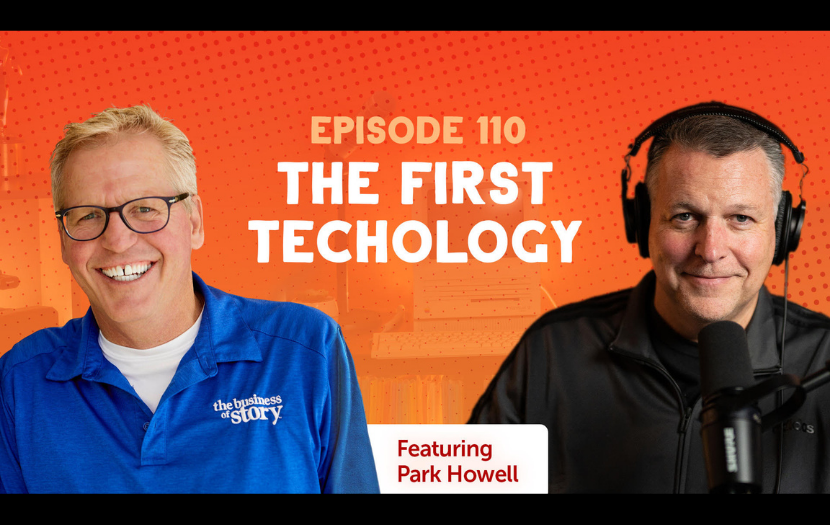
Catch Park Howell on Steve Gilman’s Brand Story Podcast
Steve is the founder and president of Gravity Group, a brand strategy and marketing firm based in Harrisonburg, Virginia.
With more than 27 years in marketing and brand strategy, he has built a reputation for asking the right questions and uncovering the deeper motivations that drive audience loyalty.
A theater director and improv practitioner outside the office, Steve brings that same instinct for authentic, unscripted conversation to every Brand Story episode, giving guests a platform to speak and trusting the audience to find what matters most.
He hosts the Brand Story podcast, where he speaks with leaders, marketers, and creatives about the ideas, experiences, and perspectives that shape meaningful brands.
This conversation went somewhere I wasn’t expecting.
What’s in It for You
- Why story is not a communication style — it is humanity’s oldest cognitive technology, traceable from prehistoric campfires to every buying decision made today
- The three-part narrative structure that drives Mozart’s sonata allegro form, Hollywood screenplays, and every effective business pitch
- The critical structural gap that makes most “brand storytelling” invisible to the brain’s actual decision-making circuits
- Why humans are rationalizing beings, not rational ones — and what that means for every piece of content you create
- The singular problem-solution dynamic: the principle Park has used to guide 600+ podcast episodes and sharpen narrative focus across every format
- Why generic AI produces generic brand communication — and what artful intelligence does instead
- The one piece of advice Park would give his younger self about focus, expertise, and the career compound effect
When the Storytelling Expert Becomes the Guest
One of the more illuminating parts of this conversation happened early.
 Steve and I discovered we both came to advertising and brand work from the performing arts — he through theater directing and improv, I through music composition and theory. And both of us arrived at the same frustration independently: we kept meeting marketing professionals who talked fluently about storytelling without ever having studied what makes a story structurally work.
That’s not a small gap. That’s the gap between content that gets produced and content that gets remembered.
The tripartite story structure — setup, complication, resolution — appears in Mozart’s sonata allegro form, in prehistoric ABT teaching moments around a campfire, and in the human brain’s pattern-seeking limbic system. It’s not a creative preference. It’s the architecture of meaning-making. And most brand communicators are producing content without it.
Why Story Is the Most Powerful Technology Ever Developed
When I told Steve that storytelling is humanity’s first technology, it wasn’t a provocative claim. It was a description.
Yuval Noah Harari argues in Sapiens that Homo sapiens are the only creatures we know of that think, plan, organize, and act in story. Everything is a fiction until we make it a reality. That’s the technology — the brain’s capacity to use narrative structure to encode learning, drive coordination, and trigger the decisions that keep a species alive.
The caveman ABT I shared on this episode is the simplest proof I know. Thong tells Larry what happened at the river. He was catching salmon, but a saber-toothed tiger showed up, so he gave the salmon to the tiger and made it safely home. Three grunts. Setup. Complication. Resolution.
Larry now knows what to do when he meets a saber-toothed tiger.
Your brand is trying to do exactly the same thing — help someone solve a problem. The ABT structure is the architecture that carries that story from your head into their limbic brain, where every real buying decision actually gets made.
Artful Intelligence — Reframing the Worst Brand Name in History
 Steve brought up the StoryCycle Genie® and made an observation that stuck with me.
He described it as a graduate student who has studied nothing but brand — one who already holds the structural knowledge you’re trying to recall, and uses it to put narrative framework around your thinking rather than replacing your instincts.
That’s exactly right. And it’s why I stopped calling what we’ve built “artificial intelligence.”
“Artificial intelligence” is the worst brand name ever invented. It tells you what it makes — artificial intelligence — not what it makes happen in your life. What the StoryCycle Genie® makes happen is “artful intelligence”: the combination of your lived experience, your humanity, and your creative judgment, governed by a tool trained on twenty years of Story Cycle System™ proof.
Generic AI is generic by design. It’s trained to produce fluent language, not narrative structure. The StoryCycle Genie® was built for one specific mission: defining, refining, building, activating, and strategizing your brand narrative. It hallucinates 98% less than generic alternatives. It writes in your voice. And once your Brand Brain is built — about an hour’s work — everything flows from it.
That’s the difference between a tool that makes content and a tool that governs your story.
Start with a free diagnostic: run your brand through the Brand Story Grader at storycyclegenie.ai. Under a minute. A 14-point assessment. Exactly where your narrative is working — and where it needs structural repair.
Learn More About Steve Gilman and Brand Story
- Brand Story Podcast — Steve Gilman’s show featuring conversations with leaders, marketers, and creatives about the ideas that shape meaningful brands
- Gravity Group — Steve Gilman’s brand strategy and marketing firm
- Steve Gilman on LinkedIn
- BusinessOfStory.com — Park Howell’s home base: workshops, resources, and the full 600+ episode archive
- StoryCycle Genie® — Build your Brand Brain and operationalize your brand narrative with StoryOps™
- Brand Story Grader — Free Assessment — A 14-point brand story assessment in under a minute, from A+ to F minus
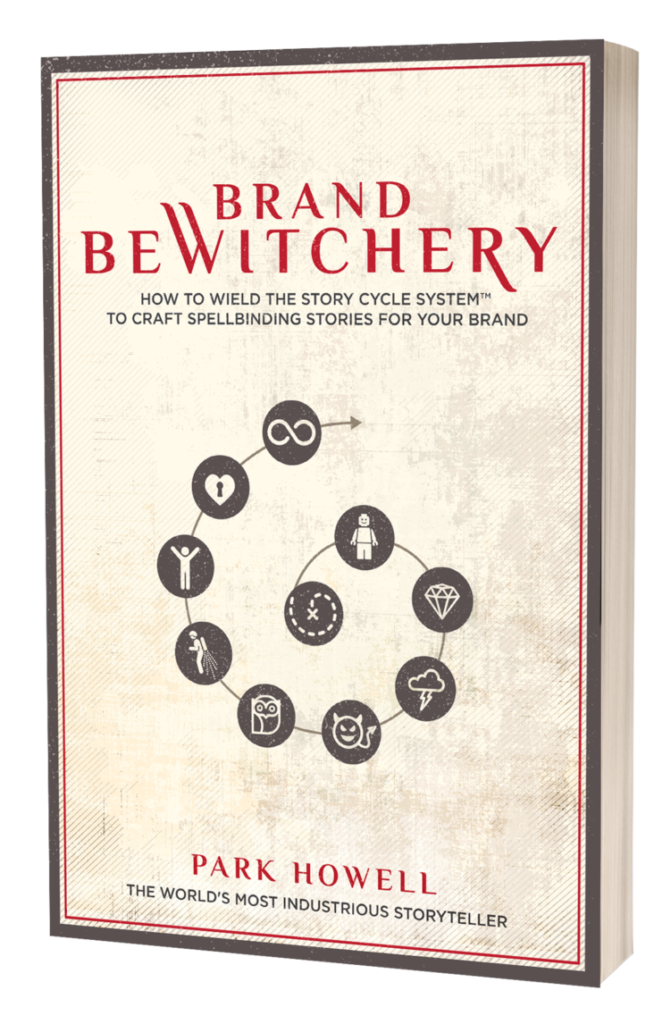
- Brand Bewitchery by Park Howell — The book that teaches the full Story Cycle System™
- ABT Framework Deep Dive — Master the And, But, Therefore narrative architecture
Three Related Episodes You’ll Want to Hear Next
- What a Hit Song Has in Common With Every Great Business Pitch — Rob D. Willis makes the case that the one-four-five chord progression and the ABT framework are structurally identical — a direct extension of the music-storytelling link Park and Steve explore in this episode.
- The Story You’ve Been Afraid to Tell Is the One That Will Change Everything — Elizabeth Brett unpacks why authentic business storytelling requires moving past polished performance to the genuine truth underneath, and the sovereignty filter that reveals what’s safe to share.
- What Happens When a Brand Decides to Make Its Own Business Model Obsolete? — Lovesac founder Shawn David Nelson argues that brand storytelling is 50% of building a great product company — and then pauses, and says it’s honestly probably closer to 90%.
Steve Gilman’s Conversation With Park Howell on the Brand Story Podcast
Brand Story Podcast With Steve Gilman — Full Transcript
How a Rainier Beer TV Commercial at Age 8 Sparked Park Howell’s 40-Year Advertising Career
Steve Gilman: I’m Steve Gilman, and this is Brand Story, where we help you build stronger, more sustainable brands. Sharing insightful conversations with brand leaders, marketers, and professional storytellers.
And my guest today is Park.
Park: If you think about it as Harari said in his book Sapiens, we Homo sapiens are the only creatures that we know of that think, plan, organize, and act in story. It is a fiction until we make it a reality. So to me, that’s that technology — the tool of just the way our brain is hardwired to use the software story to make meaning out of the madness of being humans.
Steve: Park is the founder of The Business of Story, a longtime brand strategist, author, speaker, and host of one of the top storytelling podcasts. After spending decades in advertising and brand, he shifted his focus entirely toward understanding why stories work and how organizations can use them to communicate more effectively.
Today, he teaches leaders, brands, and organizations how to clarify their message through story. He’s also the creator of the Story Cycle Genie, an AI-powered storytelling platform built around his story frameworks.
Park, welcome to Brand Story. How are you today?
Park: I’m doing great, Steve. Thanks for having me.
Steve: Absolutely. The audience doesn’t know this, but we took a shot at this before and had some technical difficulties. We had a trial run — and this is the second take.
Park: The SM7B, whatever you call it, has been a marvelous microphone. Then after four years, it completely blew up on me during your interview. So thanks for having me back.
Steve: Sometimes technology just decides to go at exactly the wrong moment.
I’m going to jump in by talking a little about your background, because I find it fascinating. You spent decades in branding and marketing. What first drew you into the industry?
Park: When I was a little kid growing up in Seattle, one of my favorite TV campaigns was for Rainier Beer. I wasn’t even close to beer-drinking age, but they were hysterical. Creative. Sort of avant garde in a really quirky way.
I always thought to myself, I want to do that someday. I want to bring those wacky commercials to the world.
That just hung with me. I studied communications, went into the ad world right after I graduated, and I’ve been doing it for 40 years.
Steve: You’ve had agencies, a lot of awards. But you got to a point where traditional advertising wasn’t enough — it wasn’t fulfilling. And you started to really think about story differently. How did that come about?
From Traditional Advertising to Brand Storytelling: How Digital Disruption Sent Park Howell to Hollywood
Park: I started my agency, Parking Co, in 1995 in Phoenix, Arizona. Very much a traditional ad agency. I ran it for ten years.
Fast forward to around 2003, 2004, 2005 — the internet was taking over. E-commerce, websites, blogs, digital marketing.
I felt like, number one, everything I knew about traditional marketing wasn’t working in the new digital realm. Number two, I found the digital realm really uninspiring and uncreative — people just blasting their stories at you. And number three, our approach to brand and narrative strategy development was not as effective in this new world of the interwebs.
So I went looking for an answer. First stop: Hollywood. Joseph Campbell, Blake Snyder, 15 beats of story, the Hero’s Journey, all of that.
I thought, wow. There are actual templates and guides to storytelling. I never knew about these. I don’t know of anyone in our world who knew about these.
So I took it upon myself to bring these to the advertising world, to the branding world. That was the big shift — from a traditional ad agency branding guy to a very story-driven branding guy.
Steve: I’m glad you did. I have the background that I started in theater and studied to be a theater director before I got into marketing and advertising. And I’ve seen what you’ve seen — a lot of marketers and storytellers in the ad world are doing storytelling in a way like they’ve never heard of story structure.
It can be a real weakness. You end up with a lot of flash and not a lot of substance that moves people emotionally.
Park: They do pay a lot of lip service to it. But like you with theater, I was in the music world. I studied music composition and theory because I wanted to know why music worked on us. I got a degree in that, a degree in communications, went into advertising.
And now I find it interesting that I’m teaching story composition and theory, especially in the leadership and branding world. You understand the nuances of telling a story from the stage, how to own an audience. Very, very powerful. Yet most people in the advertising world have never made that leap into really understanding the craft of story.
What Mozart’s Sonata Allegro Form Reveals About the Universal Three-Part Story Structure
Steve: Your background in music just fascinates me. A lot of the best editors and creatives I’ve worked with are musicians. The link between storytelling and music is emotional. Music, whether it has words or not, takes you on a journey. There’s a beginning, a middle, and an end. Tension and relaxation. All the things that happen to you emotionally while you listen to music are the same things that happen when you read or hear a great story.
Park: There’s rhythm to it. There’s syncopation.
Way back when I was studying composition and theory, they told us that Mozart’s Sonata Allegra form was based on story structure — setup, development, resolution. Act one, act two, act three. Back then it didn’t make much sense to me. But when I started studying story, I got it.
He would introduce a theme — the character of the piece. Then in the development section, act two, he would take you somewhere completely different from where you started, so you were wondering how it resolves. Then he brings it full circle in the final resolution.
It’s just the way our brains are set up to make meaning. Here’s the situation. Here’s the problem. Here’s how we resolve it.
It’s a primal learning tool that keeps us storytelling apes alive and functioning.
Story as Humanity’s First Technology: The Caveman ABT and Why Your Buying Brain Runs on Story
Steve: You’ve talked about storytelling being one of the first technologies. Can you unpack that?
Park: If you think about it as Harari said in Sapiens — we Homo sapiens are the only creatures we know of that think, plan, organize, and act in story. Everything is a fiction until we make it a reality. That’s the technology. The way our brain is hardwired to use the software of story to make meaning out of the madness of being human.
Here’s a fun example I like to use.
Jump into a cave. There’s our rotund cave mate, Larry, warming himself by the fire. He looks up and sees his buddy Thong in the doorway — completely disheveled, broken fishing pole and everything.
“Thong, where you been?”
“Well, I was down at the river catching sabertooth salmon for dinner.”
“Oh, and?”
“But sabertooth tigers showed up.”
“Oh! What’d you do?”
“I gave the salmon to the tiger. It likes salmon better than Thong. Therefore I’m safely back here at the fire with you, Larry.”
Three grunts. And-but-therefore. Perfect story structure using story as a learning tool.
Now Larry knows: if he gets confronted by a sabertooth tiger, give it the salmon and you should be safe.
That’s what we use story for in advertising, marketing, branding — a very primal learning tool. Because what are we all doing with our products or services? We are trying to help someone solve a problem. Set up. Problem. Resolution.
Why Humans Are Rationalizing Beings, Not Rational Ones — and What It Means for Brand Storytellers
Steve: That resonates with everything I learned studying theater and the biology of story. I had a professor tell me that everyone slows down at a car accident because we’re biologically programmed to see what went wrong and learn from it. We’re always very curious about what happened. And if we don’t have the story, we’ll invent one that makes sense of the disorder.
Park: Exactly. It brings context to what we’re trying to figure out.
Our primal limbic brain — the amygdala, hippocampus, I’m no neurosurgeon but I did stay at a Holiday Inn Express last night — is operating in the background. Pattern seeking. Problem solving. Decision making. And oh, by the way, it’s also the buying brain. It says: yes, I’m going to buy into what you’re saying.
Story is the Trojan horse to get into that fortress. And once we’ve decided we’re going to buy in, we level it up to our executive functioning reason brain — which is essentially the PR department — to make excuses for all the decisions we already made in the background.
Steve: Marcus Collins, who wrote For the Culture, made the same point on this podcast — we’re not rational human beings, we’re rationalizing human beings. We all think we’re Spock, but we’re actually more Kirk. The emotion drives the yes and the purchase. Then the rationalizing brain takes over explaining why it was such a good decision.
600 Episodes, 12 Years: What Keeps Park Howell and the Business of Story Going Strong
Steve: You’ve done 600 interviews over 12 years. What kept you going?
Park: There are times I’m thinking, you know, maybe I’ll take a hiatus. And then I meet great people like you, and I get to go on shows or they come on my show, and I learn so much.
And playing the long game as I have is very beneficial in the age of artificial intelligence. Because where is the trust built? The trust isn’t built with the bot. The trust is built with the individual. A podcast really does that — you get to meet the real deal.
Right when you think you’re not actually having an impact anymore, you are. I’ll get an email from someone somewhere in the world that says: I heard something three weeks ago. I tried it. That just keeps me coming back for more.
The Singular Problem-Solution Dynamic: Why the Human Brain Can Only Focus on One Problem at a Time
And number two — something I’ve found really interesting is that we all suffer from the curse of the expert. We come in with too much information, too many things we want to cover.
I always coach guests: we have a singular problem-solution dynamic that we’re going to examine in the next 40 minutes to an hour. What is the one thing we’re going to focus on and solve for our listeners today?
When we start going down rabbit holes, I pull it back: okay, we’re getting off that one thing. Let’s pull it in.
Our brains are not multitaskers. Find the singular problem-solution dynamic and have a conversation focused on that signal. It makes listenership go way up. It helps me, as the host, guide a conversation that’s actually going to have impact for my audience.
Steve: You really do a great job of that. It’s so interesting how successful different podcasts can be with completely different styles. I think your audience finds you because of how you do something — style, approach — not because you tried to be everyone’s everything.
Authentic Style vs. Podcast Formula: How to Build a Voice That’s Recognizably Yours
Steve: How did you find your style for your show?
Park: You’re doing it from you — from what is authentic to you. You’re not trying to be anybody else.
I’ve tried a bunch of different formats and some of them I cringed at. That’s just not me. I finally stopped overthinking it and said: here’s who I am. This is how I like to do my show. This is the way I’m going to do it, whether you like it or not.
Steve: There’s a lot of wisdom in that. When you are authentic and you are you, you’re going to connect with some guests deeply and others not so much. And the audience that goes with you on that feels respected.
Honestly, I’ve done my 10,000 hours in interviews — documentary films with brands like Greenpeace, 30 years ago. I let the influence of my improv background enter the interviewing. It’s an act of hospitality — make people feel welcome, really listen for the follow-up, let them go where they want to go. Don’t impose my idea of what should happen on them. Give it some form on the fly. That’s basically my style.
Park: And you’re doing it from you — from what is authentic to you. I love that.
What Is Artful Intelligence? How the StoryCycle Genie Reframes AI as a Human Storytelling Amplifier
Steve: Before we run out of time — here we are talking about very human things, storytelling as the most human technology there is. And now we’re talking about AI and a tool that helps you tell stories. It’s almost a contradiction you’ve made work. Tell me about the StoryCycle Genie and how those two things come together.
Park: The first thing I want to do is reframe artificial intelligence, because it’s the worst brand name you could ever possibly have.
One of my rules of brand storytelling: your story is not about what you make, but what you make happen in your audience’s life. “Artificial intelligence” as a brand name is what they made. But what it can actually make happen in your life is what I call artful intelligence.
Artful intelligence works when you combine your own lived experience, your humanity, your talents, and your abilities with this unbelievable tool of AI — but you guide it. It amplifies your storytelling. You do it faster. But it does not take the humanity out of it unless you enable it to do so.
So here’s the quick backstory on how we built the StoryCycle Genie.
It took us about two years to really get it working well. My co-founders Shawn Schroeder and Matt Levine had a digital ad agency in Sacramento. Back in 2016, they called me and said: we’re trying to rebrand our agency. We’ve been working on it for two years and we don’t think we can do it. We don’t even think you can, but we’re willing to pay you to come in and try.
We pulled it together. We found their brand story operating system.
Over the next few years they grew, and ended up selling both the agency and their content platform. After Covid, Shawn called me and said: I love your Story Cycle System. But it takes three months to work through everything. I think we can use AI to expedite that process using your IP.
We spent two years building it. We launched it last July.
Now agencies, SMBs, and some enterprises can use all the intelligence from my agency days to create what we call a Brand Brain. A Brand Brain to operationalize their brand narrative — what I call StoryOps™.
You’ve got DevOps. SalesOps. MarketingOps.
The one thing most companies don’t have is an operating system for their brand narrative — everybody speaking from the same story, living in the same vision, having the same impact.
Steve: I’ll tell you — when you sent me the output from it, it’s like having a great graduate student who studied nothing but brand and has the thing you’re trying to remember, helping you put structure around what you need to get done. Making sure it’s actually story structure and not just a cool idea or a flashy thing.
It’s like someone tapping you on the shoulder saying: that’s cool, but it’s not a story. Here’s how we put it in a format that human beings will actually respond to. And not everyone has that expertise, or can afford it, or has the time.
Park: Thank you. It’s narrative native. The and-but-therefore structure is at the core of the StoryCycle Genie. Guided by our ten-step Story Cycle System. It has three dozen different genies internally — think of them as a branding content agency in a bottle. They all speak to each other through what we developed as the cognitive mesh architecture.
You build your Brand Brain. Then it creates your marketing strategy based on what it knows about your brand story. All your content. Competitor analysis. You name it.
One way people can test it: go to StoryCycleGenie.ai. There’s a free Brand Story Grader. Put in your name, email, and the URL you want graded. In under a minute you’ll get a grade from A+ to F minus and a 14-point brand story assessment. Validates what you’re doing well, reveals gaps you can quickly fix, inspires you with new ways to think about your brand story. Costs you absolutely nothing.
Why Can’t ChatGPT or Generic AI Tools Replace a Purpose-Built Brand Storytelling Platform?
Steve: So why not just use ChatGPT or Claude? I know that’s a common objection.
Park: It can’t do what we do. Generative AI is generic AI by nature.
The StoryCycle Genie was built for one specific purpose: to help you define, refine, build, activate, and strategize your brand narrative. We use Anthropic and ChatGPT APIs depending on what we’re asking it to do, but we’ve built it on our own proprietary platform. It’s governed by the Story Cycle System and your specific brand story.
It hallucinates 98% less than generic AI. It speaks and writes in your voice, not in generic AI voice. It’s a true StoryOps™ system to operationalize your brand story. Once the Brand Brain is built — which you can do within an hour — everything else flows from that.
Generic AI can’t do that. It’s not built on our IP, doing what we do.
Steve: Congratulations on that. Good for you for taking everything you’ve learned and distilling it into something useful for others.
Park: Artful intelligence. That’s what it truly is.
The Storyteller’s Prime Responsibility: Why Truth Always Prevails — and Manipulation Always Backfires
Steve: Story is the first technology, and it’s how humans make sense of the world. What responsibility do we have as storytellers?
Park: Is it up to every individual to use story the way they want? Politicians use story to spread mistruths. A lot of brands do the same.
But here’s the thing I think is so interesting about story: the truth does prevail.
You can tell as many mistruths as you like, in the most compelling ways possible. But the truth always finds its way to the surface.
So I would say the responsibility of the storyteller is: first, know how powerful story is to get people to do things. And then second, really ask yourself — is what I’m asking this person to do in their best interest?
That’s the responsibility.
Steve: I love that answer. The truth always prevails. You can use falsehoods in storytelling to manipulate an audience only so far. It works really well — until it stops working completely. The truth doesn’t stop working. It’s a lasting tool.
Park: And I like to end every one of my shows with this: the most potent story you’ll ever tell is the story you tell yourself.
So make that one epic.
Ask yourself: what story are you currently telling yourself? Are you a good person? A happy person? Someone trying to help others? That will be the signal for every story you tell from here forward.
The responsibility of the storyteller: be true to yourself.
Park Howell’s Advice to His Younger Self: The Power of Getting Focused Earlier
Steve: What would you call this chapter of your life right now?
Park: I’m 65, so I’ve been doing this a hell of a long time. This might be the last chapter of this particular book. Maybe it’s the epilogue — or maybe it’s the epilogue that launches the next chapter. Really helping people embrace artful intelligence so they can have the impact they want to make in the world.
Steve: And last question: what advice would you go back and give your younger self?
Park: Get more focused earlier.
In your 30s, you’re building a family, building a business, building a career, trying lots of different things. You swing at a lot of different fences.
If you can get that singular problem-solution dynamic down for yourself — what’s the one thing — everything else tends to take care of itself.
Steve: That’s great, man. Thanks so much for being here today. This was really fun.
Park: Thank you, Steve. This has been a pleasure.
Steve: Want to hear more inspiring stories? Subscribe on your preferred podcast app so you don’t miss an episode. And if you like what we’re doing, please rate, review, and share. It’s the best way to support us. Thank you for listening to Brand Story.
Brand Story Podcast With Park Howell — FAQs
Q: What Is the ABT Framework and How Does It Help Business Storytellers?
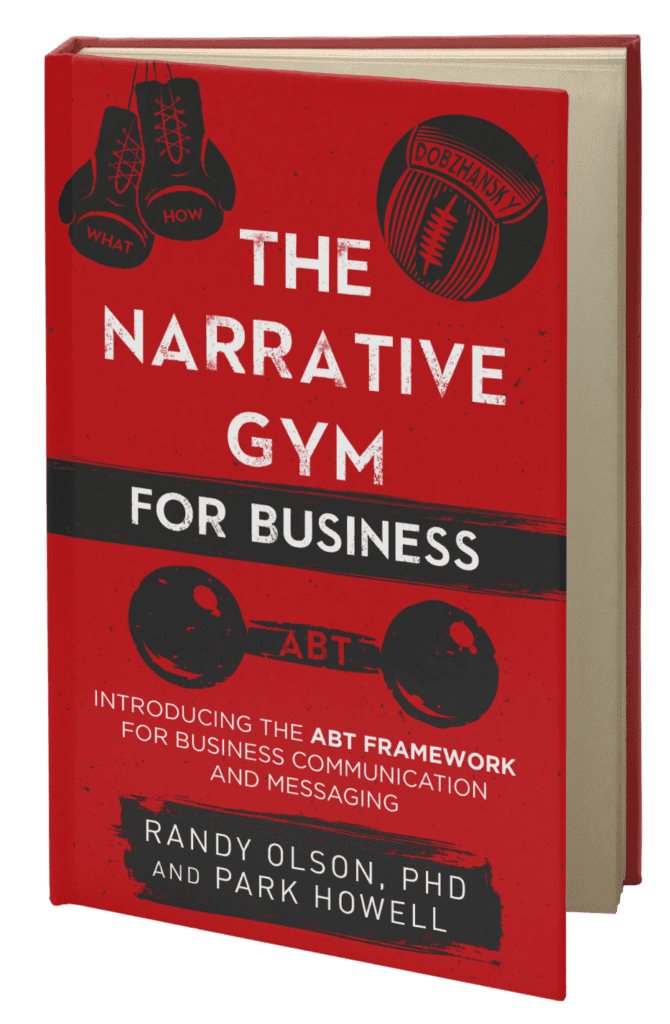
A: The ABT (And, But, Therefore) framework is a three-part narrative structure Park Howell identifies as the DNA of all effective storytelling — establishing context (And), introducing tension or conflict (But), and resolving it with a clear consequence (Therefore). Originally popularized for science communication by Randy Olson, the ABT mirrors the narrative logic that drives Hollywood screenplays, Mozart compositions, and prehistoric campfire teaching moments alike. For business communicators, it transforms presentations, pitches, and content from information dumps into stories the brain is hardwired to follow. Applied consistently, the ABT framework gives marketers a repeatable, proven architecture for creating messages that move audiences from awareness to action.
Q: What Does “Artful Intelligence” Mean, and How Does the StoryCycle Genie Use It?
A: “Artful intelligence” is Park Howell’s deliberate reframing of AI — repositioning it not as a replacement for human storytellers but as an amplifier of the craft they’ve already developed. Where generic AI tools optimize for fluency and volume, artful intelligence prioritizes narrative structure, emotional authenticity, and strategic intent. The StoryCycle Genie® operationalizes this concept by training AI on the Story Cycle System’s proven frameworks, so every output carries the narrative architecture of a well-told brand story rather than the generic polish of automated content. The goal is never to automate storytelling — it’s to give storytellers a smarter, faster way to apply the structural knowledge that most marketers never study.
Q: How Is Storytelling Considered Humanity’s First Technology?
A: Drawing on Yuval Noah Harari’s Sapiens, Park Howell argues that story is not simply a communication style but humanity’s original cognitive technology — the breakthrough that allowed early humans to coordinate beliefs, behaviors, and large-scale cooperation in ways no other species could. Even a prehistoric ABT illustrates the principle: a tribe member returns from the river with a story about the salmon, the tiger, and the trade that saved his life — and now everyone at the fire knows what to do. This reframe has profound implications for marketers: storytelling isn’t a soft skill or a creative flourish. It is the most sophisticated persuasion system in human history, and understanding it as technology means it can be studied, mastered, and applied with precision.
Q: What Is the Story Cycle System and How Does It Differ From Generic Brand Messaging Frameworks?
A: The Story Cycle System is a ten-step brand narrative framework developed by Park Howell that guides organizations from identifying their core audience and purpose to articulating a complete, emotionally resonant brand story. It incorporates proven Hollywood narrative structures alongside tools like the ABT framework, the OOO (Organization, Offering, Outcomes) exercise, and brand archetype identification to build stories that are both emotionally compelling and strategically aligned. Unlike generic messaging frameworks that organize features and benefits, the Story Cycle System builds narrative from the inside out — grounding brand story in authentic purpose before a single marketing asset is created. The result is a brand narrative architecturally sound enough to drive genuine audience connection and conversion.
Q: Why Does Park Howell Say Humans Are “Rationalizing Beings” Rather Than Rational Decision-Makers?
A: Park Howell draws on neuroscience to highlight a distinction most marketers miss: humans don’t make decisions rationally and then feel emotions about them — they make emotionally-driven decisions first, in the limbic brain, and then construct logical justifications afterward. This “rationalizing” pattern means leading with data, features, and logical arguments is structurally backwards for persuasion, because the cognitive gatekeeping happens at the emotional level before reason ever engages. For brand storytellers, this reframes the entire creative brief: the goal isn’t to convince the rational mind but to move the emotional one, then give the rational mind enough ammunition to justify the decision it’s already inclined to make. Story is the most effective tool humans have developed for triggering that emotional first response.
Q: What Is Park Howell’s Singular Problem-Solution Philosophy for the Business of Story Podcast?
A: Park Howell’s singular problem-solution philosophy holds that every episode — and every effective act of communication — must be organized around one clearly defined problem and one clear pathway to resolution. This principle is a direct application of ABT narrative logic to the craft of podcast hosting: without a unifying tension and resolution, even the most interesting conversation becomes a collection of unrelated insights that listeners can’t remember or act on. By disciplining himself and his guests to identify the single most important conflict-resolution arc in any conversation, Howell ensures that Business of Story delivers a memorable, actionable takeaway rather than an impressive but forgettable idea salad. It’s one reason why, after more than 600 episodes, the show has maintained both its focus and its audience.
Q: How Does the StoryCycle Genie Differ From ChatGPT or Claude for Brand Storytelling?
A: ChatGPT and Claude are trained on broad internet data and optimized for general-purpose language generation — they produce fluent, grammatically correct content, but they lack the structural intelligence to consistently apply ABT logic, audience-first positioning, and brand archetype coherence that effective brand narratives require. The StoryCycle Genie®, by contrast, is trained specifically on the Story Cycle System’s proven narrative frameworks, making it purpose-built for the strategic and structural demands of brand storytelling. The difference is the difference between a generalist writer who can produce polished prose and a master storyteller who understands why certain narrative structures move audiences and others don’t. For marketers who need content that is architecturally sound — not just grammatically fluent — the StoryCycle Genie represents a fundamentally different class of AI tool.
Q: What Does Park Howell Say About the Storyteller’s Responsibility to Truth?
A: Park Howell holds that the storyteller carries a profound ethical obligation — to serve their audience’s genuine interests through honest, authentic narrative rather than manufactured emotion or manipulative persuasion. Truth, in his view, is not just a moral imperative but a strategic one: audiences are finely tuned to detect inauthenticity, and brand stories built on exaggeration or spin will ultimately collapse under that exposure. The storyteller’s prime directive is to illuminate real problems, deliver genuine value, and build trust across every touchpoint — because truth always prevails, and the brands that tell it consistently are the only ones that endure.
Q: What Does Mozart’s Sonata Allegro Form Have to Do With Business Storytelling?
A: Park Howell draws a striking parallel between Mozart’s sonata allegro form — with its three-part structure of exposition, development, and recapitulation — and the universal tripartite narrative architecture that underlies every effective story. Both follow the same cognitive blueprint: establish expectations and context, introduce tension and complication, resolve to a satisfying conclusion. The implication is significant: great storytelling, like great music, is not arbitrary or purely inspired — it reflects how the human brain organizes and processes experience. For business communicators, this means narrative structure is not an artistic luxury but a cognitive necessity, and mastering it is as learnable and repeatable as any other strategic skill.
Q: What Is Park Howell’s Best Advice for Marketers Who Want to Become Better Storytellers?
A: Park Howell’s central advice comes down to two disciplines: study the actual mechanics of narrative structure, and get focused earlier. Most marketers talk about storytelling without ever examining what makes a story structurally work — the limbic triggers, the ABT architecture, the emotional arc — and that gap between instinct and craft is where most brand communication falls flat. His reflection on his own career is that specialization compounds: the earlier you commit to a singular area of mastery, the more depth, credibility, and impact you build over time. For storytellers specifically, that mastery begins not with creative talent but with structural understanding — because the marketers who know why stories work will always outperform those who only know how to produce them.