Joe Lazer’s Super Skill Book Reveals Why Your Story Instinct Closes More Deals Than any Algorithm
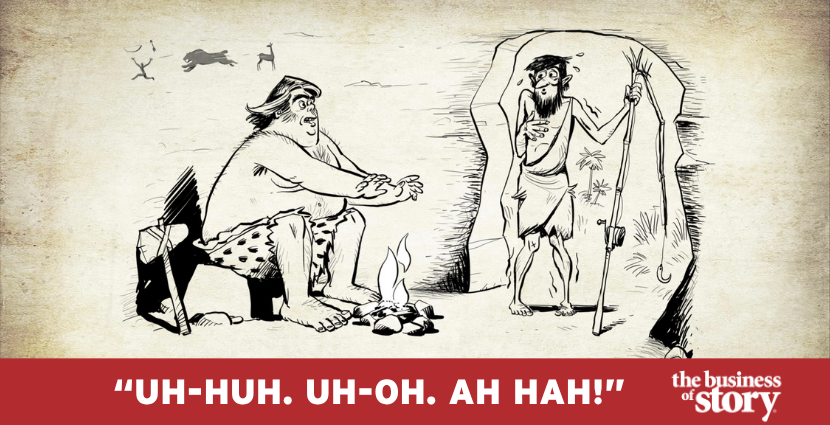
Imagine rotund caveman Larry warming himself by the fire when his cavemate Thog appears disheveled in the doorway with a broken fishing pole.
“Thog, where you been?” asks Larry, hands toasting over the warm fire.
“Down at river, catching saber-toothed salmon for dinner,” Thog replies.
“Uh-huh,” grunts Larry.
“But saber-toothed tiger show up.”
“Uh-oh!” Larry leans in.
“I give salmon to tiger,” Thog explains. “It like fish better than Thog. So I’m back here with you, Larry.”
“Ah hah!” Larry delights.
Six syllables. Three beats. The entire architecture of human narrative: setup, problem, resolution. Delivered around a fire, by a man with a broken fishing pole, to an audience of one.
So easy even a caveman can do it.
A caveman did.
Listen Now: Joe Lazer shares his storytelling findings tol in Super Skill on the Business of Story Podcast..
Story Is Not Something We Invented. It’s the Software We Run On.
We didn’t create storytelling the way we created the wheel, the printing press, or the microchip.
Or artificial intelligence.
Story evolved in us.
It’s the software driving the hardware of our primal, meaning-making limbic survival brain. This neural architecture predates language, writing, agriculture, and every other tool we’ve ever fashioned.
Long before we had words for what we were doing, our brains were already wired to process experience in exactly three beats:
Uh-huh. Here’s the world as it is. Setup. Context. Agreement.
Uh-oh. Something threatens that world. Conflict. Tension. Complication.
Ah hah! Here’s how we navigate it. Resolution. Meaning. Survival.
You know this structure by another name: the And-But-Therefore — the ABT. Trey Parker and Matt Stone, creators of South Park, use it to test every scene they write. Randy Olson, the scientist-turned-filmmaker, codified it in Houston, We Have a Narrative.
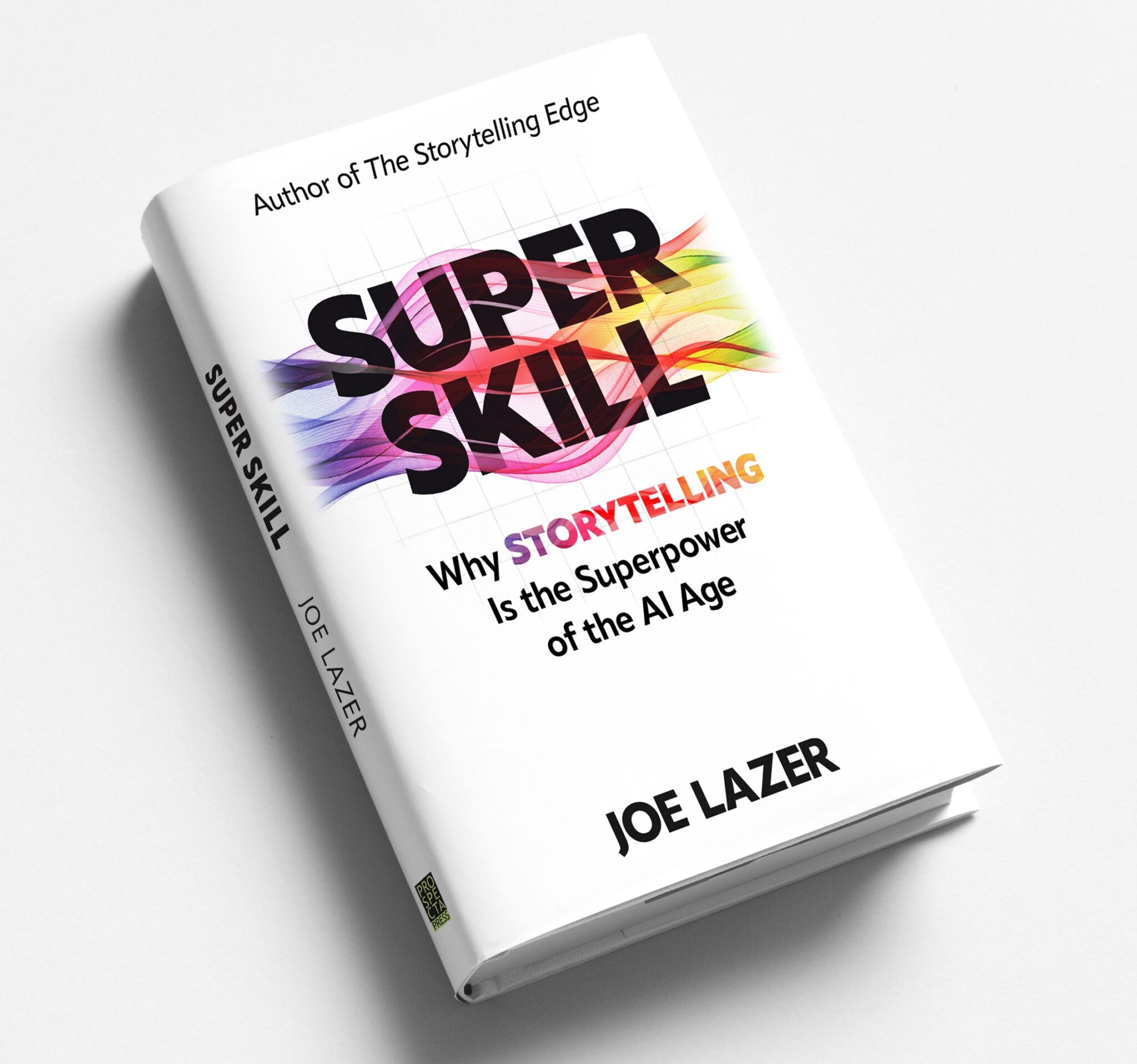 And now Joe Lazer, in his essential new book Super Skill: Why Storytelling is the Superpower of the AI Age, shows us why this ancient three-beat structure, in all of its variations, is the most important professional skill you can develop in the age of artificial intelligence.
Larry didn’t lean in because Thog was a good communicator.
Larry leaned in because his brain was built to lean in the moment tension entered the story.
That’s not rhetoric. That’s neuroscience. And that’s survival, the one job our brains are built for.
The Cognitive Revolution Was a Story Revolution
In Sapiens, Yuval Noah Harari states that Homo sapiens is the only organism we know of that plans, organizes, and acts guided by the stories we tell ourselves and others.
Not instinct alone. Not raw strength. Not even raw intelligence.
Story.
It’s what separated us from the Neanderthals, who were, by many measures, physically stronger and neurologically comparable to us. It’s what allowed us to cooperate in groups of hundreds, then thousands, then millions. It’s what built religions, nations, currencies, and constitutions. All of them shared narratives that billions of people agreed to believe and act upon.
Harari calls this the Cognitive Revolution, dating it to roughly 70,000 years ago, when something shifted in our neural wiring and suddenly allowed us to communicate in ways no other species could match.
What he’s really describing is the moment our limbic storytelling software became sophisticated enough to run collective fictions, stories big enough for entire civilizations to live inside.
And it made us, as Joe Lazer writes, something extraordinary:
“Storytelling is humanity’s greatest cognitive superpower. It’s how we transformed from a mid-rate species with few dominant traits into ultra-social learning machines that rose to conquer Earth.”
The most aggressive, invasive, dominant species this planet has ever seen.
Not because of our claws or our speed or our size.
Because of our ability to tell each other what happened, what it meant, and what we should do next.
Story may be more important for our ancestors’ survival and evolution than our opposable thumbs.
The One Thing AI Cannot Do
AI can write. It can code. It can analyze, optimize, and generate content at speeds that would have seemed impossible five years ago.
It cannot tell Thog’s story.
It can generate words. It can mimic narrative patterns. It can produce content that looks, on the surface, like a story.
But it has no broken fishing pole. No close call with a saber-toothed tiger. No skin in the game, no oxytocin in the telling, no lived truth in the resolution.
Neuroscientist Dr. Paul Zak’s research shows that when we hear a story with genuine tension and emotional resonance, our brains release oxytocin, the neurochemical of trust, empathy, and connection. That response evolved over hundreds of thousands of years.
It only fires for real stories, told by real humans, about real stakes.
As AI floods the internet with what Joe memorably calls “the Vortex of Mid,” an endless churn of competent, forgettable, algorithmically averaged content, the stories that break through will be the ones that are unmistakably, irreducibly human.
Your limbic brain knows the difference.
So does your audience’s.
The Foundation: The Story Only You Can Tell
This is where the StoryCycle Genie® begins. Not with a content calendar, not with a prompt, not with a framework imposed from the outside.
With a question.
What is the story only you can tell?
Every person, every organization, every brand has a story inside them unlike any other, shaped by specific experience, hard-won wisdom, and a particular way of seeing the world. The StoryCycle Genie® was built to do one thing: guide you to discover, share and live that story through Artful Intelligence powered by the proven Story Cycle System™.
Not artificial intelligence. Artful Intelligence.
The distinction matters. Artificial intelligence generates the average voice of every brand before yours. Artful Intelligence amplifies the voice that was always yours — and has always been yours to tell.
That Foundation is the load-bearing center of everything the Genie builds with you. Not for you. With you.
The Principles: How the Genie Works
Four non-negotiable Principles define who the StoryCycle Genie® works with, how it works, what it charges, and who owns what.
Brand Brain First. The Genie is a brand storytelling collaborator, not a content creation engine. The brand brain comes first. Everything else follows. Larry’s limbic brain processed Thog’s story because it was built to. Your brand brain works the same way. It needs to be engaged before content can mean anything.
No Frigid, No Rigid. The StoryCycle Genie® doesn’t work with people closed to discovery. Frigid means treating the collaboration like a vending machine. Rigid means being unable to see the bigger picture. We turn them away. No apologies.
We Subscribe to Story Fluency, and Price Accordingly. We cost more than generic AI subscriptions. We make no apologies for that. We don’t sell prompts. We build brand storytelling fluency, the compounding strategic foundation that grows more powerful over time. Fluency doesn’t reset at the end of the month. It compounds.
The Story Belongs to the Storyteller. The story we discover together is yours. Not ours. We don’t hold your story hostage to a subscription. Cancel anytime, without penalty, without losing a word of what you created. The story was always yours. We just helped you find it.
The Character: Three Genies That Put Your Super Skill to Work
If Super Skill is the philosophy, the StoryCycle Genie® is the practice. The Artful Intelligence collaborator built to help agencies and consultants operationalize the storytelling software already running in their brains.
StoryCycle Narrative Genie™: Give Your Story the Right Shape
Larry leaned in the moment Thog introduced tension. Your audience works the same way.
The StoryCycle Narrative Genie™ helps you find the uh-oh in every brand story, the tension that makes people lean in, and structure it into the ABT framework that the limbic brain is wired to receive. It analyzes your brand’s narrative for emotional resonance, maps your messaging to proven story shapes, and ensures every piece of content is built on the kind of conflict and resolution that triggers genuine human response.
Not engagement-bait. Real story.
Behavioral Messaging Genie™: Build the Habit That Builds the Brand
Joe’s first principle is deceptively simple: build a storytelling habit. Not a campaign. Not a content calendar. A habit, the daily practice of finding, shaping, and sharing stories that build trust and drive action over time.
The Behavioral Messaging Genie™ helps you embed that habit into your agency’s workflows and your clients’ communications. It applies behavioral science to craft messages that don’t just inform. They persuade, inspire, and create the kind of loyalty that no ad spend can manufacture.
Search Optimization Genie™: Make Sure Your Story Gets Found
In the storytelling economy, attention is capital.
The Search Optimization Genie™ ensures your stories are discoverable everywhere your audience is looking: Google, AI-powered search, voice assistants, and beyond. It structures your content for zero-click search and answer engines, so your narrative authority compounds over time.
In a world where AI answers every informational query before anyone clicks a link, the only sustainable content strategy is one built on genuine thought leadership and authentic human story.
This Genie makes sure yours gets found.
Seventy Thousand Years Later
Imagine agency principal Lauren at her standing desk when her business partner Jay drops into the chair across from her, tie loosened, laptop bag sideways.
“Jay, where you been?” Lauren asks, eyes still on her screen.
“Henderson pitch,” Jay says. “Brought our best AI-generated brand story deck.”
“Yeah,” Lauren nods.
“Client stopped me on slide three. Said it sounded like every other agency they’d seen.”
“Seriously?” Lauren’s chair swings around.
“Pulled up StoryCycle Genie® right there in the room. Ran them through the Brand Story Genie™. Forty minutes later, they’re leaning forward, telling us things about their business they’d never put into words before. We closed on the spot.”
“Sweet!” Lauren grins.
Six syllables. Three beats.
“Yeah.” The world as it was. Setup. Agreement.
“Seriously?” Something threatened that world. Complication. Stakes just got real.
“Sweet!” The world as it can be. Resolution. There it is.
Uh-huh. Uh-oh. Ah hah.
The limbic brain doesn’t care what year it is. It doesn’t care whether the fire burns wood or Wi-Fi. It cares whether the story is true.
The Moral of the Story
Your clients’ customers are still Larry. Still warming themselves by the fire. Still leaning in the moment tension enters the room. Still making every buying decision, every trust decision, every loyalty decision based on the stories they’ve been told and the stories they tell themselves.
The software hasn’t changed.
The hardware hasn’t changed.
What’s changed is the noise level. And in a world drowning in AI-generated mid, the story that cuts through isn’t the most optimized one.
It’s the most human one.
That’s your super skill.
It always has been.
The question is whether you’re using it.
Find Out How Strong Your Brand Story Really Is
Before you can tell a better story, you need to know where your current story stands.
Take our free Brand Story Grader, an expert assessment of your brand’s narrative strength across the dimensions that actually matter. You’ll walk away with clear, actionable insights, not a sales pitch.
Sources & Further Reading
- Yuval Noah Harari, Sapiens: A Brief History of Humankind — The Cognitive Revolution and humanity’s storytelling superpower
- Dr. Paul Zak, “Why Your Brain Loves Good Storytelling,” Harvard Business Review — Oxytocin, narrative tension, and the neuroscience of trust
- Randy Olson, Houston, We Have a Narrative — The And-But-Therefore framework for scientists and communicators
- Trey Parker and Matt Stone on “But/Therefore” — The South Park creators explain their narrative test
- Joe Lazer, Super Skill: Why Storytelling is the Superpower of the AI Age — The essential guide for agency leaders in the AI era
- Park Howell interviews Joe Lazer, Business of Story Podcast — Full episode now available
FAQ: Storytelling, the Limbic Brain, and the Future of Your Agency
Q: What does the limbic brain have to do with marketing? A: Everything. The limbic system is the brain’s ancient meaning-making engine. It processes emotion, assigns threat and reward, and drives decision-making before the rational mind even weighs in. Marketing that speaks to the limbic brain through story doesn’t just inform. It moves people.
Q: Why is storytelling described as evolutionary software? A: Because unlike tools we invented, storytelling evolved in us. It’s the cognitive operating system that allowed humans to transmit survival knowledge, build social trust, and coordinate collective action at a scale no other species could match. We don’t use story. We run on it.
Q: What is the ABT framework and where does it come from? A: And-But-Therefore. Setup, conflict, resolution. It’s the three-beat structure that mirrors the limbic brain’s natural pattern for processing meaning, and it’s been the backbone of every compelling story ever told, from Thog’s fishing trip to Shakespeare to Super Bowl ads. Park Howell has built an entire methodology around it.
Q: What is Artful Intelligence and how is it different from artificial intelligence? A: Artificial intelligence generates the average voice of every brand before yours. Artful Intelligence, the craft, intentionality, and human-centered design at the heart of the StoryCycle Genie®, amplifies the voice that was always yours. One replaces your thinking. The other amplifies it.
Q: What is the “Vortex of Mid” and why should agencies care? A: Joe Lazer’s term for the gravitational pull of AI-generated content toward mediocrity. As the cost of average content approaches zero, its value does too. Agencies that differentiate through authentic, human-led storytelling will win. Those that don’t will be commoditized.
Q: What does “the story belongs to the storyteller” mean? A: Everything you build with the StoryCycle Genie® is yours, permanently, unconditionally, and without penalty. Cancel anytime. You keep every word. The story was always yours. We just helped you find it.