How to Find Your Authentic Brand Archetype That Governs Your Storytelling
What is your authentic brand personality archetype? Revealing it and consistently projecting your personality to the world is essential if you want to govern your brand story and stop narrative entropy.
Just ask the Swedish company that makes remote-controlled demolition machines that once asked my agency, Park&Co, to help sell more of them.
Brokk’s machines tear down walls, break up concrete, and squeeze into tight spaces so a crew with jackhammers doesn’t have to. Their marketing was leading with features and benefits, the industrial drone of engineering made audible.
I told them to stop.
“Your real business,” I said, “was demolishing the competition.”
So we built the Brokk campaign around a creature I called the “Swedish Army Knife,” a Transformer-like machine with octopus-like arms that could tear down, break up, and devour anything in its path.
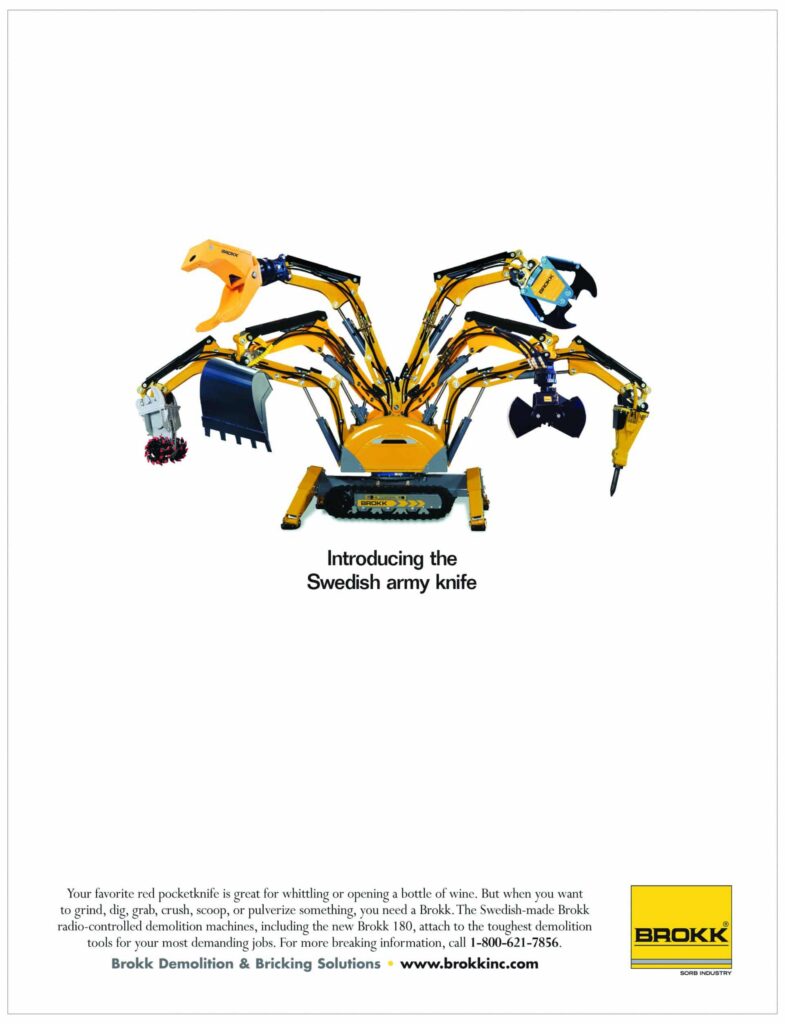
This is the “Swedish Army Knife” ad my agency, Park&Co, created for Brokk in 2001. After launch, the phones rang like crazy, Brokk grew 200%, and they’re still running it 25 years later.
Ad created by Park&Co for Brokk.
When sales and marketing first saw it, one of them said, “But that is not what our product looks like.”
They were right. It looked better. The product already had a personality, but it was hiding behind standard B2B marketing, which, like in most B2B cases, meant Boring-to-Bored.
We ran the ad in crowded trade magazines, and contractors noticed. After the 2001 campaign launched, the phones in Brokk’s sales department rang like crazy. The business grew 200%.
Brokk is still running that ad 25 years later. I call that story endurance, because we are able to capture and articulate a specific brand personality archetype that was unique to Brokk and rocked the construction and demolition industries.
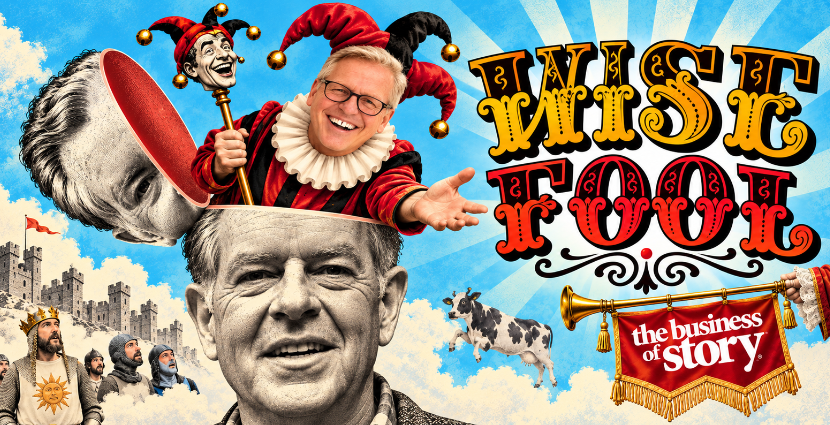
Looking back, that campaign was my Wise Fool archetype at work. A serious machine dressed up as a ridiculous creature delivering a truth the sales team didn’t want to embrace…at first.
It took me years to codify my own brand personality archetype: The Wise Fool.
[I ran Brokk through the Brand Archetype Genie™ in the StoryCycle Genie® and revealed its current personality at the end of this article]
The Brand Archetype Nobody Gave Me
I’ve run the Story Cycle System™ for years, teaching brand archetypes to hundreds of founders, CMOs, and agency principals. It’s fun!
I could look at a company’s behavior, its language, and its customer relationships, and within an hour tell you whether it was a Sage brand, a Hero brand, or a Ruler with Caregiver tendencies. I had done it for Coca-Cola and the US Air Force, construction companies, water conservation campaigns, and for used-car dealerships in Quebec and community health centers in Phoenix.
So, earlier this year, I decided to run my own Park Howell/Business of Story brand through our StoryCycle Genie™ archetyping expert to see what I would come up with.
Many of the 60+ archetypes on the list described a piece of me. But no single one held my whole personality.
I was too irreverent for the pure Mentor. Too studied for the pure Fool. Too much of a storytelling Magician to be simply either.
I tried the Jester. Closer, but not quite.
I tried the Sage. Yes, but it left out the best parts of what I actually do in a room: the question that lands harder than expected, the truth delivered with just enough wit that it can’t be dismissed and can’t be ignored.
As brilliant as the StoryCycle Genie® is at defining your primary and two secondary archetypes, I just couldn’t settle on one. So I collaborated with the Genie to create a brand personality that really hit home: The Wise Fool.
Think of the Wise Fool as Joseph Campbell meets Monty Python.
Campbell brings the mythological gravity. The deep structural wisdom of the Hero’s Journey. The studied mastery of how humans make meaning through story, earned over forty-plus years, 20 of them running my own agency.
Monty Python brings the irreverence. The willingness to puncture a sacred cow mid-sentence. To make the room laugh right before it understands. To deliver the most important idea in the meeting through the most unexpected door.
My friend Bruno Sarda, who brought me in to teach Sustainable Storytelling at ASU, once told me he liked my mischievous approach to storytelling.
“It keeps people on their toes while challenging their beliefs,” he said.
Together they produce something the standard twelve archetypes cannot name: hard-earned wisdom and fearless wit, fused into one.
That fusion has an old precedent in the Court Jester, the one figure in any royal court relied upon to tell the king and queen the truth without having their head lopped off. The Jester filtered nothing. That was the role. I have no problem speaking truth to leaders, especially the sticky stuff.
Here’s what that looks like in my own work.
When we first landed the Goodwill of Central Arizona account in 2003, I told them they had to clean up their 17 stores, remove the “scent of thrift” by moving the coffee maker up front, and increase inventory selection before we would run their TV campaign.
They were stunned.
Then they made the changes. We ran the commercials, and per-store sales jumped 42% the following month. Goodwill is the Regular Guy or Gal Next Door archetype.
When I was asked to speak at Robert Redford’s Raise the River event in Phoenix to help the struggling Colorado River, I started by telling the audience I was the son of a dam builder. Contradiction is the best lure you can cast in a room.
Robert Redford was know as the rugged Thoughtful Individualist archetype.
When the international translation company Avantpage asked me to refine their brand story, they told me they were in the translation business.
I said, “No, you’re not. You’re in the empathy business. Your mission is to help immigrants truly understand the new world they’ve moved to.”
Avantpage landed on the UVP and tagline “Empathy beyond words” to communicate their Sage/Caregiver brand personality.
If you take one idea from this article, take this one. Name your brand archetype precisely, or someone else will name it for you.
Your Brand Archetype Is an Operating System
Brand archetypes are found in twelve universal character categories built on Carl Jung’s psychology and first mapped for brands by Margaret Mark and Carol Pearson.
I was mesmerized by their book, The Hero and the Outlaw: Building Extraordinary Brands Through the Power of Archetypes.
Archetypes work as operating systems, the governing personality that produces consistent brand voice and brand identity across every output, at every scale.
Too many teams treat their archetype as a mood board, a word pinned to the conference room wall after a two-hour session, or a creative exercise to make the about-page sound warmer. That badly underestimates the job.
Your archetype is your Brand Brain’s governing personality. It is the structural filter through which every content decision, every design consideration, every tonal call, every word choice either passes or fails.
When you have named your personality precisely, your brand stops fragmenting under pressure. AI tools stop producing generic category content and start producing something that sounds unmistakably like you.
An unowned archetype is a brand that fragments under AI acceleration.
From 12 Brand Personality Archetypes to 60
When I started studying brand archetypes, I thought the job was to pick one of the 12.
Then I found Margaret Pott Hartwell‘s work.
Hartwell and her co-author, Joshua C. Chen, showed in their 2012 toolkit, Archetypes in Branding: A Toolkit for Creatives and Strategists, that each of the 12 is really a family. Every family holds four nuanced sub-archetypes. The Hero family alone breaks into the Athlete, the Liberator, the Rescuer, and the Warrior.
That’s 60 personalities to choose from, and the toolkit includes a companion deck of all 60 archetype cards.
The 12 tell you which neighborhood your brand lives in. The 60 tell you which house.
And the 60 are a starting point.
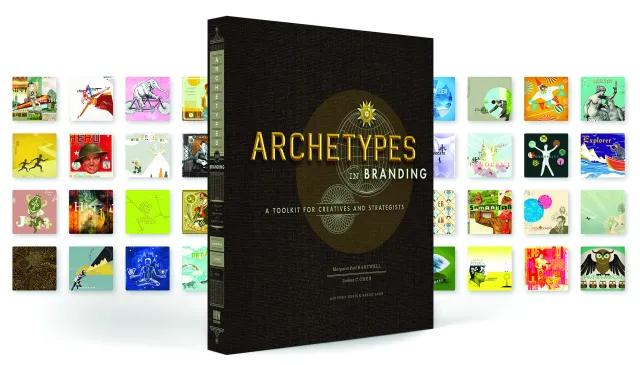
Margaret Pott Hartwell and Joshua C. Chen turned the 12 classic brand archetypes into 60. The 12 tell you which neighborhood your brand lives in. The 60 tell you which house.
Book cover: Archetypes in Branding by Margaret Pott Hartwell and Joshua C. Chen (2012).
Other branding systems slice the 12 families their own way, with their own sub-archetype names and counts. Jung himself never settled on a number. Carol Pearson, who co-wrote the original 12, quotes him on her own site: “There are as many archetypes as there are typical situations in life.”
That line gave me room to name my own. When no card in any deck holds your brand, you’re free to name the one that does. That’s how I arrived at the Wise Fool.
Both books are essential reading.
Both authors have joined me on the Business of Story Podcast: Margaret Mark and Carol Pearson on how brand archetypes create deeper customer connections, and Margaret Pott Hartwell on how character archetypes create magnetic brand demand. If you want to go deep on brand archetype theory and practice, start there.
Why Brands Fragment
When your organization scales content production, your brand archetype, named precisely and installed deliberately, is what keeps every output sounding like one coherent voice instead of the 16 distinct personalities of Sybil. Which is rather scary.
Most brands drift into narrative entropy, the slow fragmenting of brand story where every channel sounds slightly different, for one reason. Their archetype was never named exactly enough to govern.
When a Brand Disowns Its Own Personality
Bud Light shows what this costs.
For more than two decades, Bud Light was America’s top-selling beer, and it ran on a clear Jester identity: irreverent, blue-collar, and funny.
Then in spring 2023, Bud Light’s Vice President of Marketing, Alissa Heinerscheid, said on a podcast that the brand “had been kind of a brand of fratty, kind of out-of-touch humor.”
That’s a marketing chief publicly disowning the Jester’s defining trait.
The market responded fast, amid a consumer boycott. In the four weeks ending June 3, 2023, Bud Light’s dollar sales fell 24.4%, and Modelo Especial took its crown as America’s top-selling beer.
AB InBev’s U.S. revenue fell 10.5% in the second quarter of 2023, which the company tied to Bud Light’s falling volume.
A Jester that apologizes for being a Jester has no identity left to stand on.
J.C. Penney was a Caregiver and Regular Person brand, built on family shopping trips and the hunt for a good coupon.
In 2011, the board hired Ron Johnson, Apple’s Senior Vice President of Retail, as CEO and handed him the whole house to redecorate.
Johnson stripped out the coupons, flattened the sales calendar into everyday low prices, and squeezed the name into a square “jcp” logo. Gone was the every-guy-and-gal brand the company was built on and neighbors recognized.
The coupon hunt was the relationship, and he deleted it.
In fiscal 2012, revenue fell 25%, to $12.98 billion from $17.26 billion, with a net loss of $985 million. Johnson was out after about 16 months.
By October 2013, Penney had returned to its classic red JCPenney logo, its third logo in under three years. The company said customers “overwhelmingly confirmed their preference for our classic J.C. Penney logo.”
On the Business of Story blog, I called it death by acronym.
The deeper diagnosis was archetype transplant rejection.
The list goes on. Tropicana’s 2009 carton redesign cut unit sales 20% in under two months. Gap’s 2010 logo redesign lasted about a week. Pepsi pulled its 2017 Kendall Jenner ad a day after launch.
Each of these brands had a personality its customers loved. None had it named and protected tightly enough to survive a new executive, a new agency, or a new idea.
So, I gotta ask you: Which trait in your brand would a new CMO be most tempted to call “out of touch”? And what would it cost you if they deleted it?
This is what StoryOps™ addresses: installing your brand archetype as the operational foundation across every content touchpoint, every channel, every AI tool running in your name.
So we are going to name yours.
The Wise Fool Against the Jester and Sage Families
First, let me show you how it works on my own brand.
I start with the 12 families of archetypes to get me closer to my actual archetypes. I, and by extension the Business of Story, as its founders, are not The Hero, the Lover, or the Ruler archetypes. We can set those aside.
We are, however, a combination of the Creator, Jester, and Sage, but we need to dig deeper.
If you’re doing this with me, take your two strongest candidate families, lay all eight sub-archetypes side by side, and ask where you overlap and where you part ways. The overlaps confirm the family. The partings define you.
The Wise Fool sits at the intersection of two families. Working through each sub-archetype shows you exactly why.
The sub-archetype descriptions I quote here and in the next section come from Red Chalk Studios’ family-by-family guides, linked on each family’s name.
The Jester Family
The Jester family contains four sub-archetypes: the Clown, the Provocateur, the Entertainer, and the Shapeshifter.
The Clown is the Wise Fool’s closest relative. It’s described as “Wise, entertaining and daring,” a mask-wearer who can “safely” make us laugh “And then cry,” taking on taboo and uncomfortable topics head-on.
The overlap is real, and the parting is the mask. The Clown’s comedy operates behind cover. The Wise Fool speaks barefaced, with 40 years of credentials signed to the truth.
The Provocateur is the pot stirrer, deploying irony, comedy, and sometimes shock to fight complacency wherever it settles. The Wise Fool shares that enemy. Complacency is the engine of narrative entropy.
The parting comes after the stir. The Provocateur moves on to the next fire. The Wise Fool stays in the room and guides the client to the truth on the other side.
The Entertainer pokes fun to help people escape from reality. The Wise Fool drags the room back into reality.
The Shapeshifter treats reinvention as a virtue. Constant shapeshifting is how narrative entropy begins, the pattern that made Bud Light’s and JCPenney’s pivots so costly. The Wise Fool keeps one identity and defends it.
Hold onto this test. In the Self-Discovery Sequence below, you’ll run it on your own two strongest families, whichever of the 12 they are.
The Sage Family
The Sage family contains the Detective, the Mentor, the Shaman, and the Translator.
The Detective digs into human behavior to understand why people do what they do. Every question in the interrogation below is Detective work.
The Mentor is the teacher and trainer who guides others toward empowerment, patiently and step by step. The Wise Fool teaches by ambush, the question first and the lesson a beat later.
The Shaman is the experiential teacher, a messenger between reality and possibility. This is the Joseph Campbell half living inside the Wise Fool, the mythological gravity that makes the humor land as wisdom.
The Translator crosses boundaries of culture, gender, and time to get at the truth of a message. The Wise Fool translates ancient myth into boardroom language.
Because the Shaman already carries the Sage family’s weight inside the Wise Fool, the blend’s second archetype needs to come from a different family entirely.
In the language of the 60, the Wise Fool fuses the Jester family’s Clown and Provocateur with the Sage family’s Shaman.
No single card in the deck holds that combination. That is why the name had to be coined.
The Self-Discovery Sequence: How to Find Your Brand Archetype
What follows is an interrogation.
Work through these questions in sequence and write your answers down. They surface the brand archetype already running your brand, whether you have named it or not.
Your job is to watch for the answer that arrives before the polished answer does.
Part One: The Primary Archetype — What Is Already Running Your Brand
Start with behavior under observation. Leave your aspirations and your positioning statement at the door.
Look at the thing you actually do, consistently, that you cannot fully explain.
- What uncomfortable truth does your brand keep circling back to? Skip the insight that makes people nod politely. Name the one that makes the room go quiet.
- What do your best clients say about you that slightly surprises you? Pass over the compliment you expected. Name the one you’ve received three times and still don’t fully own.
- If your brand were fired for being too much of one thing, what would that thing be? Too blunt? Too rigorous? Too irreverent? Too earnest? Too contrarian?
- When your work is at its worst — when it feels off, when it sounds like everyone else in your category — what is the quality it has lost? What got diluted?
The answers to 3 and 4 are often the same archetype, approaching from opposite directions. The thing you get “fired” for being too much of is usually the thing that, diluted, makes you indistinguishable.
Part Two: The Supporting Archetypes — What Gives Your Brand Personality Depth
No brand archetype works alone. The Sage without a secondary becomes a lecture. The Hero without a secondary becomes a bully. The Wise Fool without structure becomes noise.
- Of the twelve archetypes (Innocent, Explorer, Sage, Hero, Outlaw, Magician, Regular Person, Lover, Jester, Caregiver, Ruler, Creator), which two show up most clearly in how you show up under pressure?
- When your brand is at its most alive, even if least polished, which archetype is driving and which one is riding alongside?
Once you’ve named your leading families, open the 60 and find the sub-archetype in each that fits most precisely, the way I did with the Wise Fool above. That is where your blend gets sharp.
Part Three: The Weighting — How Much of Each Brand Archetype
The combination matters. But the weighting matters just as much, because the ratio determines whether your blend is a clear brand identity or a muddy contradiction.
Business of Story runs approximately 60% Wise Fool, 25% Creator, and 15% Rescuer.
Change the weighting, and you get a different brand entirely. Still intelligent. Still occasionally direct. But no longer the thing that makes a client feel slightly ambushed by their own truth.
- If you had to assign rough percentages to your primary and supporting archetypes, what would the ratio be? Trust the first number that arrives.
- What specific language does your primary archetype own? What words, sentence structures, or rhetorical moves belong to it that you would lose if you diluted it?
- When you describe your blend out loud, does it produce a distinct picture no single archetype on the list would cover? Or does it sound like a compromise between two options you couldn’t choose between?
The Business of Story Blend: Wise Fool, Creator, and Rescuer
Business of Story runs on three archetypes: roughly 60% Wise Fool, 25% Creator, and 15% Rescuer from the Hero family.
The Creator belongs here because it has been persistent in Business of Story, and in me from the beginning.
The Creator family creates “to not only find meaning in life, but to make meaning,” turning abstractions, visions, and dreams into reality.
Here’s the Proof: The Story Cycle System™. Co-creating the StoryCycle Genie®. Writing Brand Bewitchery and co-authoring The Narrative Gym for Business. Nearly 600 episodes of the Business of Story podcast. My agency Park&Co’s first 30-second TV spot, for Goodwill of Central Arizona, which won a Rocky Mountain Emmy. Coining the term Artful Intelligence.
Each of those is a thing that did not exist until it was made.
Within the Creator family, the Storyteller is the sharpest expression of Business of Story. The Storyteller is “the bridge, the charismatic who brings people together, connecting them to shared experiences,” so that difficult topics can be explored.
The Shaman inside the Wise Fool finds meaning in ancient stories like the Hero’s Journey. The Creator makes new things from that material.
The Shaman is the gravity. The Creator is what gets built.
The Rescuer earns its 15% because the stakes are personal.
The Rescuer steps in “when no one else will,” there “to restore balance, driven by the need to help,” saving people from internal threats such as self-betrayal.
A brand that drifts from its archetype is betraying itself. The Rescuer steps in to restore the brand’s balance and stop narrative entropy before it compounds.
The three archetypes appear to contradict each other.
The Fool who refuses to take the king seriously. The Creator who takes the craft very seriously. The Rescuer who takes the client’s survival personally.
That contradiction is the service.
In a client engagement, it moves in three beats.
- The Wise Fool asks the question that makes the room go quiet, the one the leadership team has been too comfortable to ask themselves.
- The Creator hands them the system that holds the answer.
- The Rescuer stays until the brand story holds under pressure.
People ask me how I sell storytelling.
I don’t sell storytelling. Rather, I instill story in their people and install it in their organizations.
The instilling happens through the proven narrative and story frameworks I teach.
The installing happens through the brand story development services we produce and the StoryOps™ governance we create with StoryCycle Genie®, the tool built specifically to help brands govern their story and stop narrative entropy.
You have an important story to tell. You can feel it, but you just can’t find it.
The Rescuer helps you rescue the story buried in your business. The Creator shows you how to craft it. Both work in support of the Wise Fool, who makes finding and living into your most powerful and prosperous stories entertaining, revealing, and fun.
That’s why my promise is to help you and your people excel through the stories you tell.
Run the same test on your own blend. Where do your archetypes appear to contradict each other, and what does that contradiction deliver for your clients?
The contradiction between your archetypes is the delivery mechanism of your value. Find it, name it, and govern it.
Brand Archetype Examples: What the Wise Fool Governs
When I installed the Wise Fool into Business of Story’s Brand Brain as its primary archetype, here is what changed, concretely.
Language: The Wise Fool arrives at a conclusion a beat before you expect it, then leaves you in the discomfort of having already known it was true. Shorter. Sharper. Willing to say the hard thing because the forty years behind it are the credential.
Content choices: Pure mastery produces a framework and trusts it to do the work. The Wise Fool produces a question that makes you doubt the framework you already have, and then the Creator builds a better one. The disruption is structural.
What it sounds like when it goes wrong: When Business of Story dilutes the Wise Fool toward pure authority, the work becomes instructional. Accurate. Useful. Forgettable within twenty-four hours, because nothing in it produced the productive discomfort that makes an insight stick.
Campbell without Python is a mythology lecture. Python without Campbell is a sketch comedy show. The Court Jester who stopped telling the truth wasn’t a jester anymore. Just a man in a silly hat.
That difference — between a brand that informs and a brand that haunts — is what a precisely named, authentically owned archetype delivers.
The Question Bridge
Here is where I am going to resist the instinct to give you the answer and give you the question instead.
You have worked through the interrogation sequence. You have candidates for your primary brand archetype and your supporting archetypes. You may even have a ratio.
But is the archetype you just named the one you would choose? Or the one that is already governing you whether you named it or not?
Sometimes those are two different archetypes. The one you would choose is aspirational. The one already in charge is operational.
And until you have named the operational archetype precisely enough to install it across your brand, the aspirational one is just a direction you are walking rather than a road you have built.
Your brand has a personality right now. Your AI is producing content from it, approximately, through the statistical average of everything your team has ever written in your name.
Your new hires infer it from what they find in their first week. Your best clients describe it to their networks in words that may not match yours.
Your brand archetype is present either way.
So, are you governing it, or is it governing you?
Back to Brokk: The Brand Archetype Genie in Action
Mike Martin, the man who launched Brokk’s North American sales division, once described Brokk’s personality to me in a single sentence: “It can get into small places and safely tear the hell out of it.”
Mike called it a wolverine. It turns out it’s also a myth.
In 1976, brothers Lars and Per-Martin Holmgren built the world’s first demolition robot in Skellefteå, Sweden. According to Brokk’s own history page, “Inspired by Nordic mythology, they named the robot ‘Brokk’ after the dwarf who forged Thor’s hammer.”
In the Norse myth, Brokkr bet Loki his head that he and his brother Eitri could forge finer treasures than a rival family of dwarves. Brokkr kept pumping the bellows while a gadfly, likely Loki in disguise, stung him on the hand, the neck, and the eye. The brothers won, and Brokkr sewed Loki’s lips shut.
A pair of Swedish brothers named their machine after one of a pair of brothers. I couldn’t make this up if I tried.
So I fed the Brand Archetype Genie three sources: the Park&Co case study, Brokk’s current website, and the myth itself. Within minutes, it returned this blend.
- 65% Warrior (Hero family). The wolverine line. The site’s “Designed to handle the toughest jobs” and “engineered to push the boundaries of demolition performance.” Brokkr working the bellows through three stings. Our own “Swedish Army Knife” campaign.
- 25% Visionary (Creator family). The world’s first demolition robot in 1976. “Pioneers in demolition since 1976” on the site. A mythic craftsman for a namesake.
- 10% Caregiver family. “Founded in safety. Driven by purpose.” Operator spotlights like “Meet Simone!”
The diagnosis that followed was the valuable part.
The Genie spotted a drift. The 2001 Wolverine was unmistakably Warrior, blunt and a little feral. Today’s site has softened toward Caregiver warmth and Explorer curiosity, which risks diluting the most distinctive signal Brokk has ever had.
Its recommendation was clean. Frame safety and purpose as Warrior motivations. Brokk fights so its operators don’t have to.
The brand voice line the Genie landed on is “Blunt force with a long memory.”
That’s a myth, a wolverine, and 50 years of demolition engineering in six words.
Your brand has a myth underneath it too, and probably a drift you haven’t named yet. Do you know which archetype your brand was born as, and where it has drifted since?
If you want help answering that, StoryCycle Genie®, the tool built specifically to help brands govern their story and stop narrative entropy, makes finding your brand archetypes, and even creating your own, easy. Enthralling, even.
It collaborates with you to develop your personality archetype and communicate it across every channel of storytelling.
You instill your archetype in the Genie. The Genie installs it in the governance of your brand story.
Start today. Open the Brand Archetype Genie inside StoryCycle Genie® and answer the first three questions from this article. Then let it show you which of the 60 you already are, or help you name the one nobody gave you.
After all, don’t YOU want to demolish your competition?
Frequently Asked Questions About Brand Archetypes
What are brand archetypes?
Brand archetypes are personality frameworks: twelve universal human patterns built on Carl Jung’s psychology. In brand identity, they function as structural filters. Every content decision, tonal call, and word choice either passes or fails against the archetype. The twelve are the Sage, Hero, Outlaw, Jester, Caregiver, Creator, Innocent, Explorer, Magician, Lover, Regular Person, and Ruler.
How many brand archetypes are there?
The classic model has 12, laid out by Margaret Mark and Carol Pearson in The Hero and the Outlaw. Margaret Pott Hartwell and Joshua C. Chen’s toolkit, Archetypes in Branding, treats each of the 12 as a family with four sub-archetypes, for 60 in all. The Hero family, for example, includes the Athlete, Liberator, Rescuer, and Warrior. Other systems use their own counts, and Carl Jung held that “there are as many archetypes as there are typical situations in life.”
How do you find your brand archetype?
Finding your brand archetype takes honest interrogation. Examine the behavior your brand exhibits consistently under pressure: the uncomfortable truths you keep circling, what gets diluted when your brand drifts, what your best clients say that slightly surprises you. Then test your leading families against the 60 archetypes in Archetypes in Branding. The archetype already driving your brand is more operationally valuable than the one you would aspirationally choose.
Can a brand have more than one archetype?
Yes. Most enduring brands operate with a primary archetype and one or two supporting archetypes. The primary archetype governs brand voice and brand identity. Secondary archetypes provide depth and dimension. The weighting matters as much as the combination. Business of Story runs 60% Wise Fool, 25% Creator, 15% Rescuer. Shift that ratio and you produce a fundamentally different brand.
What is the difference between brand archetype and brand personality?
Brand personality describes the observable traits a brand expresses: wit, warmth, authority, irreverence. Brand archetype is the structural source of those traits, the framework installed in the Brand Brain that produces consistent brand personality across every channel, every team member, and every AI-generated output at scale. The archetype is infrastructure. The personality is the output.
What happens when a brand does not name its archetype precisely?
Narrative entropy: the slow fragmentation of brand story where every channel sounds slightly different, where the brand your VP of Sales describes no longer matches what your content team produces. Under AI content production, an imprecise brand archetype generates statistically average output. In the market, the cost can be steep. Amid a 2023 boycott, Bud Light’s dollar sales fell 24.4% in four weeks, the same spring its own marketing chief publicly disowned the brand’s Jester humor.
How does a brand archetype govern brand voice?
A precisely named and installed brand archetype governs every language decision: sentence structure, tonal register, rhetorical moves, word choice. It determines what gets said before the framework earns the right to say it, and what gets left unsaid. Brand voice without a governing archetype is style without structure. Usable, inconsistent, and indefensible under pressure.
How do you keep AI content true to your brand archetype?
Install the archetype where your AI tools draft from. StoryCycle Genie®, the tool built specifically to help brands govern their story and stop narrative entropy, holds your brand archetype blend in your Brand Brain, so the content it produces starts from the same personality every time.
What are brand archetype examples from real brands?
Coca-Cola runs on the Innocent: optimism, simplicity, belonging. Apple expresses the Creator-Outlaw blend, making tools for rule-breakers. The US Air Force channels the Hero. Business of Story runs 60% Wise Fool, 25% Creator, 15% Rescuer. The Wise Fool delivers the truth, the Creator builds the system, and the Rescuer stays until the brand story holds. Each combination produces a distinct brand identity that resists being genericized.