Master the Primal Art of Business Storytelling
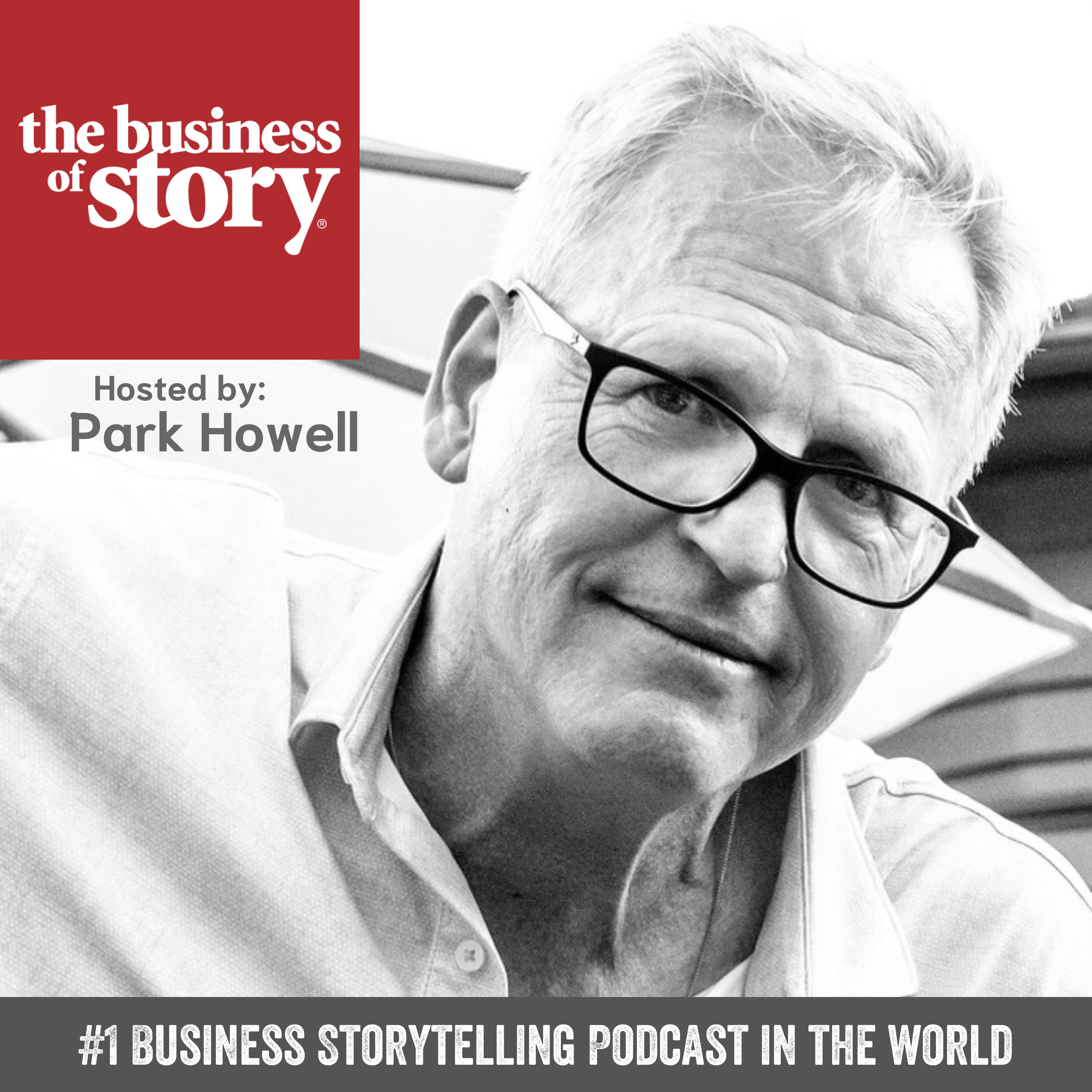
The Business of Story Podcast With Park Howell
Transform Your Business Through Proven Narrative Mastery
Every marketing director, business owner, and sales professional understands that the right story can transform how customers respond to their message.
If you master the vital storytelling structures that have driven human engagement for millennia, then you’ll make a deep connection with your audience that moves them to take action.
But you may be frustrated because conventional brand storytelling advice offers generic tips and surface-level techniques instead of the primal storytelling principles that actually create lasting impact.
That’s exactly where The Business of Story podcast transforms your approach to business communication.
Through Park Howell’s proprietary guidance, you gain access to primal storytelling amplified with cutting-edge technology, enabling you to excel through the stories you tell while accelerating your Return on Intelligence through remarkable storytelling mastery.
Your Guide to Storytelling Excellence
Park Howell brings 40+ years in branding and over two decades of proven expertise in marketing storytelling, combining primal narrative wisdom with modern precision.
As the creator of the revolutionary Story Cycle System™, which has grown brands by 600 percent, propagator of the ABT (And, But, Therefore) narrative framework, and co-creator of the StoryCycle Genie™, Park has pioneered “Vibe Branding”.
Vibe Branding combines emotional intelligence with artificial intelligence, guided by proven storytelling structures, to accelerate ROI: Your Return on Intelligence.
His sacred mission: help you excel through the stories you tell, delivering measurable results through systematic application of primal storytelling principles.
Latest Episodes: Primal Storytelling in Action
Recent Releases:
- 10 Essential Story Elements of Vibe Branding That Make Your Brand Narrative Enthralling
- The Five Essential Elements (the H.E.A.R.T.) of the Perfect Pitch With Ben Wiener
- How to Unlock Brand Alignment to Accelerate Your Business Growth With Brandon Coleman Jr.
- How to Tell Your Startup Lifecycle Story to Sell Investors & Customers on Your Brand With Gregory Shepard
- How to Effectively Position Your B2B Brand With April Dunford
Each episode delivers actionable insights you can implement immediately, combining proven primal storytelling frameworks with contemporary business applications for remarkable results.
Begin Your Storytelling Mastery Journey
Subscribe now and join thousands of professionals who’ve transformed their business communication through primal storytelling principles amplified with today’s technology. Available on Apple Podcasts, Spotify, Google Podcasts, and all major platforms.
Exclusive Subscriber Benefits:
- Access to primal storytelling resource library
- StoryCycle Genie™ early access updates
- Monthly storytelling mastery workshops focused on Return on Intelligence
- Direct connection with the storytelling excellence community
Or subscribe anywhere you get your podcasts.
Subscribe to Top-Rated Storytelling Podcast and Make Your Brand Story Stand Out
iTunes | Spotify | Pandora | Stitcher | Amazon Music | Get the podcast in your inbox every Monday
The Companies Winning the War for Talent Aren’t Telling Better Stories — They’re Telling Truer Ones
What Happens When You Stop Packaging Your Culture and Start Revealing It
You’re a talent leader, an HR director, a CEO trying to build a team that can carry your organization forward. And you know that the right people — not the right technology, not the right product — are the only competitive advantage you have left.
But you’re frustrated because your career site looks like everyone else’s.
Your employer brand sounds like everyone else’s. And many of the candidates who do apply don’t last, because what you promised and what they experienced didn’t match.
That’s not a messaging problem. That’s a truth problem.
And it’s exactly what Bryan Adams has spent 20 years solving.
Meet Bryan Adams: The Employer Brand Strategist Behind Nike, Apple, and HappyDance
Bryan Adams is the CEO and founder of HappyDance, a platform helping global companies align leadership, culture, and talent strategy.
Before building HappyDance, he founded Ph.Creative, one of the world’s most awarded employer brand consultancies, advising leadership teams at organizations including Nike and Apple.

He’s the bestselling author of Give & Get Employer Branding and the upcoming book Sell the Truth.
His TEDx talk, Culture Eats Competition for Breakfast, has been viewed more than 1.4 million times, and its central argument is the through-line from everything he’s built: belief, not strategy alone, drives performance inside organizations.
That’s not a motivational claim. It’s a practitioner’s observation from two decades inside the world’s most complex talent challenges.
His upcoming book, Sell the Truth, is the capstone — everything Bryan has learned about why sanitized stories fail and honest ones convert, codified into a framework any leader can use.
What’s in it for You
- Why people are the only competitive advantage left in a world where technology is a commodity
- Bryan’s core intellectual contribution: “The truth that matters isn’t the one you’re most comfortable telling. It’s the one your audience most needs to hear.”
- The TRUTH Framework — a five-step storytelling system (Trigger, Reveal, Unlock, Tension, Harvest) designed for culture and talent
- Why being nice is quietly holding your organization back — and the distinction that transformed VF Corporation globally
- How HappyDance drives career site conversions up to 12% vs. an industry standard of 3–5%
- What the StoryCycle Genie® revealed about HappyDance’s brand — and what Bryan said he might have to steal
The Truth Is the Strategy
Most employer brand work starts in the wrong place. It starts with aspiration — what leadership wishes were true — rather than what’s actually true.
Bryan’s framework is built on a different premise: find the true story of where you are now, where you want to go, and what it’s going to take to get there. Answer those three questions honestly, and you have everything you need to build an employer brand that resonates internally, attracts the right people externally, and sets realistic expectations from day one.
Here’s the insight that makes this immediately actionable for every storyteller in this audience: ABT requires truth in the BUT. The tension only works if it’s real. You can have perfect ABT architecture — a beautifully constructed And, But, Therefore — and still fail if the BUT is sanitized. Bryan’s TRUTH Framework is the quality control layer that makes ABT actually work.
The VF Corporation story is the clearest illustration. When Bryan went in to work with the organization behind the North Face, Vans, and Timberland, he discovered something unexpected: everyone was too nice. Not a conspiracy. Just a culture where niceness had become a barrier to candor, feedback, and growth.
The insight that unlocked everything: sometimes being nice isn’t kind, because you’re not giving the gift of honesty.
That one distinction — introduced as a cultural pillar through storytelling across the entire global organization — was transformational. Not just for culture, but for performance.
The TRUTH Framework in Action
Bryan’s TRUTH Framework is a five-step storytelling structure designed specifically for employer brand and culture storytelling. It works like this:
Trigger: An inciting incident that grabs attention (“Within the first two days, I thought I’d made a terrible mistake.”)
Reveal: Where the truth surfaces (“This job is harder than I expected. I don’t have all the skills yet.”)
Unlock: The insight behind the truth (“My manager told me: nobody has all the skills. This is an environment where we’ll coach you through it.”)
Tension: What’s at stake (“I had an uphill battle. I had to learn fast, make allies, and earn my place.”)
Harvest: The positive impact (“Six months in, I don’t recognize the person who walked through that door. I’m being considered for promotion. I love it here.”)
That story, placed on a vacant role page for the same team, answers the biggest objection candidates have before they ever apply.
Artful Intelligence Meets Employer Brand
When Park ran HappyDance through the StoryCycle Genie®, the results were what Bryan called “spooky accurate.” The Genie identified all three primary audiences correctly, surfaced the four emotional triggers for each, and generated a unique value proposition that stopped Bryan cold: “Transform your career site into a candidate experience that makes top talent choose you.”
Twenty years in the branding game. He said he might have to steal it.
That’s not artificial intelligence. That’s artful intelligence — your expertise and market intuition, reflected back to you with clarity and precision.
Links
- HappyDance: happydance.love
- Pre-order Sell the Truth: happydance.love/sell-the-truth
- Bryan’s TEDx Talk: Culture Eats Competition for Breakfast
- Give & Get Employer Branding (Bryan’s first book)
- Bryan Adams on LinkedIn
- StoryCycle Genie®: storycyclegenie.ai
- Free Brand Story Grader: storycyclegenie.ai/brand-story-grader
Deepen Your Storytelling Mastery: Three Essential Episodes
To amplify your transformation from today’s conversation, these carefully selected past episodes provide complementary wisdom from the Business of Story archive:
How to Effectively Position Your B2B Brand, with April Dunford — April’s positioning framework is the perfect companion to Bryan’s truth-finding process: both start with what’s genuinely true about your organization before building outward.
The Machines Can Code. They Can Calculate. But They Cannot Connect., with Joe Lazauskas — Joe’s research on why human storytelling becomes more valuable as AI scales is the philosophical foundation beneath everything Bryan and Park discuss in this episode.
How to Unlock Brand Alignment to Accelerate Your Business Growth, with Brandon Coleman Jr. — Brand alignment from the inside out is exactly what Bryan’s TRUTH Framework is designed to create — this episode deepens that practice.
Bryan Adams’ Conversation With Park Howell on The Business of Story Podcast
From San Diego to Spain: How Bryan Adams Built a Global Employer Branding Career
Park: My old mate, Bryan Adams. Great to have you back on the Business of Story.
Bryan: It’s great to see you again, Park. It’s just like two old friends catching up. Love it.
Park: We met back in like 2016. You had just written a book and came on my show early on. Then we did a co-show where one recording ended up on both of our shows. You had me out to Liverpool — one of the greatest trips I ever had — to hang out with you and your team. We did some story training there and in London.
Then you had me back on the show a couple of years ago with your second book. You came over and became a resident of San Diego for several years running your advertising world and your internal communications world. And now you’re coming to me from Spain, although you’re living back in the UK. Did ice run you out of our beautiful country?
Bryan: More or less. We’ll just skip over the ice bit. I left to go back to the UK because of the superior weather. No — definitely wasn’t that either.
Park: I know we were trying to get together at Hotel Del when you were in San Diego. I was speaking at Social Media Marketing World a couple of years ago and I apologize — I spoke and didn’t expect to be held afterwards for about another hour answering questions. There you were drinking all by yourself on the deck of the Hotel Del. I owe you a drink for that.
Bryan: You do, and I’ll hold you to it. Having a drink on the sundeck of the Del as the sun’s going down is not the worst place to be, so it was fine.
Park: And by yourself, so you don’t have to deal with any annoying questions from me. I get that.
Bryan: You said that, not me. It’s always a pleasure to see you, Park, it really is.
Park: You’re the uber entrepreneur. You always have something churning in the storytelling world. I’m very eager to hear what you’re up to now.
What Is Employer Branding? Bryan Adams Explains — and Why Nike Gets It Right
Bryan: A few years ago, I was running an employee brand agency called PH Creative and we built a bit of technology to serve our customers. It was so good that every time we gave it to a customer, they literally did a happy dance because they couldn’t believe it did what it was supposed to do.
We actually split that division out of the consultancy and called it HappyDance. It was such a roaring success that we got rid of the consultancy just to focus on HappyDance. So we build enterprise-level career websites now for global brands like Uber, HubSpot, and SAP — so they can showcase their employer brand and attract the best talent.
I’m still in the world of employer brand. I’m still up to my neck in what I love most in the world, which is storytelling. But now we’re selling a SaaS product, which I’m very proud of.
Park: For those of us not completely versed on employee branding — what is that exactly? Give us an example.
Bryan: Put simply, it’s the other side of the coin of branding. A lot of people are familiar with a brand slogan like “Just Do It” at Nike. My last global employer brand as a consultant was actually Nike’s employer brand.
We went in and essentially came up with a brand slogan aimed at a talent audience — to attract people to come and work for Nike and build a reputation for the company as an employer so they can attract the world’s best talent from competitors like Adidas, Uber, or Tesla.
Park: What was their employee brand? Everybody knows “Just Do It.” How did you play off that for their employer brand?
Bryan: It’s very different. The employer brand slogan was “What Moves You Moves the World” — because it was all built around the insight that people joined Nike for the prestige of the swoosh. No surprise there. But they stayed because of the deep connection to the purpose of the organization once experienced on the inside.
The whole company is run like a sports team — and that is true. I saw it with my own eyes. Every position counts. Across the globe, whether you’re in retail or corporate, whether you’re in Mexico or APAC or America, everybody found their own motivation to drive their career forward through what they did making a real difference.
That was probably my most loved brand. I remember watching Back to the Future and seeing Marty McFly’s Bruins enter the frame — the first scene you just see these two Nikes walking. I thought, wow, those are cool. That was my first introduction to loving that brand. To end a 20-year consulting career by touching that brand was amazing.
Building an Employer Brand Strategy: What Every Company Must Prioritize First
Park: Somebody thinking about employee branding in their company — what do they have to think about? What are the things they consider to develop a really powerful brand?
Bryan: Typically what you’re trying to do with an employer brand — or branding in general — is create differentiation, a point of difference. You’re looking to make yourself more relevant than your competitors. In employer brand, those are talent competitors. And then you want to be the most memorable.
But if you’re trying to distill it down to the basic essence — and this is the inspiration for my next book — what’s the unique truth inside this organization that people need to know? The thing that people feel on the inside: how do we put our finger on that and articulate it to the outside talent community, setting their expectations and motivating them to lean in and want to know more?
If you can do that, you can build an authentic communication strategy built on the truth, which usually differentiates companies right out of the gate.
Then you can start to look at the common characteristics, traits, and capabilities across a global organization — or a small team in a startup. Same applies. What are the pillars of your brand strategy and how does that come across to coherently galvanize and crystallize the culture you want to build?
If you can build a very simple strategic structure around the truths inside your organization, everything hangs off that. People should be able to use your cultural employer brand framework to make decisions in Singapore that are similar to decisions in California — because everybody’s pointed toward the same set of values, capabilities, and strategic themes.
Park: Finding that truth is very difficult for people because they’re navel gazing. You can’t read the label from inside the jar. They need someone like you to come in — like a psychologist — to help reveal those truths, find out what are true truths versus aspirational truths, which are very different. Is that what your book is about?
How VF Corporation Found Its Authentic Employer Brand Truth: The Real Difference Between Being Nice and Being Kind
Bryan: You’re right. The biggest challenge most organizations have is actually finding that truth. The aspirational truth is a bit of an oxymoron — if it’s aspirational, usually it’s not true.
Twenty years in consulting, working with some of the world’s largest organizations, the one thing that hasn’t changed is: find the truth and learn to sell it. It’s not spin, it’s not packaging, but you’ve got to be able to sell it — which means leveraging it positively.
Typically, leadership will have a view they believe to be true. Your employees will have a view they believe to be true. So will your customers. Then you’ve got this reality versus aspiration. What’s the truth around the destination?
What it comes down to is: what is the true story of where you are now, where you want to go, and what it’s going to take to get there? If you answer those questions in that order, you’ve got all the true ingredients to put something together that resonates internally, attracts people externally for the right reasons, and connects aspiration to reality.
Park: Can you give us an example of a company you’ve done that with?
Bryan: One that springs to mind is VF Corporation — the organization responsible for brands like The North Face, Vans, Supreme, and Timberland.
One thing that was holding them back worldwide: people were too nice. I thought it was a conspiracy. Everyone was just so lovely. But when I scratched below the surface and looked into some of the challenges and aspirations, being nice was holding them back.
What it was stopping people from doing was giving candid feedback — honest, constructive criticism. It was getting in the way of collaboration and helping people get better.
It was around the time Kim Scott wrote Radical Candor. So we introduced a pillar to their employer brand around the idea of the difference between being nice and being kind. On a global scale, we gave people permission to lean in with the truth when they see an opportunity to add value — even if it meant somebody’s feelings might be hurt.
We taught the organization it was okay to give it and okay to think differently about receiving it. When that crystallized and changed from just a strategy in a PDF to being explained with storytelling across the organization, it was transformational.
The difference between being nice and being kind — sometimes being nice isn’t kind because you’re not giving the gift of honesty. That was fantastic. And that company controls more than 1% of the world’s cotton, so I like to think it had a big difference on a lot of people’s lives.
Measuring Employer Brand Impact: The ROI Metrics That Earn HR a Seat at the Executive Table
Park: How do you actually measure that kind of impact? With our ABT, for instance, we can measure it when we do an A/B test on a LinkedIn campaign — someone does it like they normally do in March, then April they see a 400% increase because they’ve used the ABT. How do you measure the impact you guys have?
Bryan: I’m not in the world of consultancy anymore, so it’s much easier for me to apply stories to a careers website and measure the conversion of qualified candidates watching the storytelling of an employer brand through the words and stories of employees.
What we start to measure through to successful hire is how many applicants were actually qualified — not just to do the role, but when assessed, how likely are they to thrive within the specific culture?
Going back to the VF example, that’s a bit more of a long strategic timeline. Those employer brand strategies impact a global organization fairly slowly at first when embedded. Then they go deeper into performance review, into the productivity of an organization. Slowly you’ll start to see that a simple tweak in an employer brand strategy can actually move the share price — because if everybody feels more comfortable, they’re able to be more productive.
The key is embedding it into things that matter that are already there in an organization — like performance review, targets, and team stories of what difference it’s made to people’s careers.
Inside HappyDance: How AI-Powered Personalization Transforms Career Website Conversions
Park: Let’s talk about HappyDance. I’ve got one person in particular in mind — Jen Russo, if you’re listening, driving into Century, I’m thinking of you right now because of how much hiring you all do and the challenges of it. If you were speaking to a large American infrastructure company, how would they use HappyDance to attract and retain the best talent?
Bryan: HappyDance is a platform that allows you to build a highly configurable website built around your brand. It’s not template-based. You really do get to show off the culture, employee experience, and your employer brand in all its glory.
We add personalization — we identify somebody coming to your career website and tailor the stories, the environment, the job listings, and all the things they might be looking for, specific to them. We give our customers the ability to have real, genuine employee stories at scale to answer the questions on the candidate’s mind, and make it seamless and easy for the right candidates to apply.
Typical career website conversions in the industry might be 3 to 5%. We see conversions of up to 12% because of the level of detail. Our origin story is employer brand consultancy, so we know what it takes to really showcase an employer brand at scale.
Our typical employee count for customers is around 38,000. We have a mid-market product available to companies of any size, but typically we deal with global brands.
Park: You obviously have AI built into it. Someone comes in searching for a job — the AI sees them coming and can do a profile and show them particular openings. Is it that tailored?
Bryan: It really is that tailored. If you give us your CV upfront, we can filter down the fire hose of all the vacant roles and say, look, we think you should consider just these six roles because you’re ideally matched.
One thing we’ve added that I’m really proud of — if people are interested, look at National Grid’s career website. We’ve introduced conversational navigation, which means just like you talk to ChatGPT or Claude, you’re more conversational in your tone. Rather than using three or four search words, the conversational navigation means we get real insight into what candidates actually care about.
So rather than a page structure, we can have a free-flowing dynamic experience and bring in stories, articles, and answers to their question to really hone in on what the candidate cares about. Straight away, they can see whether this is an organization for them. The candidates that go forward from that type of experience are already much higher qualified.
Park: And you’re capturing all that intel from what people are saying. So next quarter, when you launch three new jobs, maybe you pull from that learning. Does HappyDance even suggest how to story against those new jobs depending on what it learned?
Bryan: You know it. Because the conversational experience is captured, we have real-time insight into what the content schedule and content strategy for that organization should be — not only for social media, LinkedIn, and Instagram, but also if there’s any content and stories that are missing or light on the website. We get real-time insight and then we can go looking for them and fill the gaps.
The continual learning mechanism is really powerful. If you’ve got the resources to go and get those employee stories quickly, it really does accelerate the relevance and engagement of the site.
Park: You’ve taken everything you’ve learned out of the branding world, running a traditional agency and then employee branding, and created a SaaS product — taking your brilliant IP, applying AI to it, and creating a whole new generation of products and capability for companies looking to recruit and retain the best talent.
We ran HappyDance through our StoryCycle Genie®. I’d love to hear two things: what did you find of the findings, and did you feel they were accurate?
StoryCycle Genie® Rates HappyDance: Employer Brand Audience Accuracy and Emotional Triggers Assessed
Bryan: Absolutely. Let’s do it.
Park: We fed it the HappyDance website and in about a minute or two it gave us the initial brand assessment. It named three primary audiences. Were these accurate? Number one: Enterprise HR Directors and VP Talent Acquisition. Number two: Employer Brand and Recruitment Marketing Professionals. Number three: Mid-Market HR and Talent Teams.
Bryan: Absolutely spot-on with spooky accuracy, Park.
Park: Then let’s look at your number one audience and talk through the four emotional triggers. Challenges first — read that and tell us how you guys respond to it.
Bryan: The challenge is “filling thousands of roles annually while protecting culture, controlling cost per hire, and demonstrating measurable talent ROI for the C-suite.” That couldn’t be more spot-on.
We’re in a world now where most large organizations are putting higher priority on not just filling the roles, but demonstrating they filled them with the best possible people, benchmarking against talent competitors. There’s definitely pressure being applied from the C-suite.
Park: How do you help them overcome that challenge?
Bryan: Because of our background — a unique origin story of deep employer brand expertise — we haven’t built the product to just be feature-by-feature competitive. We’ve built what we know our customers want and need to completely fulfill the requirements to showcase employer brand in all its glory. And of course, it integrates with all the other enterprise-level HR tech stack it needs to.
Park: The next category of emotional triggers: fears. Read that and how do you respond?
Bryan: “Losing top talent to competitors who tell better stories, being held accountable for a career site that quietly repels the best candidates.”
That’s really interesting because repelling volumes of candidates that aren’t right for your organization is actually something organizations really want. But their biggest fear is having the best talent in the world come to their career site willing to apply — and just leaving out of inane frustration or friction that isn’t by design.
If a site doesn’t load well, or there aren’t inspiring, relevant stories of how a career could grow or how they make a difference — that’s playing right into the biggest fears of talent leaders.
Park: HappyDance walks that fine line — repelling prospects you don’t want while not repelling those you do want to keep around.
Bryan: Exactly. My last book, Give and Get Employer Branding, was about two-way value exchange — being brave enough to repel the many in order to compel the few that are really well matched to your organization.
Park: You know how I repel potential customers? I put them through my rigid and frigid test. If someone shows up and says, “Park, we really want to use your stuff, but we’ve got a lot of people who aren’t really into story and we’re going to have a hard time winning people over” — that’s rigid. And the frigid test: those are people you can tell it’s all about them. A little annoying, a little obnoxious. People you don’t want to work with.
Bryan: I love that. I use the three F’s — fame, fortune, and fun. You’ve got to be fun to work with, so nobody frigid or rigid. Then we only need two out of three: you can either make us famous or make us a fortune. Two out of three of the three F’s.
Park: I love that. Okay, category three: frustrations.
Bryan: “Self-serve platforms that require the team to become web developers and content strategists on top of everything else. Career sites that generate traffic but lose candidates in the experience.”
There’s one competitor — every ounce of my body wants to name them, but I won’t. We get a lot of business from them because they cause so much frustration. Difficult to log into, rigid, doesn’t allow you to do what you want, very template-based, has a tendency to break, takes weeks and weeks for somebody to get back to you.
HappyDance is very stable. It works every time. It’s very flexible. You can change every aspect of the site in real time, very quickly and easily. And we create new features by listening to our customers and giving them what they ask for, not what we think they want.
Park: And the final one — their aspirations.
Bryan: This is my favorite. “A career site they’re proud to share, one that performs as a genuine talent attraction engine and positions them as a strategic contributor to competitive advantage.”
The reason this is my favorite: I believe employer brand and people in business are the only competitive advantage left with AI and technology now being a commodity. People are the only competitive advantage left.
Success for us is when the website goes live. If you look at Uber Jobs — that’s probably one of the biggest global brands we’ve ever done. We put that website live, it was shared internally, and everybody was just passionately proud to see the brand showcased in such a fantastic way. That emotional response really meant something to us.
If you look at Canva, Salesforce, Johnson & Johnson, Verizon, General Motors — every single one of my customers there would tell you they’re proud to send people to their career site to apply for a job.
Park: That is awesome. Not a surprise, Bryan, because I’ve seen your work over the years and it’s always been excellent. Where did the Genie reveal gaps? Did it share some things you hadn’t thought about?
Bryan: The unique value proposition — “Transform your career site into a candidate experience that makes top talent choose you.” I had to read that a couple of times because I’m like, damn it, Park, that’s really simple. I really like that.
I was super excited to read it and also a little bit wounded because I’ve been in this branding game 20 years and I thought, actually, I might have to steal that.
The brand personality — the organization traits: concierge, practitioner, and purposeful. That made me reflect. “Purposeful reflects the organization’s conviction that everyone deserves a job they love” — that’s a moral stake in the ground, not a tagline. I was glad to see that because that’s something really important to me.
And the emotional promise: joy. That spoke to me because HappyDance — that name was actually born out of the emotional response of our first couple of customers. They couldn’t articulate how they felt. They just did a little dance.
Park: The way you would use this, Bryan, is you as a customer of the StoryCycle Genie® would run your own brand story. It first gives you that assessment — takes about two minutes. It says, here’s how you’re showing up. You want to get that to about 90% accurate.
If some things are missing on your website that the Genie didn’t pick up, or the wording was a little confusing, the Genie is going to say, “I don’t get this — what are you trying to say here?” It gives you a rating, a score from zero to five of how well you’re doing in different areas. You go in and say, “No, this isn’t right. I need to tweak this.” You just tell it. It doesn’t ask you a bunch of questions. It’s a little bit like mirror, mirror on the wall — how is my brand showing up for all?
Then you look at it and say, “Okay, this is 90% accurate. Go.” You push a button, it goes through the Story Cycle process guided by my 10-step Story Cycle System with the And, But, Therefore narrative framework at the heart of it. In about five minutes, it creates that complete narrative strategy.
Bryan: Isn’t it funny how our worlds are so overlapped. We’ve really stayed with story in common for so many years, but we’ve both ended up going full circle — being able to put your finger on the truth is your point of difference. And it doesn’t surprise me, but you’ve really got something here, Park. As a brand consultant of 20 years, I can tell you it’s eerily accurate and I can see how it could be really powerful for a lot of people.
Bryan Adams’ TRUTH Framework: A Five-Letter Storytelling System for Authentic Employer Branding
Park: Let’s talk about your framework — the TRUTH framework — because that was something new in your materials that I haven’t seen you use in the past.
Bryan: You know me, Park. You’ve studied so many different story experts over the years and so many different frameworks. I wanted to contribute something specifically to my little niche world — employer branding — and actually now, business leadership, because I think employer brand really does need to sit with business leaders.
A good CEO should be focused on being a talent magnet and a storyteller. That’s primarily what a CEO is.
The TRUTH story framework is essentially — and this is standing on the shoulders of giants, not reinventing the wheel — what I noticed was there wasn’t one framework that was a tailored suit, a really good fit for exactly what was needed in the employer brand space.
It’s a five-step framework. T-R-U-T-H. Not surprisingly, it spells TRUTH.
You will recognize that it’s pretty much ABT, bracketed with a startling Trigger designed to get attention in this world where everyone’s fighting for attention. And then Harvest is the H, which makes absolutely clear what the end result was — the change, what changed for the better.
In the middle: Trigger is the inciting incident designed to get attention. Then Reveal — where the truth is brought to the attention of the audience. Right next to Reveal is Unlock — we know the truth, so what’s the insight behind it? Usually that’s where the penny drops or it becomes relevant to an audience.
After Unlock, we have Tension — what’s at stake here? If we don’t move forward, what’s the consequence of inaction?
And then Harvest — making it perfectly clear the positive impact of the journey.
For me, that encapsulates 20 years of observation working with global organizations. Talent needs to be able to say, “I can see my contribution will matter.” So it’s not just having an aspirational purpose like “start with why” — there needs to be some value in: okay, why me? What’s it going to take to get there? What does my contribution mean?
That’s it in a nutshell — a five-stage story structure designed for culture and talent.
The TRUTH Framework in Action: How to Craft a Career Progression Story That Attracts Top Talent
Park: Can you give us an example of that in action?
Bryan: I’ll give you a talent progression story — because it’s not enough for the organization to talk about what it’s like to work there. What you want to do is find an employee who has that lived experience and get them to tell the story.
In this case, I’ll give you five questions designed to elicit the story rather than tell it yourself. Applied to career progression:
Trigger might be: “Within the first two days of the role, I thought I’d made a terrible mistake and nearly quit.”
Reveal might be: “This job sounded easier than it is. This is really tough and I haven’t quite got the skills to thrive.”
Unlock: “I spoke to my manager. They settled my nerves and said, ‘Nobody’s got all the skills to thrive, but this is an environment where we will support you, coach you, and lead you through what’s required to be a great contributor.'”
Tension: “So now I had an uphill battle to climb. I had to learn new skills on the job, make fast friends, and embrace all the resources and the culture to accelerate my own career. The power is in my hands, but I’ve got to make it happen.”
Harvest: “Six months on, I don’t recognize myself who walked through the door in the first couple of days. I’ve embraced all the support of people around me and the resources available. I’ve learned new skills and now I’m being considered for promotion. And I’ve got to say — I love it here.”
Now imagine having that story on a vacant role in the same team as that employee. If the biggest objection for taking that role is people not sure whether they have what it takes to thrive — what a great story to overcome that objection and get great talent to apply.
Park: Or somebody you’ve got great talent in there that you really believe in and they are second-guessing themselves or have imposter syndrome — and then you say, “Let me tell you Cindy’s story.” You’ve got that library there and say, “You’re not alone. We’ve all been through this.”
Bryan: Exactly. In the story library, it’s literally questions to ask at each point. When people answer those five questions, you can stitch it together and you know it’s a coherent, proper story with all of the things you need to edit together.
How to Pre-Order Bryan Adams’ New Book “Sell the Truth” — Required Reading for Every Talent Leader
Park: Final bit here — your book coming out in September. Tell us about it.
Bryan: It’s called Sell the Truth. It’ll be available in all good bookstores and on Amazon. If people want to register for notification and early access, they can go to www.happydance.love/sellthetruth and put their details into a little form. You’ll get instant access to some early resources and that will guarantee notification when the book drops in September.
Park: Awesome. And we’ll have that link in our show notes. Bryan, it’s been a pleasure, man. It’s always good to see you. We’ve got to catch up in person here soon.
Bryan: We have to do that. For now it’s still uno until we can meet again in person.
Park: I will never forget when we were pulling into the venue in London — actually, we were backing out — and the guy driving the big van hits the bike rider. And then he went into immediate “save my ass” mode, looking at you like, “back me up, back me up.” He was looking at me and I said, “Hey man, I’m just a foreigner. I’m going to be out of here in two days.” Did you ever back him up or whatever came of that poor guy?
Bryan: I was trying to be as vague as possible. I was like, “Hey, don’t bring me into this.”
Park: Just another great story. Bryan, thanks so much. Can’t wait to see you again soon and good luck with HappyDance.
Bryan: Always a pleasure. Thanks for having me on again, Park. Great to see you.
Frequently Asked Questions About Employer Branding
Q: What Is Employer Branding and Why Does It Matter for Attracting Top Talent?
A: Employer branding is the other side of the coin from consumer branding. While a consumer brand like Nike uses “Just Do It” to attract customers, an employer brand uses a different message — like Nike’s “What Moves You Moves the World” — to attract the world’s best talent. It defines how a company is perceived as a place to work, differentiates it from talent competitors, and sets expectations for candidates before they ever apply. Done well, employer branding builds a reputation that draws in people who are genuinely aligned with the organization’s culture, purpose, and direction — reducing cost per hire, improving quality of hire, and strengthening retention.
Q: What Is HappyDance, and How Does Bryan Adams’ Career Website Platform Help Companies Win the War for Talent?
A: HappyDance is an enterprise-level SaaS platform that builds highly configurable, brand-specific career websites for global organizations. Founded by employer branding expert Bryan Adams, it grew out of his agency PH Creative and is now used by brands like Uber, HubSpot, SAP, Canva, Salesforce, Johnson & Johnson, Verizon, and General Motors. HappyDance uses AI-powered personalization to tailor the candidate experience — showing relevant stories, job listings, and content based on who’s visiting. It also features conversational navigation, similar to ChatGPT, that helps candidates find roles they’re genuinely suited for. The result: conversion rates of up to 12%, compared to an industry standard of 3–5%.
Q: What Is the TRUTH Storytelling Framework for Employer Branding?
A: The TRUTH framework is Bryan Adams’ five-step storytelling structure designed specifically for employer branding and organizational culture. Each letter stands for a stage: Trigger (a startling inciting incident that grabs attention), Reveal (where the truth is surfaced for the audience), Unlock (the insight behind the truth — where the penny drops), Tension (what’s at stake if nothing changes), and Harvest (the positive outcome and transformation). The framework builds on the ABT (And, But, Therefore) narrative structure while adding a compelling opening hook and a clear resolution. It’s designed to help organizations tell authentic employee stories that attract candidates, build culture, and demonstrate that individual contribution truly matters.
Q: How Do You Find the Authentic Truth Inside Your Organization for Employer Branding?
A: Finding the authentic truth requires answering three questions in sequence: Where are you now? Where do you want to go? And what will it take to get there? The challenge is that leadership, employees, and customers often have different views of what’s true — and aspirational truths (things you wish were true) are not the same as actual truths. Bryan Adams’ approach involves deep listening across all levels of an organization to surface the real story, not the polished one. The goal is to find the truth that resonates internally, attracts the right talent externally, and connects aspiration to reality in a way that’s credible, differentiated, and genuinely motivating.
Q: What Is the Difference Between Being Nice and Being Kind in Workplace Culture?
A: This distinction was at the heart of Bryan Adams’ work with VF Corporation (The North Face, Vans, Supreme, Timberland). The organization was full of genuinely lovely people — but that niceness was holding them back. Being nice meant avoiding difficult conversations, withholding honest feedback, and prioritizing comfort over candor. Being kind, by contrast, means giving someone the gift of honesty — even when it’s uncomfortable — because you care about their growth and the organization’s success. Inspired by Kim Scott’s Radical Candor, Bryan helped VF Corporation embed this distinction into their global employer brand, giving people across the organization permission to lean in with constructive truth. The result was a cultural shift that improved collaboration, performance, and organizational capability worldwide.
Q: How Do You Measure Employer Brand ROI? The Metrics HR Directors and Talent Leaders Need Now
A: Measuring employer brand ROI works on two timelines. In the short term, HappyDance measures career website conversion rates (qualified applicants as a percentage of visitors), quality of hire (how likely candidates are to thrive in the specific culture), and time-to-fill. In the longer term, employer brand strategy embeds into performance review systems, productivity metrics, and team-level storytelling — and can ultimately influence share price, because a more engaged, candid, and capable workforce is a more productive one. The key is connecting employer brand metrics to things that already matter in the organization: retention rates, internal mobility, employee engagement scores, and the stories people tell about working there.
Q: How Does AI Personalization on Career Websites Improve Candidate Conversion Rates?
A: HappyDance uses AI to identify who is visiting a career website and tailor the experience in real time — surfacing relevant employee stories, job listings, and content specific to that candidate’s background and interests. If a candidate uploads their CV, HappyDance can filter thousands of open roles down to the six most relevant matches. Its conversational navigation feature allows candidates to describe what they’re looking for in natural language — the way they’d talk to ChatGPT — rather than using keyword searches. This creates a more relevant, friction-free experience that increases the likelihood that the right candidates apply, while naturally filtering out those who aren’t a good fit. The result: conversion rates up to 12%, versus an industry standard of 3–5%.
Q: What Is the “Give and Get” Employer Branding Philosophy and Why Does It Matter?
A: Give and Get is the title of Bryan Adams’ second book and the philosophy behind his approach to employer branding. The core idea is two-way value exchange: a company gives candidates an honest, transparent view of what it’s really like to work there — including the challenges — and in return, it gets candidates who join for the right reasons and are genuinely equipped to thrive. This means being brave enough to repel the many in order to compel the few who are truly well-matched. It’s the opposite of aspirational employer branding that oversells the culture and attracts people who leave disappointed. Give and Get employer branding builds trust, reduces turnover, and improves quality of hire by setting honest expectations from the first touchpoint.
Q: How Can the StoryCycle Genie® Strengthen Your Employer Brand Strategy?
A: The StoryCycle Genie® analyzes your brand’s digital presence and produces a comprehensive brand narrative assessment in minutes — identifying your primary audiences, their emotional triggers (challenges, fears, frustrations, and aspirations), your unique value proposition, brand personality traits, and emotional promise. When Bryan Adams ran HappyDance through the Genie, it identified his three primary audiences with “spooky accuracy” and surfaced a UVP — “Transform your career site into a candidate experience that makes top talent choose you” — that Bryan called genuinely surprising and immediately useful. The Genie then builds a complete brand narrative strategy using Park Howell’s 10-step Story Cycle System and ABT framework, giving employer brand leaders a strategic foundation they can refine, iterate, and build on.
Q: What Is Bryan Adams’ Book “Sell the Truth” About — and Where Can You Pre-Order It?
A: Sell the Truth is Bryan Adams’ upcoming book, releasing in September 2025, focused on the power of authentic storytelling in employer branding and business leadership. Building on his TRUTH framework, the book argues that the most effective communication strategy — for attracting talent, building culture, and leading organizations — is simply finding your authentic truth and learning to sell it. Not spin, not packaging, but honest, compelling storytelling that connects where you are now to where you want to go. To register for early access and be notified when the book drops, visit www.happydance.love/sellthetruth.

Your Best Ideas Are Not Going to Come From a Chatbot
The Brain State That Separates Original Thinkers From Everyone Else
You are a coach, an entrepreneur, a marketer, a thought leader with ideas that could change lives. And you know your best thinking doesn’t happen at your desk. It arrives in the shower, on a walk, in that half-awake moment before the alarm goes off.
But in the age of artificial intelligence, you’re being quietly pressured to outsource that genius. To let the machine think for you. And every time you do, your creative muscle weakens.
That’s the urgent, timely, and deeply human argument at the heart of Sara Connell’s new book, The Download — and it’s exactly what she unpacks in this episode of the Business of Story.
Meet Sara Connell: The Author Who Downloaded a Book About Downloads
Sara Conn
ell is a 5x bestselling author, the founder of Thought Leader Academy, and one of the most compelling voices in the thought leadership space today. She helps coaches, experts, and entrepreneurs scale their impact and create six to seven figures by becoming bestselling authors and in-demand TEDx speakers. She has been featured on Oprah, The New York Times, Good Morning America, TODAY, Forbes, and Entrepreneur.
Her upcoming book, The Download, explores one of the most important questions of our time: what if we could train our brains to access genius, creative, original thinking on demand — even in the age of AI?
The meta irony? The book itself came to Sara as a download. She was walking, wondering what to write next, when the idea arrived fully formed. That’s not a coincidence. That’s the method.
What’s in it for You
- The neuroscience and quantum physics behind creative downloads — and why your best ideas feel like they come from somewhere beyond your rational mind
- The Gamma Walk: Sara’s step-by-step daily practice for inducing the brain state associated with flow, channeling, and breakthrough insight
- Why AI slop is a beta-state problem — and what MIT brain scans reveal about what happens to your creativity when you outsource your thinking to a machine
- How the reticular activating system works — and how to train your brain to filter for creative breakthroughs throughout your day
- The coincidence journal and the Download app: two practical tools for capturing ideas before they vanish
- The SWOO framework (Science Meets Woo) — how neuroscience validates what artists and mystics have always known about inspiration
The Science Behind the Shower Moment
Most of us have experienced a download. That moment in the shower, on a walk, in the space between sleep and waking, when a complete idea arrives. A book. A business decision. A solution you’d been grinding on for weeks.
Sara has spent years studying where those moments come from — and more importantly, how to make them happen on purpose.
Her research draws on neuroscience, quantum physics, and the work of scientists at Stanford, Harvard, and the Noetics Institute. The result is her SWOO framework: Science Meets Woo. It’s the bridge between the measurable and the mysterious. Between the peer-reviewed and the profound.
The key insight: your brain operates in different wave states. Beta is where most of us live — analytical, task-focused, and largely closed to creative downloads. Alpha and theta open the door. But gamma — the channeling state studied in Tibetan monks at the University of Wisconsin — is where the real magic happens. It’s the state athletes call flow. It’s what musicians mean when they say the music played through them. It’s what writers mean when the book writes itself.
And it’s trainable.
The Gamma Walk: How to Do It
Sara’s signature practice is simple enough to start today.
Set an intention. Identify what you want to download — a decision, a creative idea, a solution. Feel the desire in your body. Then think of someone or something you love and send them a beam of warmth. This activates gamma wave production in the brain.
Then walk. Five to ten minutes. No podcast, no voicemail, no music. Stay present to your sensory surroundings. Let your attention rest gently on what’s around you — birds, wind, passing cars. This is what Stanford researchers call soft fascination. It’s the state that increased creative output by 60% in their walking studies.
Capture what arrives. During the walk or after. In your phone, your journal, or the Download app Sara built specifically for this purpose.
Repeat daily. Watch for themes. Act on even a fragment of what arrives. Because action invites the next download.
AI Slop Is a Beta-State Problem
Here’s the line from this episode that stopped me cold.
“Gamma state doesn’t lead to slop. Beta state leads to slop.”
An MIT study cited in this conversation found that people who outsourced their writing entirely to AI showed measurably reduced brain activity. A dead zone in the prefrontal cortex. The people who actively created — or co-created — showed the brain fully lit up.
Sara’s point is not anti-AI. It’s pro-human. AI can only generate from what humans have already created. If we stop generating original thought, we stop feeding the creative ecosystem that AI draws from. The human who brings a lived anecdote, a genuine insight, and a distinct voice to an AI collaboration produces something the machine alone never could.
That’s what I call artful intelligence. And it starts with protecting and developing your own gamma-state creativity first.
Links and Resources
- SaraConnell.com
- Sara Connell on Instagram
- Download: Train Your Brain. Unlock Your Genius. Create Miracles book
- StoryCycle Genie®
- FREE Brand Story Grader
Deepen Your Storytelling Mastery
- The Machines Can Code. They Can Calculate. But They Cannot Connect., with Joe Lazauskas
- Using Artful Intelligence to Tell Your Sustainability Story, with Bruno Sarda
- The Agencies That Thrive With AI Will Project the Most Flexible Identity, with Marcus Sheridan
Sara Connell’s Conversation With Park Howell on The Business of Story Podcast
How to Train Your Brain for Creative Downloads in the Age of AI with Sara Connell
Park: Hello, Sara, welcome to the show. Coming to me from Chi town, I guess, Chicago.
Sara: So happy to be here.
Park: And whereabouts of the East Coast did you grow up?
Sara: My parents are in DC, so I grew up right outside in Alexandria, Virginia, and I have a sister in New York and a sister in Philly, and then we have cousins and everyone in Boston. So I’m the outlier.
Park: What brought you to Chicago?
Sara: I came out here to go to school. I went to Northwestern University and then moved to London for a while. I got to live abroad and then, you know, it’s funny — it kind of got to me at first. I thought, so flat. I don’t like the Midwest. Why is there no… you’re out in the mountains, right? It’s so beautiful and I missed it. But it’s such a — the people are great. There’s great food, great nature. So I figured I’m gonna stay.
Park: Awesome. And you are coming to us today to help our audiences download their next big creative idea. What do you mean by that exactly?
What Is a Creative Download? How to Access Genius Ideas from a Higher Source
Sara: So I have a book coming out later this year called The Download, and it is intentionally a little bit of a play on the era that we’re in. We are in an era where we download everything from the cloud, from different software, or from AI. And I really wanted to explore the way that — and I’m sure everyone listening has had a moment — where you were either in the shower or you were walking or you kind of woke up in that in-between sleep and waking, and you suddenly had some kind of idea come to you. Whether it was clarity about a decision or a book you were going to write or a business idea.
If that was a download, have you had one of those, Park?
Park: Yeah. Yeah, I think you’re exactly right. And it’s the muse out there. Some people say it’s a saint looking over your shoulder and guiding you. When you’re writing your book — and you probably experienced this too — I’ve written a couple of books where you get in this flow and it’s like you are the vessel for another intelligence that is feeding through you to the page.
Now that I mentioned that, I was just driving up from Phoenix the other day and I was listening to filmmaker Robert Rodriguez. He’s amazing — a guy who learned how to make films for like $7,000 and they became huge hits. He was talking about this very thing on the Joe Rogan show, April 15th, 2025, in and around that area. It is a fabulous show on this very subject. He talks about letting that muse come through, just start writing and it’s gonna work for you. Start painting. And he goes, as soon as we start having imposter syndrome, we are shutting off that gift, that muse coming through. So I think maybe that’s what you’re talking about.
Sara: It’s so similar. I’m going to absolutely listen to that episode later today because I know I’ll love it. That’s it. So we’ve all had these downloads, right? And I got really curious about where they come from, what’s really at play, and what if we could train our brain for them.
I love neuroscience. I love physics. I love, even though I’m a creative and a writer, that world — and it’s been very important to me in my own personal development, my own business development. We weave brain science-based strategies into helping people write books and talks and TED talks and the things that we do at our thought leader programs.
And so I thought, what if I just… it came to me, right? The book actually downloaded, which is very meta. I was sort of walking like, I’m downloading a book about downloads. So there was a little joke there.
These things — whether we think of it as the muse, God, the universe, consciousness, or our subconscious mind — we could think of it as… I know writers who are materialists. They don’t have a worldview that includes something beyond the brain and the matter of physical reality. And yet they’ll still say, I get these ideas from my subconscious or from the imaginal mind.
The reason I’m so fascinated right now is one, that we know so much more with science. We can actually put electrodes on our brains and we can watch things happen when we read and create and ideate. Stanford and Harvard and all these great places have studied this stuff. So you can really nerd out.
The neuroscience has proven what a lot of us have experienced as intuition and strokes of insight and downloads. But also because we’re in an era where it is very, very tempting — and we are encouraged, if not maybe subtly bullied — to really outsource our creative thinking and our imaginal thinking and our innovation because we do have this explosion of artificial intelligence.
I found myself even thinking, I could just have AI write this article. And I was like, no, wait a minute. I’m going to back it up because I know that the AI can only generate from what we’ve all created so far. And so I want to be responsible in myself and the people that I get to work with, making sure we’re continuing to fill it with original creative thinking. There’s an urgency around making sure that we don’t lose that muscle.
The Science of Creative Downloads: Neuroscience, Quantum Physics, and the SWOO Framework Explained
Park: Let’s talk a little bit about your backstory. What did you study in college to lead you to your career now? And I would imagine it’s probably some program that’s very logic and reason-driven, like all of us. And yet now you’re jumping over into the woo woo world, which a lot of people would call it. Give us a little bit of that backstory.
Sara: I call it SWOO, which is like science meets woo, because I feel like some of us might like the woo, but our left brain does need to be satisfied with research. We want the data and the research, and then our whole brain can embrace these ideas.
I grew up in a very traditional household, was raised Catholic. There was no woo. Then I went to college. I was a liberal arts major, studied English and communications. I did have to take a science credit and I was not happy about it. There was one class that fit in my schedule and it was on neuroscience. And I thought, well, I have no idea what that is.
It was one of my favorite classes I took in the entire four years. An ex-Navy pilot taught this class. He was fabulous, interesting, and I was riveted because I learned about things like neuroplasticity — which means we can change what we believe and therefore what’s possible for us in our lives. I learned about visualization, I learned about all kinds of things. And this was a hard Northwestern University science class. It was nothing woo. This was science.
However, it was a science I’d never been exposed to and it definitely planted seeds as I began to pursue a career in writing and coaching and all the things. I just love the woo, right? But I wanted to understand the why behind that woo.
What is happening in our own brains as we have to become the people capable of getting the muse to talk to us? And also, what could we embed in the work that we create that could make it transformational, not just informational or inspirational? That’s where the neuroscience and the SWOO really comes in.
Our brains are wired for story. You’re an expert in story and brand and these incredible ways that we get to share our message. And so there’s neuroscience behind that, right?
It’s so fascinating to me that people say visualizing is helpful, you know, to manifest. There’s all the woo words. But why? And what happens in the brain when we’re visualizing? Now because of peer-reviewed studies, we can see the brain matter reorganizing itself around a visualization as opposed to only a physical action, like learning to play the piano, for example. And so it’s really incredible. It’s a little bit like sci-fi comes into our real life.
Alpha, Theta, Beta, and Gamma Brain Waves: Which State Unlocks Your Most Creative Ideas?
Park: Well, you know, speaking of playing the piano, I play the piano and I was just up in Seattle visiting our 101-year-old mother who’s hanging in there. She asked me if I could play for her. And I came down and I played four or five songs that I just knew — a lot of music I wrote because I was doing a lot of music writing back in the day. And then I would try to play some other songs that I knew, but I was logically like, okay, how does this go? My muscle memory around those was gone. If I had had five minutes to plow through it, it all would have come back. And that experience always feels to me like something else is being channeled. I am just a musician and it flows through me and it plays.
And I think that is true in writing and a lot of things that you are talking about here. Have you read Dan Brown’s most recent book, The Secret of Secrets?
Sara: I sure did because it’s fiction. Dan Brown wrote the fictional version of the download, like in a way, right? It’s so much.
Park: Yeah, and he talks about noetics in there, which I was unfamiliar with. I listened to it and then have been doing a lot of study in noetics. And one of the metaphors he uses — and apparently science has proved this out to some respect — is our brain is like an antenna and there are all these different transmitting radio stations in the universe around us. And it depends on how you tune your antenna. Are you going to listen to the horror story channel about your life or positivity or creativity or worry?
Sara: Yes, it’s so true. Isn’t it fascinating? And if anyone hasn’t read it, Dan Brown always writes a good story. He brings a lot of the noetics in. In researching this book, I talked to a lot of quantum physicists and neuroscientists and surgeons and doctors and also regular people who just are creatives and get downloads and want to know where did that come from.
There’s things that feel miraculous to us, right? To me, when something downloads that I know I didn’t think of with my rational intellect, I find that absolutely extraordinary that we have the capacity to dial into something. And often it’s by chance. I don’t know how I got on that station. I just know I got something really good. But we don’t know how to get back to it.
And so in the book, what I was aiming to do is give us a method that we can more consistently, more frequently, more on demand, get on that station that’s giving us those yummy things — whether it’s the big idea or the affirmation or the clarity, whatever it is.
The noetics piece is fascinating because Dr. Dean Radin and Dr. Julia Mossbridge are, I believe, still co-founders of the Noetics Institute in California. And I got to know Dr. Julia really well and Dean Radin a bit through the book.
It is just so fun to meet the scientists who have been studying things that have been previously relegated more to the spiritual realm or the woo world. This is not a new marriage, people. We’ve been talking about this even in this kind of era since Einstein and Max Planck. Tesla. There’s people who have been talking about this constantly. But it is exciting to see how available it is and how much we can train our brains to get the downloads.
The Gamma Walk Method: A Step-by-Step Practice for Triggering Peak Creative Brain States
Park: So there’s a lot of people listening right now going, OK, Park, here we go. What is the method? What is the method that you talk about that people could use right away?
Sara: Yeah. So I’m going to give a tool that there is in the book. There’s like a four-part method. I think if I was listening to this, I’d want someone to tell me something I could do today, right now.
So there’s a thing I call the Gamma Walk and it’s named after the Gamma Brain State. Just to give a little bit of context — the last couple of decades, scientists felt that the genius zone was when our brain was in a combination of alpha and theta waves. Those of you listening will recognize alpha theta by a time when you feel deeply relaxed. You weren’t asleep, but maybe this is a state if anyone meditates or does breathing or yoga — when you’re in Shavasana, laying there at the end. You’re in an alpha. Yoga Nidra. I go to sleep to Yoga Nidra recordings every night.
So that is the alpha theta. Where we’re usually as humans when we’re awake, we’re in beta. Getting stuff done, we’re thinking, rational left brain, like I can think my way through this.
And then the Dalai Lama agreed to a study with a number of his monks at the University of Wisconsin. And these monks were cycling — their brains were going up into a state that’s now identified as gamma. And they didn’t think the human brain was capable of this. And these monks were like, think those are interesting? Here you go. Let me show you something really interesting.
I’m sure we’ll find more brain states. People are predicting epsilon and lambda. There’s always going to be new frontiers in what we can discover about our world and ourselves.
Why I call it the Gamma Walk is because gamma is called the channeling state. So when you were talking about getting into the flow with your music and it’s kind of channeling through you — or people who experience that shower download, or sometimes people say, it felt like this book was just kind of coming through me, or this music was coming through me, or athletes will talk about the ball was playing through me — it’s the flow state. So I named it the Gamma Walk.
What produces gamma, even if we’re not a monk who’s meditated for 15 hours a day, fascinatingly is love. It’s one of the key energies and frequencies that produces it, that gets us on that radio dial.
So to do this Gamma Walk, what you would do is think of something you want to download. Do you want clarity on a decision you’re making? Do you want that next big idea for a creative project? Do you want a solution in your business? Whatever it might be, on any given day, we have a desire, right? And desire is a form of love.
Then I have people just think of someone or something you love and almost as if you could send a beam of energy to that person. Somehow this starts producing gamma waves in the brain.
And then you just go on a walk. If you have to walk inside, if your body doesn’t let you walk, you can gamma glide or gamma gaze out the window. It’s not limited to ability level. And the point is you’re at that point just focused on being present and you’re going to allow the distance.
We get on the right channel through that intention setting and love. And then we listen. You might just listen — if you’re walking outside, birds are chirping, cars driving by. Just notice anything that kind of drops in.
Sometimes I’ll get a download on the walk. And lots of times I don’t get a download on the walk. I feel happy to have gone on a walk. And then it comes later that day, again, in the shower, in a dream, in a conversation. But you’re honing your antenna through this practice.
And what it really is about is creating white space, which we’re very bad at doing. On this walk, you could do it for five, ten minutes. You’re not inputting anything. You’re not putting on a podcast or answering a voicemail. You’re doing your best to just stay present to your sensorial surroundings.
At Stanford, they researched this and people’s creativity and innovative ideas went up by 60% when they went just on a walk instead of trying to think at their desk or come up with something or stay on the computer. We kind of get it, right? It creates a little break. We get in a different state. But I wanted to know what the brain is doing. And then I added in some of the gamma stimulators to this idea. And the Stanford researchers said we get into a state of what’s called soft fascination. And that’s their term for when we get the dial tuned to get the downloads.
Real Download Moments: How a Poverty Study Sparked a Bestseller and Creative Inspiration Changed a Family Forever
Park: So give us an example that has happened to you, where you purposely did this practice of getting in a gamma state flow and you had that aha moment of channeling something almost otherworldly that maybe surprised you and maybe even scared you or freaked you out a little bit.
Sara: Yes. I’ve had a lot because now I do a Gamma Walk every day. I’ll say one — I’m going to give two kind of short examples, one more professional and one personal.
So I was wondering, you know, what am I going to write about next? I’ve written — you know, like you, Park — many books. Yeah, I’ve got number seven coming out this fall because I snuck another one in there. So I didn’t know what I was writing about and I took a walk.
A text flashed across — kind of breaking the rules of the walk, I kind of saw my phone. It was like a news story alert. It was in 2021, I believe. And it was a study out of Oxfam that was published in The Guardian that said women had lost $800 billion in the pandemic. That was like the collective economic hit at that point for women during the pandemic because of all the things that happened in the world.
And that number really horrified me because I thought, wow, that’s already — like there’s already a pay gap and all the stuff that we hear about. I thought, yikes, that’s really a problem. And suddenly I was thinking about how all these people I knew had always recommended this book, The Science of Getting Rich by Wallace Wattles. And I thought, I want the science of getting rich for women.
I suddenly just knew. The way I can recognize a download is like it has that otherworldly feeling — there’s sort of a resonance or a vibration around it. And I thought, someone had to have written this book. So I look it up — there’s nothing. I call my friends in publishing — nothing. And I said, I’m gonna write that book.
And that was the next book I wrote. It was really just to be of service, to be part of an economic comeback for women post-pandemic. I had 25 other self-made women millionaires weigh in on this topic. That’s an example of just walking along, that was not on my radar, it wasn’t anything, and suddenly through this news story, the book just showed up. I knew I had to write it.
That’s the other marker of a download. I don’t know if you feel this way, Park — it’s like there’s a feeling of almost like I’m compelled to do something with this. It’s like, this came for me. This came for me, right?
And then the other one was really wild. My husband and I went through seven years of fertility treatments to have our son. And it was — anyone who’s walked that kind of a walk, right? It’s hard, it’s long, it’s expensive. Very emotionally crushing. And I started taking these walks just out of desperation because every time the phone rang, it was like a friend of mine saying they were pregnant. And I was very happy for my friends, but it was really hard.
My husband and I ended up getting pregnant. And then unfortunately, I went into premature labor and we lost our twin boys. They were stillborn.
Park: I’m sorry.
Sara: And walking was like the one thing I could just go — I don’t know what to do with all this pain. So I’m just gonna walk. And my mother was doing the same thing around something completely different. She was walking because she was turning 59 and she felt like she had no role model for what she was going to do. She’s like, I don’t want to retire. I’m not done. I feel like I’m youthful. I feel like I’m healthy. I just don’t want to move to Florida. I don’t play golf. I don’t know what I’m supposed to do.
And long story short, we would take these walks and we would talk to each other afterwards. And I got nothing. I don’t know how I’m going to have a child. I don’t know what I’m supposed to do next.
And a very wild thing happened when she was on one of these walks months later — she had this vision come through her, this download, to offer to be the surrogate for our child. Now, this is a woman almost turning 60, okay?
When she suggested or offered this, we thought, our doctor’s going to call it the psych ward. I mean, like, this is just crazy. This is insane.
Park: Yeah.
Sara: And that is how my son came into the world 15 years ago from that download on those walks. It turns out — obviously it was my egg, my husband’s sperm, my mother’s womb. My mother joked, “He’s in your old room.” You know, that was like the twisted jokes that we made in our family during this miracle.
To us, it could feel very… some people might hear this and think, that’s horrifying. To us, it was a miracle. A way that we never talked about, never imagined, nothing we could have come up with on our own. We were looking at adoption and all kinds of other options. And this just through these walks, getting in that soft fascination state, somehow this idea just swooped in and it ended up being the way we had our child.
How to Capture Creative Downloads Before They Vanish: The Coincidence Journal and Download App
Park: That is wild. Okay. Wow. We’ve covered a lot of amazing ground here. So here’s what I want you to do right now for us. Any listener out there that is wrestling with an idea, maybe they’ve got a challenge they cannot figure out how to overcome, or they’re kind of starting to picture this beautiful painting they want to make or this commercial they want to write or whatever. Just take us through the exact steps you would coach a new person trying to go on a Gamma Walk.
Sara: Yeah. So start with just what I know so far, right? You might say, I have an idea for this commercial I want to do, or I have this idea for the song I want to write. You would use that same process I described. You’d feel that desire in your body — just actually feel it. Like, I want to have clarity on this project or I want this to be a success. You think of someone or something you love, a pet, a child, a friend, whatever it is — beam some love. And then you would go on that walk, just like I described. Not inputting sound or music. You just try to be present, listen in.
And then you’re going to pay attention both during the walk and afterwards for anything like I just described that swoops in through a news story, an idea. And you’re going to capture it. I keep it — we have an app for it now for our clients, but in the phone, wherever. Because sometimes we get the downloads and then we forget.
Park: Like a radio wave, goes right through us. Yeah.
Sara: Right. Exactly. So you want to capture that download and then you want to watch for themes. So maybe you take another walk the next day and you either feel that same idea comes to you and it’s stronger, or something brings another puzzle piece swooping in. So you’re really going to let this call and response with the universe happen.
You’re going to watch for the signs. And you’re going to capture them because the capturing part is really important — because sometimes we miss the fact that, my gosh, this is coming up eight times in a row. We just think it was a fleeting one-off. And it kind of creates buy-in to us to believe it and to trust it.
And then you want to take whatever action you can take on the download you’ve received so far. So again, if it’s, I don’t really know what the whole song is, but I hear this one chord — go play the chord. It’s like what you talked about, it sounds like in that episode on Joe Rogan. It’s like, we’ve got to start the brush moving on the canvas. We want to get the fingers typing on the screen. We want to get the arms around the instrument and start making — even if it’s not the whole picture, there’s something about the action that will bring in the next download.
So we want to be actioning it, listening for it, and we’re putting together a puzzle.
And then I think it’s really important to find ways to case-build for trusting this muscle. What I mean by that is really looking at — are there times in our past that we’ve had those creative inspirations and flashes that did work out? Because a lot of times we question: should I spend the time, the money? I don’t know. We get imposter syndrome.
I think it was Einstein who said we’re supposed to have imagination as our source and logic as its servant. And we’ve created a society where we’ve essentially switched those. We’ve made logic the master and completely forgotten imagination. And so this practice of Gamma Walking — or some people like to free write or meditate or swim, whatever people want to do to get in that soft fascination state — capture them, act on them. And then what happens is we’re building something that does come into 3D form that we can touch, taste, smell, hear, and we believe in it more.
Park: I’m glad you clarified that, because I was going to ask you, does it have to be walking? You know, if I’m a swimmer, can I go swimming? If I’m a sailboat person, can I go sailing?
Sara: And just do whatever is natural to you. Going back to this idea of capturing it — you had a guest on a couple of years ago talking about a coincidence journal, which I started keeping.
Park: And I was not into noetics. I was not into what you’re talking about at all. I was just starting to learn about this stuff. And I’ll tell you, Sara, the first two months, I started keeping that coincidence journal and then paying attention to a coincidence that happens more than three times — they typically happen in threes, if not more. Then I say, okay, the universe, woo woo is trying to tell me something. What is it trying to tell me? And I would go on a walk, or I would even park it over the side and come back to it the next day with a fresh mind and go, this is the through line, maybe I need to follow this.
What Is the Reticular Activating System and How Does It Train Your Brain to Filter for Creative Breakthroughs?
Sara: Yeah, and I love that you kept that journal because it’s exciting, right? And what you’re doing for the brain science is the reticular activating system. If you’ve read about that or anyone listening — it’s a part of our brain that essentially filters information for us because we’re exposed to some obscene number like 11 billion bits of information every second. I mean, it’s horrifying if we think of it. So our brain has to filter out almost everything. So we think we’re seeing reality, but we’re seeing reality through the filters of what we’ve trained our brain to go look for.
And most of us just do that unconsciously, because who’s thinking about training your brain for something? However, what you did is you started to train your brain to look for coincidences. They’re there, but you were able to actually notice them and then say, if this is a message, what is the message?
And that’s a meta question that’s based in neuroscience. So for anyone that’s not woo, you might find it easier if you like this idea but think it’s weird — you could use a meta question. Just means the way that the question is phrased works on different parts of your brain. And you could say, instead of thinking, what is the sign the universe is telling me, which might feel a little out there, you could say, if there was a message here, what would it be? Or what could it be? Or if I was getting a download that I tried, what would my most recent one have been?
And then it doesn’t threaten the brain’s mammalian parts that say, that’s weird, I don’t know what that is, that’s unfamiliar — which means danger to our primal brain. And we start to allow a space for curiosity and inquiry, which it sounds like the coincidence journal gave you.
Park: Yeah, definitely did. And I’ve always had kind of this sense of something else out there. I’ve never pursued it until just really within the last few years. And I think it probably has come through my own experience and really learning story, studying it. How does it work on our brain? And Joseph Campbell would say, you know, when you follow your bliss, doors will open where there were only walls before. And I absolutely experienced that when I started learning about the hero’s journey.
Back in 2006, our son was going to film school at Chapman University and said, send me your books and record lectures since I’m paying for them because I want to know what Hollywood knows about this stuff. And I started reading and doing a deep dive into the hero’s journey and how it’s almost like an incantation when you really look at a story or you even think of your life as in a story, then things do start happening.
I mean, I completely closed down my ad agency, which had run for 20 years, and followed just — what is this story thing and how am I supposed to bring this to the world? And I’ll tell you, we’re talking about where doors open where there are only walls before. I went to Robert McKee’s famed three-day story session with our son Parker, who is the filmmaker. A month later, I was sitting in Robert McKee’s living room in Connecticut, recording a podcast. I didn’t even have a podcast. I knew I wanted to start. It wasn’t this show. I just said, I’ve got a podcast, and I spent three hours asking him about story structure and so forth. And I left there going, okay, this is what Campbell’s talking about. Because how else did I show up there?
Sara: It sure is. How else? And this is what that all falls under — I call it the download constellation, right? There’s the intuitive nudges, the ideas that drop in, also those signs. You couldn’t have made that happen if you tried, right? If you’d efforted that, you could not have concocted a reason to be… McKee was someone who, in my understanding, didn’t often do those kinds of interviews. That’s not an everyday easy thing. You weren’t someone that had a friendship with him for 20 years. That is extraordinary. And yet the doors open where there were no doors. Absolutely.
AI vs. Human Creativity: What MIT Brain Scans Reveal About Original Thinking That AI Can Never Replicate
Park: Yeah. And I just see it happen over and over again. When is your book coming out?
Sara: So it comes out in October and it just went up for pre-order. It’s called The Download, obviously, as I said. It just went up for pre-order starting today. So what a fun day. But it comes out October 6th and we will be doing all kinds of fun stuff during the pre-order period and giving people access to the app for free.
I just want people to have — you kept that coincidence journal and we have built in the app and it’s free for anyone even if you don’t buy the book or anything. And it has a download diary. So you know how some people are like, I lose things and I have notebooks everywhere? This is all in the cloud and it’s private. No one else on the app will see your own downloads. But then you can feed it. What I’m loving is then I’ll say, show me the last month of downloads. And then I can see the themes and the patterns like you’re talking about.
And it doesn’t get lost because, like your coincidence journal, you think, whoa, I’m getting a lot of these. There’s a lot. I am getting talked to and guided and these things are happening for me. Whereas, again, we move on to other things. Our attention span is 2.9 seconds right now is the average stat. So we’re very distracted quickly. This keeps them all somewhere so that we can really understand if we do think we’re being guided or we do believe in coincidences, we can see them happening and get those reflected back to us.
Park: Yeah. Well, didn’t you talk about the timing being so perfect too with our inundation of technology and artificial intelligence? I think it’s artful intelligence because you are bringing your lived experience and your intuition to it. And it can really actually augment your intelligence just by working with it as a confidant.
Sara: For sure. There’s so much good. And I’m speaking at an event in two weeks in San Francisco called Human Plus Tech. And the whole purpose — it’s such an exciting event because it’s not just people talking about things. They actually have software developers and venture capitalists and thought leaders coming together in real time. But the whole premise is to work on projects that promote human flourishing with the AI and with technology. We’re not anti, but we’re also not going to default to not showing up and working our own brains and being creative because that’s needed for the future of our species too.
Park: Yeah, well, in the development of our StoryCycle Genie, which I want to talk about just a second with you — I came to channel through me and it was kind of an aha moment when I was writing a blog post thought leadership piece about it. And I said, I realize that what we’re talking about is emotional intelligence — EI plus AI, artificial intelligence, equals a whole new kind of ROI. And that is return on your intelligence.
And I want to underscore, italicize, underline, and make bold your bringing yourself to it. And then what it can do is amazing.
So for instance, you’ve obviously put together a very, very thoughtful brand and a website, and I gave it to the StoryCycle Genie. I do this with all of our guests. And then I sent you yesterday the 13-page output that says, essentially, mirror mirror on the wall, how is my brand showing up for all? What did you think of what you received?
Sara: Well, if anyone hasn’t gotten to do this yet, it’s extraordinary, right? Because I didn’t know that was a surprise, Park — that I didn’t know that you were gonna send that. And there is something about, my gosh, how am I being perceived? Because we all know what we intend our brand to be. And that does not mean it’s how it’s perceived, right?
So there were so many — I mean, it’s very comprehensive. I think especially for anyone that doesn’t know about some of your frameworks. Understanding your unique selling proposition is different than your emotional promise. So I think that you’re giving someone an insanely comprehensive look at their brand, but not just what the brand is doing, but how it could be improved and how we could strengthen the brand messaging.
And to have that — you and I had never met, we’d never talked — but the fact that you put that through your proprietary bot, your AI, it’s incredibly accurate and also showed the opportunities. It’s like, well, this is under-leveraging. It showed me two things I was under-leveraging.
One, that we have the 100% success rate, which we really do in our Thought Leader programs. If people do the things, their book will be finished, it will be published, it will be a bestseller on Amazon or above. And everyone who’s done our TEDx process has spoken at TEDx. That’s pretty cool.
Also, the fact that we are passionate about books that start movements, thought leadership that is a movement — something more transformational. And so it really keyed in on that, which is exciting because I’ve been sharing about that more on Substack and we have an event every year called Women Starting Movements. And my son has said, it has to be Leaders Starting Movements because why are you being exclusionary? And every, you know, men and women come to it. So he’s correcting me to be more inclusive and egalitarian there.
But the bot found that, right? Like the AI found — you’re not, this is a differentiator. Other people in the space — there’s tons of people who do books, tons of people who teach speaking, lots of people in the thought leadership space. But we really do specialize in having your thought leadership lead, start, and lead a movement. And they pulled that out. And I got excited that it sort of identified that as like, make this front and center.
Park: Yeah. And it identified your three primary audiences, the expert in the gap, it called it, which I thought was a really — is that a term you use or was that something it came up with to identify that?
Sara: So the AI came up with that. We don’t call it the expert in the gap. We’ve done things like invisible thought leader or emerging, or whatever. But the thought leader in the gap is a whole different way of phrasing that, right? And that’s gonna spark things in people’s minds. So that was all the AI.
Park: Did you like that? Yeah, well, what we found it does — it validates what you’re already doing well. It reveals gaps that you can then fix in your own brand storytelling. And it also inspires you with new ways to think about it. And that’s where that expert in the gap moniker for your number one audience surprised me because I’ve never seen it come up with that.
And again, this isn’t just like turning everything over to AI. This is literally artful intelligence because Sara, I’ve spent 20 years building and working my Story Cycle System and we’ve grown brands by as much as 400%. And so everything that Genie is working off is coming from our human intelligence and experience first. And then it took us two years to build it. So we prompted and then we reprompted, then we reprompted again, then we’re like, hey, we’re getting closer, we’re getting closer. Till it got to the point of, this is now augmenting my own intelligence.
Sara: And Park, I want to thank you as someone who just appreciates great thought leadership because so many people are just whipping off a bot in five minutes and then saying, I’ve got a genie that will write your copy, your sales page or whatever. That is very different than someone who artfully, mindfully iterates and makes sure that that AI genie is really doing a version of your intelligence back to what you said a few minutes ago. And that is very, very different than when people are just dumping all their stuff into Claude and then saying, okay, you’ve now read my last eight sessions with my clients, make a bot that does this.
Artful Intelligence vs. AI Slop: Why Human-Led Brand Storytelling Still Wins in the Age of Generative AI
Park: Gamma state doesn’t lead to slop. Beta state leads to slop. You’re overwhelmed and I’m not blaming anybody — you’ve got to get that next thought leadership piece up, but you also got to do nine other things. Here, ChatGPT, crank this stuff out for me. That looks pretty good. Let’s get it up there. Check and move on. And yet you’re doing no good for yourself. You’re doing no good for the world with that.
Sara: Right. In the MIT study, they did brain scans on people using the AI to create writing, and then people that didn’t. And what’s sobering is the brain scans are dead. Like it’s a dead zone on the people that used the AI when they didn’t participate — they just let the AI write the essay. And they just have a dead brain versus the people that had to co-create or create. Of course, the prefrontal cortex is lighting up and they’re creative. You see the whole thing happening.
And so I always think of that. I can’t unsee that, right? And what you’re talking about is you let yourself get lit up. You participate in it. You’re contributing to it. And then you make something really magical.
How to Collaborate with AI Without Killing Your Creative Voice: The Human-First Framework for Thought Leaders
Park: Yeah, well, thank you for going through that. I mean, I know it was kind of last minute because I was traveling, but I ran your brand through it yesterday and it took the Genie about two minutes to give that assessment. That’s page one. So it says here’s who she is.
If you were using it as a paid customer, a collaborator with it, you would look at that assessment and go, yeah, it’s 70% accurate, but I think it’s missing this, this, and this. You just tell it that. Get it to like 90% accurate, and then you’d say, okay, now run the Story Cycle. And in the next five minutes, it took that assessment, looked at your competition, looked at the industry, and then wrote and provided you with the next 11 pages of your whole brand narrative strategy.
And then you could go, okay, this is great, I need to tweak this, this isn’t the right audience, this is the audience I want you to look at — because again, it’s polling from how you’re currently showing up. And you go, boy, I like the UVP, the unique value proposition, but I would like three versions of it based on this primary takeaway. And then get one that you get close, then you would go in and you would wordsmith it maybe a little bit more.
The idea — what we’re hearing back from people — is it’s about 90% to 95% accurate when it’s all said and done. And then they go in and tweak it. And then, of course, you update the brain with every iteration whenever you’re creating content from it, strategy. It learns you. It becomes your cohort, your co-pilot, if you will, in building, managing, and telling your brand story.
Sara: Park, do people then have it write — like you say, okay, now write a sales page for this thing, or is it going to be able to be your copywriter because it knows you?
Park: Totally is. It knows you. And like Sara, it would not only know your brand and how your enterprise is going in the market — it has a voice author’s genie in it. You would just give it your five bestselling books, the new book coming out, anything you’ve written, and it starts writing like you. And then you coach it, you just say, okay, ooh, I see a little bit of AI slop. I never say it like this. That’s obvious. An AI tell. Sorry about that. Because we are working with large language models. It’ll pull it out and hopefully never do that again.
But we get to the point that I can write with it. And here’s an example of how I use it. Say your book comes out, right? And I love it. I read your book and I go, man, I really love this. I want you, Genie, to digest your book. Not stealing from it. Just like, here’s what she wrote, and I want you to celebrate this particular part that I really liked, and I want you to relate it over to yourself, the Genie, and how people can collaborate with you after doing that Gamma Walk to even augment that inspiration. Write a thought leadership post, completely search-optimizable for AEO, GEO, SEO, whatever.
It will then maybe give me a 1,200 to 1,600 word post. And then I’ll read it like, okay, this is really good. Let’s take this section out. I like this. I wouldn’t say it like this. But then here’s the real secret, Sara — I go, oh, this reminds me of an anecdote in my life. And then I would write that anecdote and I would say, I now want you to start this article with this anecdote and I want you to weave the theme throughout. And I end up with a really solid thought leadership piece that maybe took me two hours collaborating with the Genie — would have taken me eight to ten hours had I tried to do it on my own and it wouldn’t have been as good.
Sara: This is what I love. This is warming my heart. It’s warming my heart because so many people are just doing the slop or they feel like I can’t even let it touch my work, right? And you’re showing us through this Genie that you’ve taken time to build — and through your collaborative process because you still did put in the two hours, right, to create something quality. We didn’t have to put in ten. And I think if anyone asked us, we’d love those eight hours back, right? Like we’d all be very grateful.
Park: Well, you’ve got to bring the idea to it. You can’t just tell some custom ChatGPT, hey, take Sara’s book, compare it to this, write me an article, boom, go. You gotta go, no, here’s what I’m really interested in — this one through line she talks about here, how it applies over here, help me pull that together in a first draft. And then let me become the chief copy editor and come in and provide you an anecdote to set that up and then work with the rest of it to make sure. And then, by the way, when it’s all said and done, I said, please record this to Park’s voice profile, because you’re going to find more insights on how Park likes to write. Thank you. Got it. Boom. It just now got smarter about how to write for me.
Sara: Thank you. Thank you for doing something quality in this space, Park.
Park: Well, I’ve got two partners, Sean Trotter and Matt Levine, that I have to thank for them. Clients of mine who came to me and said, we love your process. We want to use AI to make it accessible to everybody. So hats off to them.
Connect with Sara Connell: Get The Download, Join Thought Leader Academy, and Start Your Creative Practice Today
Park: So anyway, Sara, thank you so much. Where can people learn more about you and even put some of your tools to work right now?
Sara: Absolutely. I would say Substack is really the place where I’m bringing this work. If you like today’s conversation and want all the fun stuff that you can do to try more techniques like the Gamma Walk or just be in community, I would say that would be the best place to come — just join me. It’s free on Substack. I have all kinds of neat things. We’ll go live. I’ll have different things happening there.
And that’s just become the hub. Instead of YouTube, I would say — before YouTube or certainly anyone can DM me on Instagram. I’ll spell my name because I don’t have an H on Sara. So it’s S-A-R-A. It’s at Sara Connell — @saraconnell — at Sara Connell on Instagram. And you can always DM me if people have questions. But Substack is where you get all the goodies. Just search on Substack “The Download with Sara Connell” and you’ll find it.
Park: I’m going to go do that right now, Sara. Thank you so much.
Sara: Thanks, Park.
FAQs
Q: What Is a Creative Download and How Can It Transform Your Business Ideas and Creative Output?
A: A creative download is the experience of receiving a complete, fully-formed idea that feels sourced from beyond your conscious, rational mind. Sara Connell defines it as those moments — in the shower, on a walk, in the space between sleep and waking — when clarity, a book concept, a business solution, or a creative breakthrough simply arrives. In her book The Download, Sara argues that these aren’t random accidents. They are trainable, repeatable experiences rooted in neuroscience and quantum physics. For entrepreneurs, coaches, and thought leaders, learning to access downloads on demand is the difference between grinding for ideas and receiving them. The key: intentional brain state management, not more hustle.
Q: What Is the Gamma Walk and How Do You Do It Step by Step?
A: The Gamma Walk is Sara Connell’s signature practice for inducing the gamma brain state — the “channeling state” associated with peak creativity, insight, and flow. Here’s how to do it:
- Set your intention. Identify what you want to download — a decision, a creative idea, a solution to a business challenge.
- Stimulate love energy. Think of someone or something you love and send them a mental beam of warmth. This activates gamma wave production in the brain.
- Walk without input. Go for a 5–10 minute walk with no podcast, no voicemail, no music. Stay present to your sensory surroundings.
- Enter soft fascination. Let your attention rest gently on what’s around you — birds, wind, passing cars. Don’t force anything.
- Capture what arrives. During or after the walk, note any ideas, images, or nudges in your phone, journal, or the Download app.
- Watch for themes. Repeat daily and look for patterns across multiple walks.
Stanford research shows that walking alone increases creative output by 60%. The Gamma Walk adds targeted brain state activation to amplify that effect.
Q: Which Brain Wave State Produces the Most Creative and Innovative Ideas?
A: While alpha and theta waves have long been associated with creativity and relaxed insight, the gamma brain state is now considered the peak creative and integrative state. Gamma waves — studied in Tibetan monks at the University of Wisconsin — represent a level of cross-hemisphere brain connectivity that produces what Sara Connell calls “the channeling state.” This is the state athletes describe as flow, musicians describe as music playing through them, and writers describe as the book writing itself. Beta waves, by contrast, are where most of us spend our working hours — analytical, task-focused, and largely closed to creative downloads. The goal isn’t to eliminate beta, but to intentionally access gamma through practices like the Gamma Walk.
Q: How Does Neuroscience Explain Creative Inspiration, Intuition, and Breakthrough Ideas?
A: Neuroscience now validates what artists, mystics, and innovators have long described as intuition or inspiration. When the brain enters lower-frequency states — alpha, theta, and especially gamma — the default mode network activates, allowing the brain to make novel connections between previously unrelated ideas. Peer-reviewed studies show that visualization alone can reorganize brain matter similarly to physical practice. Sara Connell’s SWOO framework (Science Meets Woo) bridges this gap: the “woo” experiences of downloads, intuitive flashes, and creative breakthroughs are measurable neurological events, not mystical accidents. The MIT brain scan study referenced in this episode shows that people who outsource creative thinking to AI show significantly reduced prefrontal cortex activity — while those who actively create show the brain fully lit up.
Q: How Can You Train Your Brain to Receive More Creative Downloads and Original Ideas?
A: Training your brain for creative downloads is a repeatable practice, not a personality trait. Sara Connell’s approach includes:
- Daily Gamma Walks to induce the channeling brain state through intention, love energy, and soft fascination
- Capture habits — a coincidence journal, voice memos, or the Download app — to record ideas before they fade
- Reticular activating system priming — setting intentions before sleep or walks so your brain filters for relevant insights throughout the day
- Case-building — reviewing past creative breakthroughs to build trust in the process and overcome imposter syndrome
- Acting on partial downloads — taking action on even a fragment of an idea, because action invites the next download
The key principle: downloads are not waiting for you to be ready. They’re waiting for you to create the conditions.
Q: What Is the Difference Between Alpha, Theta, Beta, and Gamma Brain Waves for Creativity?
A: Each brain wave state serves a different creative function:
- Beta (13–30 Hz): Alert, analytical, task-focused. The state most of us default to during work. Useful for execution, but largely blocks creative downloads.
- Alpha (8–12 Hz): Relaxed, open awareness. The creative on-ramp. Accessible through meditation, walking, or yoga. Where ideas begin to surface.
- Theta (4–8 Hz): Deep relaxation, hypnagogia, the edge of sleep. Where intuitive leaps and dream-state insights emerge. Yoga Nidra is a reliable theta access point.
- Gamma (30+ Hz): Peak cognitive integration, cross-hemisphere binding, the “aha” state. Associated with flow, channeling, and breakthrough insight. The target state of the Gamma Walk.
Creative mastery involves moving fluidly between these states — using beta to execute, alpha to open, theta to dream, and gamma to channel.
Q: How Does Using AI Tools Affect Human Creativity and Brain Activity?
A: An MIT study cited in this episode found that people who outsourced their writing entirely to AI showed measurably reduced brain activity — a “dead zone” in the prefrontal cortex compared to those who actively created or co-created. Sara Connell frames this as the central urgency of our moment: AI can only generate from what humans have already created. If we stop generating original thought, we stop feeding the creative ecosystem that AI draws from. The solution isn’t to avoid AI — it’s to remain the creative originator. As Park Howell puts it, “Gamma state doesn’t lead to slop. Beta state leads to slop.” The human who brings a lived anecdote, a genuine insight, and a distinct voice to an AI collaboration produces something the AI alone never could.
Q: What Is the Reticular Activating System and How Does It Help You Generate More Creative Ideas?
A: The reticular activating system (RAS) is the brain’s relevance filter — the neural network that determines what you consciously notice out of the approximately 11 billion bits of information hitting your senses every second. Most of us let the RAS operate on autopilot, filtering for threats, tasks, and familiar patterns. But when you deliberately prime it — through journaling, intention-setting, or asking yourself a creative question before sleep — you train it to surface relevant insights, coincidences, and connections throughout your day. Park Howell’s coincidence journal is a perfect example: once he started tracking coincidences, his RAS began flagging them constantly. The journal didn’t create the coincidences. It trained his brain to see them.
Q: What Is “Soft Fascination” and Why Does It Dramatically Boost Creative Thinking?
A: Soft fascination is a term from Stanford research describing the effortless, low-demand attention we experience in nature or during gentle movement — watching clouds, listening to birdsong, walking through a park. Unlike “hard fascination” (screens, urgent tasks, active problem-solving), soft fascination doesn’t consume cognitive bandwidth. It allows the default mode network to activate, which is where the brain makes its most creative and integrative connections. Stanford researchers found that walking — even on a treadmill — increased creative output by 60%. Sara Connell’s Gamma Walk is built on this foundation, adding intentional love-energy activation and gamma stimulators to amplify the effect. Soft fascination is not zoning out. It is the optimal state for receiving downloads.
Q: How Do You Capture Creative Downloads Before They Disappear?
A: Creative downloads are fragile. They arrive in brain states — gamma, theta, alpha — that are neurologically distant from the beta state we use to work, analyze, and remember. The moment you shift back to beta, the download can vanish like a dream. Capture strategies that work:
- Immediate voice memo — speak the idea the moment it arrives, even mid-walk
- Coincidence journal — a dedicated notebook for tracking recurring ideas, signs, and patterns
- The Download app — Sara Connell’s purpose-built tool for capturing, organizing, and reviewing downloads over time, with a private download diary and pattern-recognition features (free, even without the book)
- No-judgment capture rule — record first, evaluate never in the moment. The critical brain (beta) kills downloads on contact.
Review your captures weekly to spot themes. What looks like a one-off idea is often the third or fourth signal of something your brain is trying to tell you.
Q: What Is Sara Connell’s Thought Leader Academy and Who Is It For?
A: Thought Leader Academy is Sara Connell’s flagship program for coaches, experts, and entrepreneurs who want to scale their impact and income by becoming bestselling authors and in-demand speakers — including TEDx. Sara brings a 100% success rate to her programs: every client who completes the process finishes and publishes their book, achieves bestseller status, and — for those in the TEDx track — speaks at a TEDx event. The Academy specializes in thought leadership that doesn’t just inform or inspire, but starts movements. Sara has been featured on Oprah, The New York Times, Good Morning America, TODAY, Forbes, and Entrepreneur. Her approach blends neuroscience-based strategies with deep narrative craft to help thought leaders build authority that lasts.
Q: What Is the Download App and How Does It Help You Capture and Develop Creative Ideas?
A: The Download app is Sara Connell’s free mobile tool designed specifically for capturing, organizing, and developing creative downloads. Unlike generic note-taking apps, it’s built around the download methodology — with a private download diary, prompts for reflection, and pattern-recognition features that let you review a month of downloads and spot recurring themes. The app is free for anyone, even without purchasing The Download book. It’s available now as part of the book’s pre-order launch. To access it, visit Sara’s Substack at “The Download with Sara Connell” or DM her on Instagram at @saraconnell.

The Agencies That Thrive With AI Will Project the Most Flexible Identity
The marketing agency model is being disrupted faster than most principals want to admit, and the threat isn’t coming from outside. It’s coming from inside the house.
Every agency wants clients who trust them completely — who renew without hesitation, refer without being asked, and never shop around.
And for years, the formula worked: build great campaigns, deliver measurable results, stay ahead of the platforms.
But the platforms are changing faster than any agency can keep up, AI is answering the questions your clients used to pay you to answer, and the services that built most agencies — SEO, paid ads, social campaigns — are being commoditized in real time.
So the agencies that survive this reckoning won’t be the ones with the best creative. They’ll be the ones willing to become something completely new.
Marcus Sheridan is a world-renowned communication expert, bestselling author, and keynote speaker who revolutionized how businesses think about trust and transparency.
He’s the author of They Ask, You Answer — rated the #1 Marketing Book by Mashable and one of the Top 5 Marketing Books of All Time by Book Authority — a framework now adopted by more than 100,000 businesses globally.
He built River Pools and Spas into a digital marketing phenomenon during the 2008 recession by simply answering every question his customers were asking online, generating over $1 billion in documented economic impact.
His newest book, Endless Customers (2025), brings that framework fully into the AI era. Today, Marcus advises organizations worldwide on Transformational Communication, and his newest keynote, “Will AI Recommend You?”, is one of the most urgent talks in business right now. He’s spoken in 15 countries, delivered 500+ keynotes, 250+ workshops, and his weekly newsletter, Known and Trusted, reaches tens of thousands of leaders.
What’s in it for You:
- Why “identity fluidity” is the single most powerful quality an agency can develop right now — and what it actually looks like in practice
- How agentic web design, schema markup, and MCPs are becoming the new baseline for every website you build for clients
- Why vibe coding is already disrupting agency pricing models — and how to get ahead of it before your clients do
- Why you need to stop apologizing for using AI and start treating it as the professional standard it has become
- How to become the one word every client needs from their agency: indispensable

Using Artful Intelligence to Tell Your Sustainability Story
You want your organization’s sustainability work to mean something, not just to regulators, but to customers, employees, investors, and the communities you serve.
And you know that the companies winning on sustainability right now aren’t just doing more. They’re telling it better.
But you’re frustrated because sustainability communications have a reputation problem.
Too many reports read like compliance documents. Too many campaigns feel like greenwashing. Too many organizations have done genuinely hard, genuinely important work, and watched it land with a thud because the story wasn’t there.
That’s exactly what this conversation is about.
Meet Bruno Sarda: The Chief Translation Officer of Sustainability
Bruno Sarda is the Head of Sustainability Services in the Americas for Ernst & Young, former sustainability leader at one of the world’s largest technology companies, former faculty member at Arizona State University, and host of the Sustainability Matters podcast.
He holds a Master of Applied Ethics in Science and Technology — a credential that sounds almost prescient in the age of AI. And he brings something rarer than credentials: a practitioner’s instinct for translating sustainability from a compliance exercise into a competitive advantage.
His definition of sustainability for business is the one I’ve been using for years: sustainability done right will help you grow revenue, reduce risk, and amplify your brand. Full stop.
That’s not idealism. That’s strategy.
What’s in it for You
- Why the rollback of sustainability regulations has unexpectedly strengthened — not weakened — the business case for corporate ESG
- How AI is both a force multiplier for environmental progress and a potential accelerator of ecological harm — and why it’s an “and,” not an “or”
- Why the Chief Sustainability Officer is really a Chief Translation Officer, and what that means for how your organization communicates its ESG work
- The sustainability metric nobody talks about: employee engagement with your sustainability story
- How to move from compliance-driven sustainability to culture-driven sustainability — and why that shift is where the real competitive advantage lives
- Why we all have magic now, and what the Harry Potter analogy reveals about AI, purpose, and power

What Happens When a Brand Decides to Make Its Own Business Model Obsolete?
You want your brand to stand for something that outlasts the trend cycle — and if you’re willing to engineer your product around the customer’s entire life, not just their next purchase, then you just might build the most loved brand in America.
But most companies can’t resist the replacement cycle. They build products designed to wear out, go out of style, or become incompatible with the next version — because that’s how you sell another one. And so the furniture industry, like most consumer goods industries, keeps running the same play: manufacture cheaply, price aggressively, and count on the customer coming back in five years.
Shawn David Nelson decided to break that play entirely.
He started Lovesac at 18 years old with a hand-sewn bean bag made from his parents’ chopped-up camping mattresses. He paid $25 to register the company at the Utah State Tax Commission in 1998. Today, Lovesac (NASDAQ: LOVE) operates 300+ showrooms, employs 2,000 people, and is one of the fastest-growing furniture brands in America — anchored by a product philosophy so counterintuitive it sounds almost reckless.
They want you to buy their couch once. And keep it for the rest of your life.
Meet Shawn David Nelson: The Entrepreneur Who Won Richard Branson’s Rebel Billionaire — and Then Survived Bankruptcy
Shawn is the founder and CEO of Lovesac and the author of Let Me Save You 25 Years: Mistakes, Miracles and Lessons from the Lovesac Story.
He won $1 million on Richard Branson’s Fox reality series The Rebel Billionaire in 2004, served as honorary president of Virgin Worldwide, and then watched his company get forced into Chapter 11 bankruptcy two years later.
He didn’t quit.
His mother’s advice — “You can quit or you can keep going” — became the defining Shawnism of his career. And keeping going meant 10x-ing the company, listing on NASDAQ, and pioneering a product category that’s now being imitated by a generation of online furniture startups who can only ride in Lovesac’s draft.
What’s in it for You
- Why demonstration marketing — not advertising — is the real engine behind Lovesac’s growth, and how it converts a showroom into a live brand story experience
- How the forever philosophy redefines sustainability as an engineering principle, not a marketing claim
- The Shawnism that saved Lovesac from bankruptcy and applies to every business, marriage, and creative pursuit you’ve ever undertaken
- Why Lovesac is onshoring manufacturing to the United States — and why Shawn believes robots in America will be cheaper than factories in Vietnam
- How brand storytelling is 50% of building a remarkable product company — and why Shawn admits it’s actually closer to 90%

The Financial Story Running Beneath Your Brand May Be the Most Important One You’ve Never Quite Understood
Every Business Is Telling Two Stories at Once
You’ve built a business on the power of story. You know that the brands people remember aren’t just the ones with the best product — they’re the ones with the clearest narrative, the most resonant voice, the sharpest sense of who they serve and why it matters.
What you may not have fully named yet is that your business is actually running two stories at once.
There’s the one you’re crafting for your audience — your brand, your messaging, your market position. And there’s the one your numbers are quietly narrating beneath everything else: your cash flow, your margins, your growth arc, your risk exposure.
Both are real stories. Both have protagonists and turning points and consequences. And how well those two narratives are aligned may be the single most decisive factor in whether your business breaks through or breaks down.
The challenge most growth-stage business owners face is that they can tell the first story with clarity and confidence while the second one remains frustratingly out of reach — not because the numbers are impossible to understand, but because the strategic financial thinking required to translate them into narrative has historically been gatekept to the Fortune 500.
The CFO-level advisor who can read your cash flow like a plot arc, who hears the tension building in your margins before it becomes a crisis, who connects what your balance sheet is saying to the direction your business story is actually heading — that expertise has cost more than most $5–$50M businesses can justify spending.
So the financial story keeps running in the background, largely untranslated, while leaders make growth decisions on instinct rather than insight.
This episode closes that gap.
Meet the CFO Who Reads Numbers Like a Narrative
Nick Jain is the co-founder of Eagle Rock CFO — a platform delivering Fortune 500-level financial advisory to businesses doing $5–$50M in revenue. A Harvard MBA who graduated at the top of his class, Nick holds degrees in math and physics and has turned around or scaled three companies with up to $100M in revenue across trucking, software, and eCommerce.
His thesis is simple and genuinely rare: most growing businesses have a financial story they can’t read — and the cost of not reading it compounds every quarter.
Eagle Rock CFO uses AI-native tools to deliver the kind of strategic financial clarity that used to require a million-dollar-a-year executive. The result is a hybrid model where machines handle the data grind and experienced operators handle the strategy — at roughly 5% of what a traditional fractional CFO costs.
What’s in it for You:
- Why cash flow isn’t the same as profit — and the specific timing gaps that catch growing businesses off guard before they become crises
- Why the metrics that matter at $2M revenue will actually mislead you at $10M — and the financial signals that predict whether your growth is sustainable or a ticking time bomb
- A simple framework for thinking like a CFO — whether you’re evaluating a new hire, a big purchase, or when to take on debt
- The three financial stories business owners tell themselves that quietly kill companies — and how to rewrite them
- Why going “code native” with AI coding agents (not chatbots) compresses 60 hours of financial analysis into 20 minutes
(more…)

The Machines Can Code. They Can Calculate. But They Cannot Connect.
What a content marketing pioneer who built Contently discovered after five years inside AI companies will change how you think about your career — and your voice.
You want your brand story to cut through the noise and build the kind of trust that actually drives business — and if you’re using the right story structures, the ones rooted in how the human brain is literally wired to receive and remember information, then you will create the kind of connection no algorithm can manufacture.
But most professionals are quietly terrified that AI is coming for their creativity, their voice, and their value. Because every McKinsey report, every LinkedIn pundit, and every breathless headline has been telling them the same thing: writers and creatives are first on the chopping block.
Welcome to the conversation that changes that narrative.
Why the Doomsday Prediction Got It Exactly Backwards
Joe Lazauskas has spent the last five years inside AI companies — first running marketing at A-Team, a machine learning startup that raised $55 million, and now as CMO of Pepper, an AI-native organic growth company. He has watched the AI revolution from the inside.
And his conclusion is the opposite of what you’ve been told.
Joe is the co-founder of Contently, one of the first and most influential content marketing platforms ever built, and the author of Super Skill: Why Storytelling Is the Superpower of the AI Age. He has spent a decade studying the neuroscience and behavioral science of storytelling — and five years watching AI reshape the world of work.
His thesis: as AI gets better at technical tasks like coding and data analysis, the uniquely human skills of connection, empathy, leadership, and storytelling don’t become less valuable.
They become the only things that matter.
What’s in it for You:
- Why AI slop is flooding the web — and why that’s actually great news for great storytellers
- The four story elements — relatability, ease, novelty, and tension — that make any audience stop and listen
- How to use AI as a creative amplifier without ever letting it replace your voice
- The science behind the vulnerability loop and why it’s the fastest way to build real trust
- Why Kurt Vonnegut’s rejected anthropology thesis turned out to be right all along
- How the Neanderthals — despite bigger brains — lost to homo sapiens because they had no Wi-Fi

How a Broken Heart Created a Hollywood Media Empire
When the Story You’re Hiding Is the One the World Needs Most
You’ve built something real. You show up, you produce, you perform — and somewhere beneath the calendar and the content and the carefully curated brand, there’s a story you haven’t told yet.
Not because it isn’t powerful.
Because it’s the one that still hurts.
Rachel McCord knows that feeling better than almost anyone. She grew up in multiple trailer parks in Georgia, moved 33 times before she was 16, and started working 13-hour days at a pizzeria at age 13 — not because her family needed the money, but because she was battling depression and didn’t want to go home.
By her mid-twenties, she had sold her first company, moved to Hollywood, launched The McCord List media network, and was producing content that landed her on the jumbotron in Times Square and on stages with Michelle Obama, Tyra Banks, and Dr. Phil.
And she was still broken.
“I was walking through life with a limp,” she told me on the Business of Story. “On the outside, I looked like I was at the top of my game. But I was struggling to connect the dots between how I felt and what I was living.”
That’s the story Rachel finally tells in her new book, You Can’t Heal Your Life, But I Know a Guy. And it’s the story every entrepreneur who has ever faked a smile on a hard day needs to hear.
Meet Rachel McCord: Hollywood Media Mogul, Open Heart Surgery Survivor, Author

Rachel McCord is the founder of The McCord List, a Hollywood media network that produces McCordless Today — a daily talk show airing on network
television and streaming on Roku, Apple TV, Samsung, and Amazon. She produces 19 shows, co-founded Viral Brand (a creator marketing company that has launched campaigns for Twilight, Harry Potter, Toy Story, and more), and has built a network of over one million vetted creators.
She is also a survivor of severe childhood trauma, PTSD, suicidal depression, and open heart surgery at 32 — a procedure one in five patients don’t survive.
Her book is not a self-help book. It’s what happens after self-help fails.
What’s in It for You
By listening to this conversation, you’ll discover:
- Why the story you’re most afraid to tell is often the one with the most power to heal others
- What EMDR therapy is and how it helped Rachel recover suppressed childhood memories in a single session
- How a business trip to Jerusalem became the spiritual turning point that changed everything
- Why self-help alone — no matter how many books you read — cannot do what faith can
- The three-part framework from Rachel’s book: Get Real, Starve Fear Feed Faith, Do What You’re Here For
- How the StoryCycle Genie brand assessment revealed both the heartbeat and the gaps in The McCord List’s brand story

Make Your Audience Feel Your Message—Not Just Hear It
Why Tone is the Secret to Brand Resonance
You want your brand story to stand out, to move people, and to drive real connection.
And you know that in a world full of endless content, it’s no longer enough to just get the words right.
But you’re frustrated because, despite your best efforts, your communications often fall flat—failing to build trust, spark emotion, or inspire action.
You wonder what’s missing.
It’s probably the tone of your brand storytelling.
Charly Tate, founder and Chief Kindling Officer at Kindling Works, built her business by helping founders and business owners discover clarity in chaos and connection through intentional, heartfelt storytelling.
With over a decade in communications and five years hosting her own music and storytelling podcast, Tater Thoughts, Charly knows it’s not just what you say, but how you make people feel.
Charly’s approach is rooted in her lifelong love of music—especially Queen—and her belief that tone is the undercurrent that gives your story life.
She’s seen firsthand how the right tone creates resonance, trust, and lasting impact.
What’s in it for You:
- Why your audience feels your message before they understand it
- How to uncover and express your brand’s authentic tone
- The biggest tone mistakes brands make—and how to fix them
- How to use music, mood boards, and emotional cues to shape your communications
- Ways to keep your tone consistent, even as your brand evolves

Why Your Growth Depends on Truly Knowing Your Buyer
Why Most Founders Get Stuck (and How to Break Free)
When your brand storytelling speaks to the right buyers—like you know them intimately—you create predictable growth.
But you may feel trapped, working harder for less, because your message misses what your market really needs.
Today’s episode is all about escaping the founder’s trap by mastering message market match.
My guest, Charles Gaudet, is the CEO and Founder of Predictable Profits, creator of The Predictable Profits Operating System™, and “The CEO Whisperer” according to Yahoo Finance.
Charles has helped clients generate over $100 million in revenue, transforming founder-dependent businesses into scalable, predictable growth machines.
Why Message Market Match Is the Real Secret to Effortless Lead Generation
If you’ve ever wondered why lead generation feels so hard, Charles has the answer: it’s not about working harder—it’s about aligning your message with what your market truly wants.
When your story lands with the right audience, everything gets easier. When it doesn’t, you’re just shouting into the void.
Charles reveals that most founders are only about 60% accurate in knowing their real buyer. The secret? Stop guessing and start using data-driven insights to find your “super consumer”—the high-value segment that drives most of your profit.
What’s In It for You:
- Understand the difference between an ICP and a super consumer—and why most businesses get this wrong
- Discover why lead generation is a struggle when your message misses your market
- Learn the three paths founders face at inflection points: change your message, change your market, or change both
- See how reframing setbacks unlocks new opportunities for growth
- Find out how to use buyer data and narrative frameworks to create a business that doesn’t depend on you
Transform Your Business Through Proven Narrative Mastery